
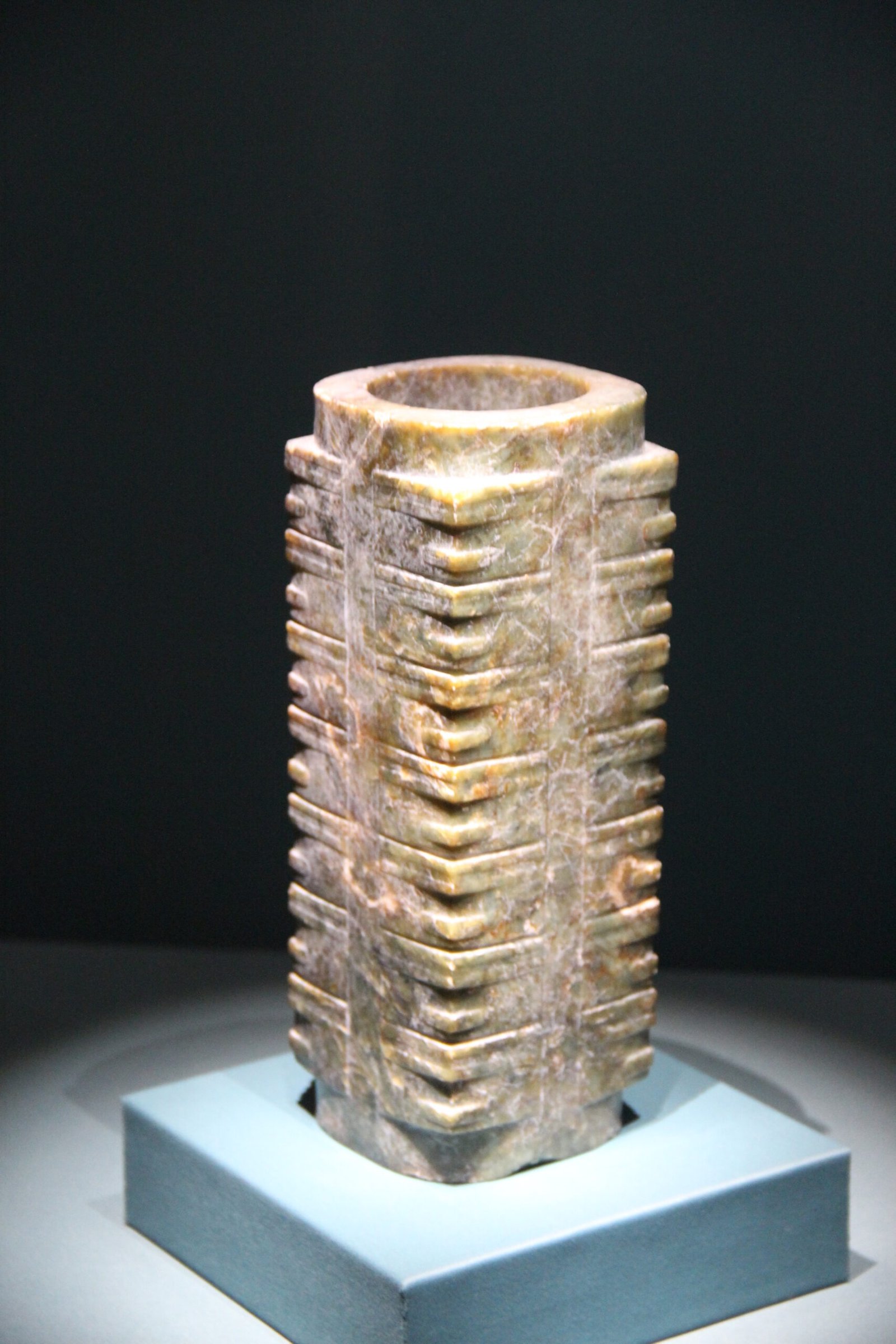
In the wetlands north of Hangzhou, the ruins of a 5,000-year-old Neolithic city reveal China’s earliest proto-state: a jade civilisation of extraordinary sophistication, with monumental hydraulic engineering, stratified society, and ritual objects that shaped Chinese culture for millennia.
At a glance
The Liangzhu Archaeological Ruins, inscribed by UNESCO in 2019, preserve the remains of a Neolithic civilisation that flourished from approximately 3300 to 2300 BC in the Yangtze River Delta. Often described as China’s first proto-state, Liangzhu achieved a level of urban organisation, centralised authority, and artistic refinement — expressed above all through elaborately worked jade ritual objects — that pre-dates the earliest traditionally recognised Chinese dynasties by a full millennium.
The site encompasses an ancient city, a system of eleven large dams and reservoirs (one of the world’s earliest large-scale hydraulic engineering projects), elite burial mounds with stratified grave goods, and a landscape of paddy fields, ritual platforms, and craft workshops extending across approximately 1,000 square kilometres of the modern Zhejiang countryside.
Key facts
- Period: c. 3300–2300 BC (Neolithic / Chalcolithic)
- Location: Yuhang District, Hangzhou, Zhejiang Province, China
- UNESCO inscription: 2019, as “Archaeological Ruins of Liangzhu City”
- Defining artifact: The cong — square-sectioned jade tube with circular bore, decorated with the taotie face motif
- Hydraulic system: 11 dams and reservoirs built c. 5,100 years ago — pre-dating comparable Egyptian systems
- City size: Urban core approximately 300 hectares; outer city and surrounding zone approximately 1,000 sq km
- Collapse: c. 2300 BC, likely due to catastrophic flooding of the Yangtze Delta
History
Liangzhu was unknown to the modern world until 1936, when amateur archaeologist Shi Xingeng discovered painted black pottery and jade objects near the village of Liangzhu in what is now Hangzhou’s Yuhang District. Systematic excavation began after 1950 and intensified from the 1980s onwards, progressively revealing the outlines of a city of remarkable scale. In 2007, the discovery of the ancient city walls — stone-faced earthen ramparts enclosing 300 hectares — transformed the interpretation of the site from a “culture” to a “city-state”. The hydraulic system, discovered by LIDAR survey and confirmed by excavation, was dated to approximately 3100–2900 BC and comprised low dams, high dams, and flood storage reservoirs capable of managing large-scale inundation events in the low-lying delta environment.
The civilisation collapsed around 2300 BC. Sediment analysis and flood deposit evidence strongly suggest that a catastrophic rise in sea level and river flooding inundated the city and made the agricultural system untenable. The Liangzhu people appear to have dispersed northward and westward, carrying their jade traditions with them: the taotie face motif on Liangzhu cong reappears, 1,500 years later, on Shang Dynasty bronze vessels, suggesting a remarkable thread of cultural continuity across the Bronze Age transition that followed the Neolithic collapse.
UNESCO’s 2019 inscription — after a decade of Chinese government nomination efforts — was a formal recognition that Liangzhu constitutes “exceptional testimony to the existence of a 5,000-year-old civilisation and early state in China,” placing it alongside Ankor Wat, the Egyptian pyramids, and the Mesopotamian city sites as one of the defining monument complexes of early human civilisation.
What you see
The Liangzhu Museum, designed by David Chipperfield Architects and opened in 2019, is itself a significant work of contemporary architecture: a long concrete building half-embedded in the landscape, its galleries organised around a central void open to the sky. The permanent collection presents the jade objects in austere lit cases that allow their extraordinary craftsmanship to dominate: cong ranging from handheld miniatures to stacked towers of multiple rings weighing tens of kilograms; bi discs of polished nephrite; axe-shaped yue blades that indicate military or ceremonial authority. The taotie motif — a stylised face with prominent eyes, nose, and fangs — is carved with a precision that, given the absence of metal tools (all jade working was done by abrasion grinding with sand), staggers the modern observer. Outside, the archaeological park preserves sections of the city walls, a reconstructed ceremonial platform, and sections of the hydraulic infrastructure, set in a wetland landscape of rice paddies and rivers that evokes, imperfectly but powerfully, the original environment.
The nearby Mojiaoshan Palace District — the presumed ceremonial and administrative core of the city, sitting on an artificially elevated platform — has been partially excavated and is accessible within the park. Elite burial mounds on the higher ground around the city (Fanshan and Yaoshan mounds in particular) yielded the richest jade assemblages: a single burial at Fanshan contained over 700 jade objects, establishing beyond doubt the existence of a ruling class controlling the production and distribution of jade as a form of symbolic capital.
Practical information
- Address: Liangzhu Ancient Town, Yuhang District, Hangzhou, Zhejiang 311113, China
- Opening hours: Tuesday–Sunday, 09:00–17:00 (last entry 16:00); closed Monday
- Admission: Museum free; archaeological park free
- Language: Exhibits in Chinese and English
- Recommended visit time: Half day (museum + park); full day for thorough exploration
Getting there
From Hangzhou East Railway Station, take Metro Line 2 to Liangzhu station, then bus or taxi (approximately 15 minutes). By car from central Hangzhou: approximately 30–40 minutes via the G25 expressway, exit at Liangzhu. Dedicated tourist shuttle buses operate from Hangzhou City and from West Lake scenic area on weekends and public holidays.
Nearby
- West Lake (Xi Hu), Hangzhou — 30 km south; UNESCO World Heritage Cultural Landscape and one of China’s most celebrated scenic sites
- Zhejiang Provincial Museum — in Hangzhou; houses additional Liangzhu jade objects and the broader Zhejiang archaeological collection
- Grand Canal (Hangzhou section) — 20 km south; the southern terminus of the UNESCO-inscribed Grand Canal
- Lingyin Temple — 35 km south; major Buddhist temple complex dating to 328 AD, set in forested hills west of Hangzhou
Sources
Find it on the map
See this place and what’s around it →📷 Become a Cultural Heritage Online photographer
Share your photos of places: they stay published under your name as the author. The more they're seen, the more you get noticed — and soon a contest will reward the most appreciated photos.
Log in or sign up free to add a photo