
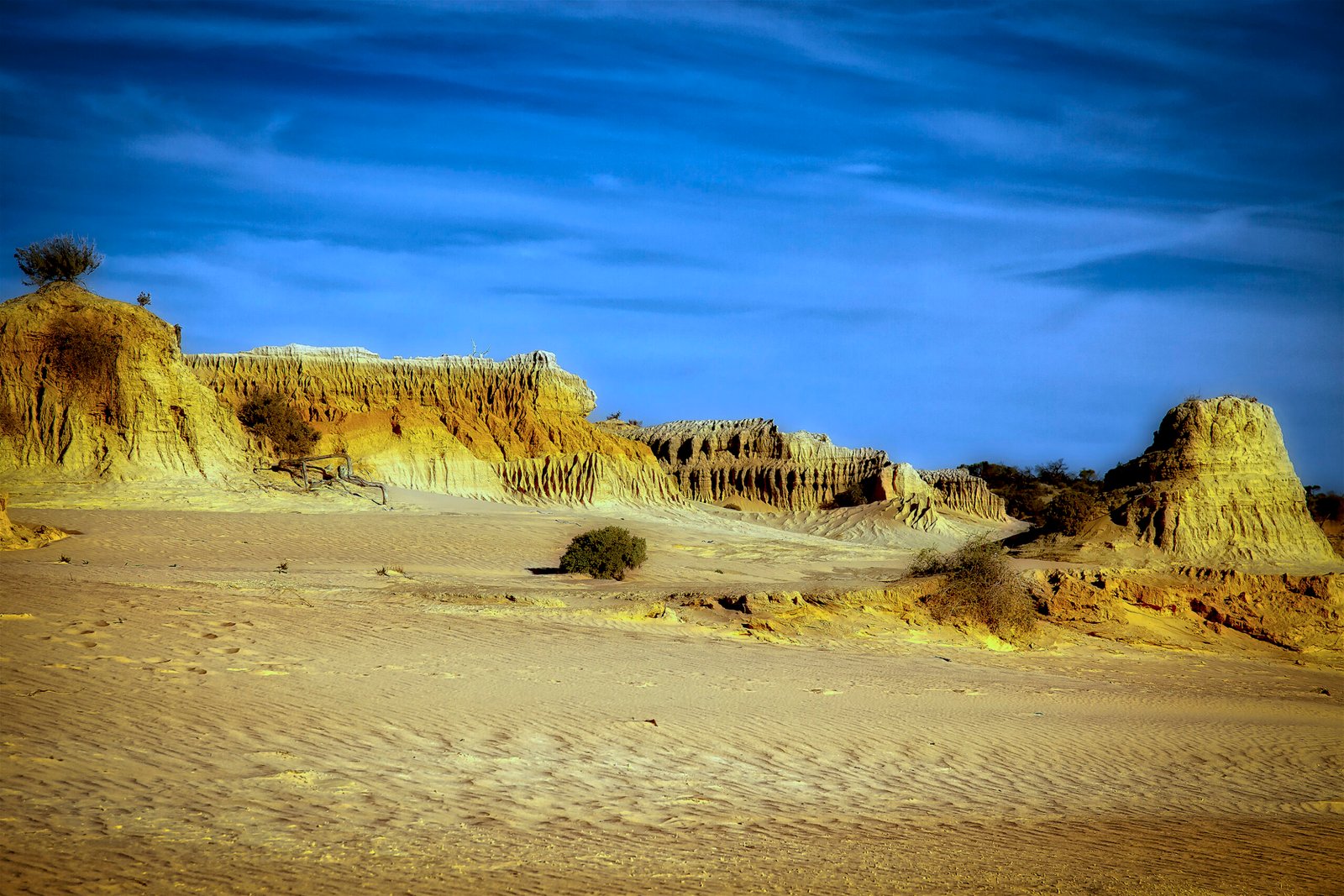
Lake Mungo
The long-dry bed of Lake Mungo in outback New South Wales has yielded the oldest known human burials outside Africa — Mungo Lady, the world’s oldest known cremation (c. 40,000 years), and Mungo Man, the oldest known ochre-stained ritual burial (c. 42,000 years) — making this the most important site of ancient human prehistory in the Southern Hemisphere.
At a glance
Lake Mungo dried out approximately 14,000 years ago, but for the previous 50,000 years it formed part of a chain of freshwater lakes — the Willandra Lakes system — fed by the Lachlan River across what is now semi-arid southwestern New South Wales. As the lake bed deflated over millennia, ancient campsites, shellfish middens, hearths, and human burials were exposed in the lunette — a crescent-shaped dune of compressed lake sediments on the eastern shore. The remains of “Mungo Lady” (c. 40,000 years, oldest known ritual cremation) and “Mungo Man” (c. 42,000 years, oldest known ochre burial outside Africa) prove that anatomically modern humans were living in Australia, engaging in complex funerary ritual, at least 42,000–50,000 years ago. The Willandra Lakes Region, including Lake Mungo, has been a UNESCO World Heritage Site since 1981.
Key facts
- Mungo Lady: Fragmentary cremated remains, c. 40,000 years old; oldest known ritual cremation in the world
- Mungo Man: Near-complete skeleton, c. 42,000 years old, buried with red ochre; oldest known ochre-stained ritual burial outside Africa
- Discoverer: Geologist Jim Bowler (Mungo Lady 1969, Mungo Man 1974) during geomorphological survey
- UNESCO: Willandra Lakes Region World Heritage Area (inscribed 1981)
- Repatriation: Both sets of remains repatriated to the Muthi Muthi, Ngiyampaa, and Paakantyi peoples in 2017
- Landscape: The “Walls of China” — a 33 km-long erosional escarpment of stratified lake sediments — is the defining visual feature
- Area: Mungo National Park covers approximately 278,000 hectares of mallee scrubland, red sand dunes, and lunette
History
In 1969, geologist Jim Bowler was conducting geomorphological fieldwork across the Willandra Lakes when he noticed fragmentary bones eroding from the lunette at Lake Mungo. Analysis revealed them to be the cremated and crushed remains of a young woman, subsequently dated to approximately 40,000 years ago. The deliberate cremation — the bones had been burned, crushed, and reburied in a small pit — was the oldest known ritual treatment of the dead anywhere in the world, evidence that these ancient Australians were already engaged in funerary practices of profound symbolic significance. In 1974, Bowler discovered a second set of remains: the nearly complete skeleton of an adult male, buried in a formal extended-position grave, his body liberally sprinkled with red ochre, hands folded over the groin — “Mungo Man,” dated to approximately 42,000 years. The red ochre had been ground into powder and carried to the site specifically for the burial, since there is no natural ochre in the Lake Mungo area; the nearest sources are hundreds of kilometres away.
Together, Mungo Lady and Mungo Man are the oldest anatomically modern human remains found outside Africa. Their existence on the Australian continent by 42,000–50,000 years ago implies a migration from Africa through South and Southeast Asia at least this early, during periods of lower sea level when island chains between mainland Asia and Australia were shorter and more navigable. The Sulawesi cave paintings (Leang Tedongnge, at least 45,500 years old) and the Mungo burials together build a picture of modern humans distributed across a vast arc of the Indo-Pacific with complex cultural and symbolic lives far earlier than European prehistory.
The Lake Mungo area has been continuously inhabited by Aboriginal Australians — the Paakantyi, Muthi Muthi, and Ngiyampaa peoples — for the entire period of human occupation. After decades of scientific curation at Australian universities, both sets of remains were repatriated to the traditional custodians in 2017, in a ceremony attended by thousands, and are now held at Lake Mungo in a purpose-built keeping place. The site is simultaneously one of the world’s most significant archaeological locations and living Aboriginal cultural landscape.
What you see
The defining landscape feature of Lake Mungo is the “Walls of China” — a 33 km-long escarpment of the lunette dune that winds across the ancient lake bed in undulating curves, its layered sediments exposing different time horizons of human and climatic history in section. The stratified pale yellow and ochre sands, eroded by wind into spires, gullies, and flat-topped pedestals, create a landscape of eerie beauty that the first European settlers compared to the Great Wall of China — hence the name. The eroded surface of the lunette is where discoveries continue to emerge: bones, shells, hearths, and flint tools gradually exposed as the wind strips millimetre by millimetre of overlying sediment.
The dry lake bed itself extends for kilometres — a vast flat plain of grey soil and sparse saltbush, ringed by the low dunes of the lunette to the east and mallee scrub to the west. In the evening light, the Walls of China turn amber and gold. The sense of time at Lake Mungo is geological: the strata in the lunette walls represent not decades but tens of thousands of years, each layer a chapter in the story of climate change, lake rise and fall, and the unbroken human presence that endured through all of it.
Practical information
- Access: Mungo National Park is open to visitors. Entry fee applies (NSW National Parks pass valid).
- Facilities: Visitor centre, camping (unpowered sites), guided tours available including Aboriginal cultural interpretation tours
- Roads: Sealed road access from Mildura (100 km) and Balranald (105 km); some internal park roads are unsealed and may be impassable after rain
- Best season: Autumn and spring (March–May, September–November); summer temperatures regularly exceed 40°C; winter nights below freezing
- The Walls of China walk: 3 km return walking trail to the lunette escarpment from the main car park
Getting there
Lake Mungo is in the far south-west of New South Wales, approximately 100 km north-east of Mildura (Victoria), which is the nearest regional centre with flights from Melbourne and Sydney. From Mildura, take the Silver City Highway north to Arumpo, then the sealed Mungo Road into the national park. From Sydney, the drive is approximately 9 hours (880 km) via Hay and Balranald; from Melbourne, approximately 5 hours (470 km) via Mildura. There is no public transport to the park; a car or tour is essential.
Nearby
- Mungo National Park Visitor Centre — Interpretive centre with exhibits on the Willandra Lakes, the Mungo burials, and Aboriginal cultural heritage
- Willandra Lakes Region — The broader World Heritage Area, encompassing multiple dry lake beds and archaeological sites across 240,000 hectares
- Mildura — Regional centre 100 km south-west on the Murray River; arts precinct, wineries, Murray River cruises
- Broken Hill — 300 km north-east; outback city with major art galleries, including the extraordinary Pro Hart Gallery and the Living Desert Sculptures
Sources
- Bowler, J.M. et al. (2003). “New ages for human occupation and climatic change at Lake Mungo, Australia.” Nature 421, 837–840.
- Thorne, A. et al. (1999). “Australia’s oldest human remains: age of the Lake Mungo 3 skeleton.” Journal of Human Evolution 36(6), 591–612.
- Wikipedia: “Lake Mungo” — en.wikipedia.org
- NSW National Parks and Wildlife Service: Mungo National Park visitor information
- Australian Government, Department of Climate Change: Willandra Lakes Region World Heritage Area listing, 1981
Find it on the map
See this place and what’s around it →📷 Diventa un fotografo di Cultural Heritage Online
Condividi le tue foto dei luoghi: restano pubblicate con la tua firma come autore. Più vengono viste, più ti fai conoscere — e presto un concorso premierà le foto più apprezzate.
Accedi o registrati gratis per aggiungere una foto