
Three kilometres south of modern Djenné, a low mound rises from the floodplain of the Bani River — unremarkable to the eye, but the most consequential archaeological discovery in sub-Saharan African history.
At a glance
Djenné-Djeno (meaning “Old Djenné” in Songhay) was the oldest known town in sub-Saharan Africa, occupied continuously from approximately 250 BC to 1400 AD — a span of 1,650 years. Excavated from 1977 onward by American archaeologists Roderick and Susan McIntosh, it fundamentally overturned the received account of African urban history. The site lies 3 kilometres south of the modern city of Djenné in the Niger Inland Delta of Mali, on the floodplain of the Bani River; the mound rises to about 8 metres above the surrounding plain and covers roughly 33 hectares, the accumulated debris of sixty generations of continuous occupation. UNESCO inscribed it in 1988 as part of the Old Towns of Djenné World Heritage Site.
History
For much of the 20th century, the dominant hypothesis in African archaeology held that urban civilisation in sub-Saharan Africa developed only through contact with North African and Middle Eastern cultures — or, at the earliest, as a consequence of the trans-Saharan trade routes that opened in the 8th and 9th centuries AD. Djenné-Djeno demolished this hypothesis entirely. The McIntosh excavations, beginning with a trial trench in 1977 and a full season in 1981, established that the site was occupied by 250 BC — approximately 700 years before Arab merchants opened the trans-Saharan gold and salt routes. Urban complexity, craft specialisation, and long-distance trade networks had developed independently in the West African savanna.
The stratigraphic record at Djenné-Djeno shows continuous urban occupation through four major phases. In the earliest phase (c. 250 BC – 50 AD), a small agricultural settlement appeared on a natural levee above the seasonal floods. The second phase (c. 50–400 AD) shows rapid expansion and the first evidence of iron-smelting — among the earliest known iron production in Africa south of the Sahara — as well as evidence of inter-regional trade in copper from Saharan mines and carnelian beads from sources 2,000 kilometres away. By the third phase (c. 400–900 AD) the site had reached its maximum extent: a densely packed town covering the full 33 hectares, with evidence of specialized ceramic production, evidence of a fishing economy organised around seasonal inundation, and physical contact with satellite settlements forming a cluster. By the fourth phase (c. 900–1400 AD) the old city was in gradual decline, possibly displaced by the growth of the modern Djenné just to the north. The site was abandoned by around 1400 AD.
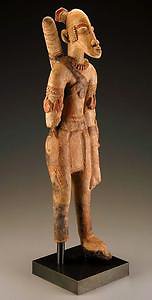
The most vivid objects recovered from Djenné-Djeno are its terracotta figurines: human figures with serpentine necks, horsemen, pregnant women, and hybrids of human and serpent. Made between approximately 800 and 1400 AD, they are among the most expressively original works in African art history. Thousands were looted from the site in the 1970s and 1980s by illegal diggers — the McIntosh excavations were in part a race against looting — and have entered private and museum collections worldwide, stripping them of their archaeological context. The figurines have no known written description of their function; the serpent-necked humans may represent deified ancestors, illness spirits, or ceremonial roles in a religion that left no other record.
What you see
Djenné-Djeno today is an undisturbed mound rising gently above the surrounding rice fields — precisely the low, unremarkable profile that allowed it to remain unknown to Western scholarship until the 1970s. The site surface shows sherds of pottery and burned clay fragments (banco, the mud-brick material of the Niger Delta) eroding from the mound’s flanks. No standing structures survive above ground: the entire built environment is buried within the mound, preserved beneath successive layers of occupation debris.
At the mound’s edge, the excavated areas from the McIntosh campaigns have been partially backfilled for preservation. What is visible, even from a distance, is the cumulative logic of the site: each generation built directly on top of the previous generation’s ruins, slowly raising the mound above the flood level. The packed proximity of house foundations excavated in the lower levels — rooms sharing walls with their neighbours, streets barely wide enough for two people to pass — conveys a population density comparable to a medieval European city. The town wall, a continuous mud-brick perimeter approximately 2 km in circumference built around the entire settlement, is partially traceable around the mound’s base.
Key facts
- Location: 3 km south of Djenné, Mali — 13.90°N 4.56°W
- Period of occupation: c. 250 BC – 1400 AD (1,650 years continuous)
- Site area: ~33 hectares; mound height ~8 metres above floodplain
- Iron-smelting evidence: c. 250 BC — among the earliest known in sub-Saharan Africa
- Key excavators: Roderick and Susan McIntosh (Rice University), from 1977
- UNESCO inscription: 1988, as part of Old Towns of Djenné (WHS No. 116)
- Notable finds: Terracotta figurines with serpentine necks; copper trade goods; carnelian beads from distant sources; perimeter town wall ~2 km circumference
Historical significance
The central finding of the Djenné-Djeno excavations is not simply that a town existed earlier than expected: it is that sub-Saharan Africa had independently developed urban civilisation, specialised crafts, and inter-regional exchange networks centuries before any contact with the Arab world or the Saharan trade routes. This discovery reversed a long-standing Eurocentric assumption in African archaeology and reshaped the field’s understanding of how and where urban complexity can emerge. The McIntosh excavations are ranked among the most significant archaeological campaigns of the 20th century specifically because they changed a foundational narrative, not because they produced spectacular monuments.
Djenné-Djeno also demonstrates the continuity between ancient urbanism and living heritage: the modern city of Djenné 3 kilometres to the north, with its extraordinary Great Mosque — the largest mudbrick building in the world, rebuilt on the 13th-century original site — represents an urban tradition that may be linked in material culture and spatial habits to the older city, even after a gap of settlement. The annual replastering of the Great Mosque, carried out collectively by the entire community, is one of the most photographed heritage rituals in Africa.
Practical information
- Access: Djenné-Djeno is not formally developed for tourism; the mound is accessible on foot from Djenné town (3 km south along tracks from the Monday market area)
- Security: Mali has active travel advisories from most Western governments due to Sahelian instability; verify current security conditions before planning any visit
- Best time: November–February (dry season, roads passable; the flood plains around Djenné are inundated July–October)
- What to see in Djenné: The Great Mosque (exterior only for non-Muslims) and the Monday market — one of the largest traditional markets in West Africa — are both within walking distance of the town centre
Getting there
Djenné is reached from Mopti (90 km east) by road, crossing a seasonal ferry across the Bani River at Djenné. Mopti has the nearest airport with irregular domestic connections to Bamako (Bamako Sénou International Airport, 570 km west). Travel to this region requires experienced local guidance and current security verification; independent travel is strongly discouraged under current advisories.
Nearby
- Great Mosque of Djenné (3 km north) — the largest mudbrick building in the world; UNESCO-listed; replastered annually in a community ceremony
- Mopti (90 km east) — “the Venice of Mali”; port city at the confluence of the Niger and Bani rivers, with Bozo fishing villages and a 14th-century mosque
- Timbuktu (400 km northeast) — the ancient Saharan caravan terminus and centre of Islamic scholarship; UNESCO-listed; also under current security advisory
Sources
- Djenné-Djeno — Wikipedia
- UNESCO WHS: Old Towns of Djenné
- McIntosh, R. J. and S. K. (1980). “The Inland Niger Delta before the Empire of Mali.” Journal of African History 22(1).
- McIntosh, S. K., ed. (1995). Excavations at Jenné-jeno, Hambarketolo, and Kaniana. University of California Press.
- Great Mosque of Djenné — Wikipedia
Find it on the map
See this place and what’s around it →📷 Become a Cultural Heritage Online photographer
Share your photos of places: they stay published under your name as the author. The more they're seen, the more you get noticed — and soon a contest will reward the most appreciated photos.
Log in or sign up free to add a photo