

A Wonder Hidden in Plain Sight
Most people have never heard of Poverty Point. This is precisely what makes it one of the most remarkable archaeological sites in North America — and one of the most consequential UNESCO World Heritage Sites few know exist. Tucked into northeastern Louisiana along a bayou once fed by the ancient Mississippi, Poverty Point is the largest and most complex prehistoric earthwork construction north of Mexico, and it was built not by farmers or empire-builders, but by hunter-gatherers.
When archaeologist James A. Ford noticed an unusual ridge pattern in aerial photographs in 1953, he had discovered something that would take decades to fully appreciate. What looked like a series of concentric arcs from the air turned out to be six enormous earthen ridges arranged in a semicircle around a central plaza, each ridge originally topped with small domestic structures. The outer ridge stretches 1.5 kilometres in diameter. These were not decorative features — people lived on them, cooked on them, raised families on them. Poverty Point was a settlement of real scale and ambition.
The Scale of the Achievement
The numbers at Poverty Point defy easy comprehension. Workers moved approximately one billion pounds of soil entirely by hand — no draft animals, no wheeled carts, no iron tools. The six concentric ridges, each standing 1 to 2 metres high and up to 25 metres wide, required sustained collective labour over centuries. This is not the product of a single season’s emergency or a single ruler’s vanity. It is the accumulated work of a community that chose, generation after generation, to build and maintain this place.
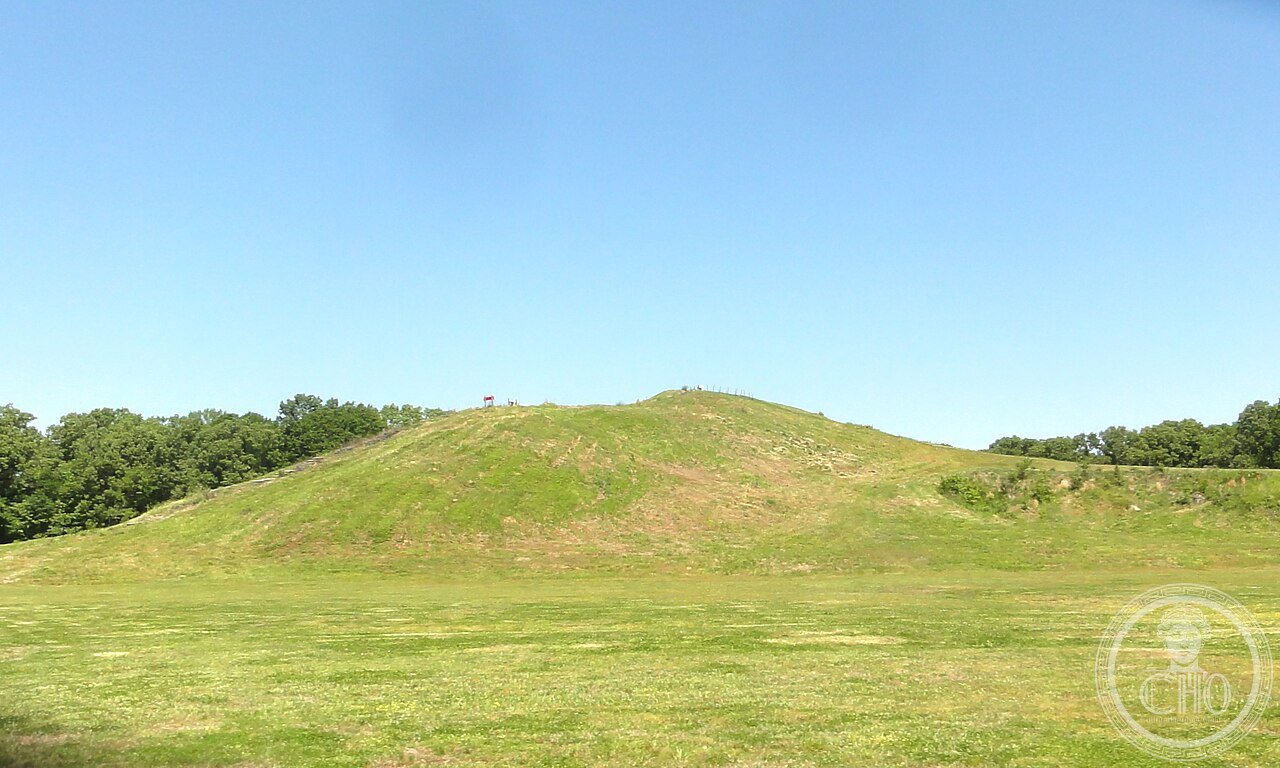
The largest of Poverty Point’s mounds, Mound A, rises 22 metres above the surrounding flatlands. Viewed from the air, its elongated form strongly suggests the silhouette of a bird in flight — wings outstretched, body defined. Whether this was intentional design or a shape that emerged organically from the construction process remains debated, but the effect is undeniable: Mound A may be the largest bird-shaped earthen sculpture ever built in the ancient world.
Hunter-Gatherers Who Built Monuments
The builders of Poverty Point overturned one of archaeology’s foundational assumptions. For generations, scholars believed that monumental architecture required agriculture as a prerequisite. Only settled farming societies, the theory held, could generate the food surplus and social organisation necessary to support a non-farming labour force engaged in construction.
Poverty Point demolishes this model. Its builders, active during the Late Archaic period (c. 1700–1100 BC), were hunter-gatherers who subsisted on fish, deer, nuts, and wild plants. They had no domesticated crops beyond a handful of minor cultivated plants. Yet they built an urban-scale ceremonial and residential centre that dwarfs many contemporary agricultural settlements. The social complexity required to plan, resource, and execute Poverty Point was extraordinary — and entirely without farming as its engine.
A Continental Trade Network
Poverty Point’s influence extended far beyond its Louisiana bayou. Excavations have revealed that the site was the hub of a vast trade network reaching across eastern North America. Archaeologists have recovered stone and minerals from sources up to 1,600 kilometres away: copper from the Lake Superior region, soapstone from the Appalachian foothills of Alabama and Georgia, chert from Indiana and Ohio, galena from Missouri.
What Poverty Point exported in return is less clear, but the scale of inbound material suggests it offered something of great value: perhaps manufactured goods, ceremonial knowledge, access to a sacred landscape, or simply the prestige of participation in its networks. The site contains no evidence of coercive power — no elite burials dramatically distinguished from ordinary ones, no clear palace or warrior class. The trade seems to have been maintained by cultural attraction as much as by political force.
Discovery and Excavation
Poverty Point’s modern rediscovery came from the air. In 1953, archaeologist James A. Ford was studying aerial photographs of Louisiana when the semicircular ridge pattern caught his eye. The earthworks were so large — and so integrated into the landscape — that they had never been recognized as artificial constructions from ground level. Local residents had lived among them for generations without understanding what lay beneath their feet.
Ford and colleague Clarence Webb led systematic excavations beginning in 1955. What they found confirmed the aerial hypothesis and then exceeded it: a site of extraordinary complexity, with massive construction sequences, rich artifact assemblages, and evidence of a settlement lasting centuries. Poverty Point was inscribed as a UNESCO World Heritage Site in 2014.
The Poverty Point Objects
Among the most distinctive artifacts recovered at the site are the so-called Poverty Point objects — small, deliberately shaped lumps of baked clay found by the hundreds of thousands. They come in a variety of forms: biconical, cross-shaped, spherical, and cylindrical. The leading interpretation is that they served as cooking stones. In a region largely lacking in natural rock, these clay objects were heated in fires and placed among food to cook it — a practical solution to a geological limitation.
Their sheer quantity — millions have been found — and their consistent manufacturing traditions suggest communal production and standardised knowledge. They are not beautiful objects, but they are historically eloquent: small, workaday things that tell us about daily life at a place where a billion pounds of earth were moved by hand and stone arrived from a thousand kilometres away.
Visiting Poverty Point Today
The Poverty Point World Heritage Site is a Louisiana state monument located near the town of Epps, in West Carroll Parish. The site includes a visitor centre with interpretive exhibits and a collection of excavated artifacts. A tram tour takes visitors across the earthworks, giving a sense of the scale that is impossible to grasp on foot alone. A 72-metre observation tower offers an elevated perspective on the ridges.
The site is open year-round. The surrounding landscape retains the character of the ancient bayou environment — quiet, green, and surprisingly remote for a UNESCO site of this significance. Visitors who make the trip to Poverty Point often describe it as unexpectedly moving: the scale of what was built here, by people without metal tools or domestic animals, across centuries, registers differently when you are standing in it.
- Location
- West Carroll Parish, Louisiana, USA (near Epps)
- Coordinates
- 32.6387° N, 91.4035° W
- Period
- c. 1700–1100 BC (Late Archaic, Poverty Point culture)
- UNESCO inscription
- 2014 (World Heritage Site)
- Key feature
- Six concentric earthen ridges; Mound A (Bird Mound) 22m tall; approx. 1 billion lbs of soil moved by hand
- Wikipedia
- Poverty Point — Wikipedia
Find it on the map
See this place and what’s around it →📷 Become a Cultural Heritage Online photographer
Share your photos of places: they stay published under your name as the author. The more they're seen, the more you get noticed — and soon a contest will reward the most appreciated photos.
Log in or sign up free to add a photo