
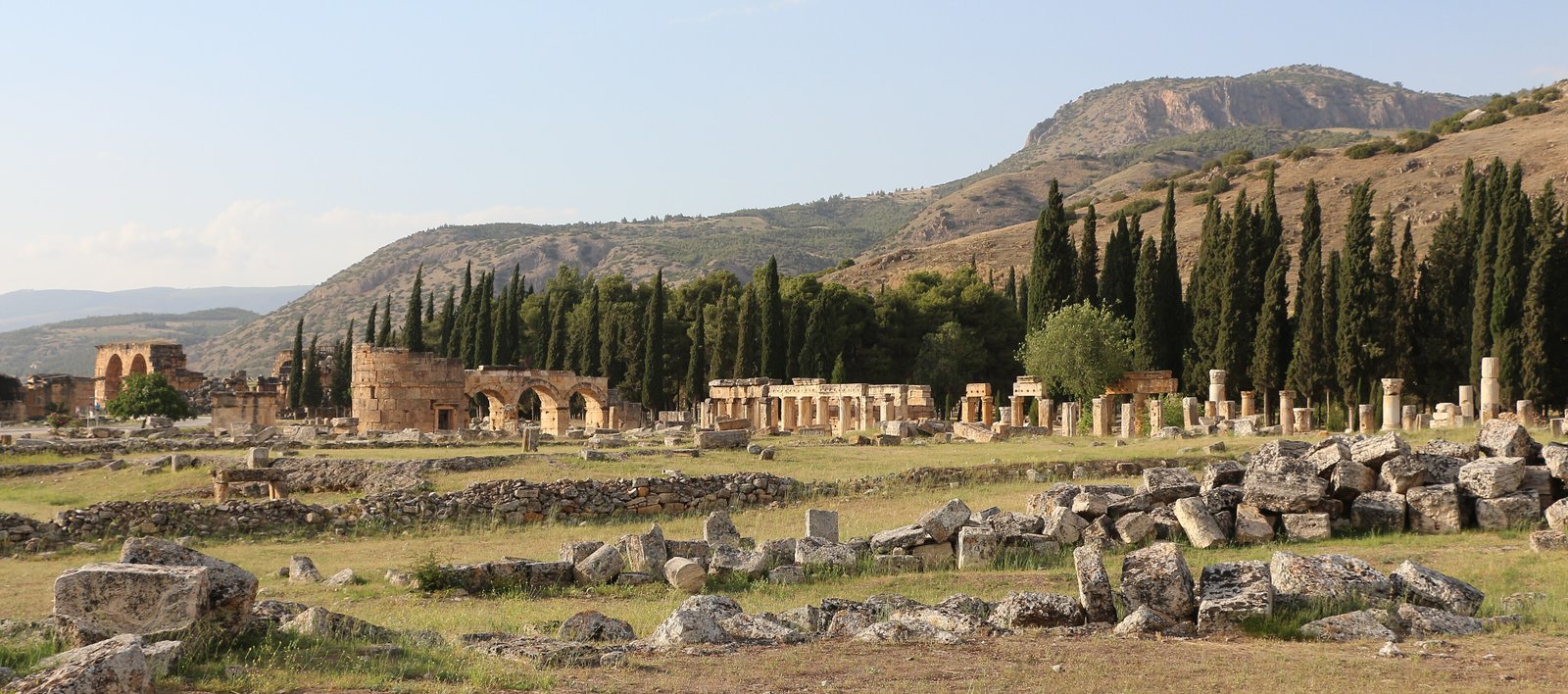
Founded above the famous white travertine terraces of Pamukkale, Hierapolis was a Hellenistic and Roman spa city whose thermal waters were said to heal every disease — and whose sacred cave breathed the death-fog of the underworld itself.
At a Glance
Hierapolis (“Sacred City” in Greek) was established c. 190 BC by Eumenes II of Pergamon on the plateau above the thermal springs now known as Pamukkale (“Cotton Castle”). It grew into one of the largest cities of the Roman province of Asia, famous across the Mediterranean for its healing waters, religious significance, and the dramatic geological landscape of white travertine cascades. UNESCO inscribed the combined natural and cultural site in 1988.
Foundation and Growth
After Eumenes II’s foundation, Hierapolis passed to Rome in 133 BC. The city flourished under the Pax Romana, attracting pilgrims and invalids seeking the curative thermal waters. A devastating earthquake in 60 AD largely destroyed the city; Emperor Nero funded its reconstruction. The rebuilt Hierapolis had a colonnaded main street (the Plateia), a theatre seating 12,000, a large agora, and the most extensive necropolis in Asia Minor. The city remained prosperous into the Byzantine period before gradual decline following 7th-century Arab raids.
The Plutonium: Cave of the Underworld
Hierapolis’s most remarkable monument was the Plutonium — a cave fissure from which carbon dioxide (CO2) emerged, killing any creature that entered. Ancient priests of Cybele exploited this phenomenon; the cave was interpreted as the entrance to the underworld, guarded by Pluto. Sealed by Christian authorities in the 5th century, its location was lost. Italian archaeologists rediscovered the Plutonium in 2013; CO2 emissions continue today.
What You See
The theatre (2nd century AD) is one of the best-preserved in Turkey, its stage building standing nearly to full height with carved relief panels. The Antique Pool (Cleopatra’s Pool) lets visitors swim at 35°C among submerged Roman columns. The necropolis (1.2 km, over 1,200 tombs) is one of the largest concentrations of ancient funerary architecture in the world. The octagonal martyrium of Saint Philip the Apostle (5th century) marks where Philip was martyred c. 80 AD. The Pamukkale travertine terraces below share the UNESCO inscription.
Key Facts
- Founded: c. 190 BC by Eumenes II of Pergamon
- UNESCO inscription: 1988 (natural + cultural, combined site)
- Theatre capacity: approx. 12,000 spectators
- Necropolis: 1.2 km, over 1,200 tombs
- Thermal water: 35°C, calcium carbonate-rich
- Excavations: Italian mission (University of Salento) since 1957
Practical Information
Located in Denizli province, ~250 km east of Izmir. Denizli airport (DNZ) has domestic connections; minibuses from Denizli Otogar (20 km). Single entrance ticket covers site and terraces; Antique Pool charges separate admission. Allow a full day. Best light at the theatre in the morning, terraces in late afternoon.
Nearby
- Pamukkale Thermal Terraces — natural travertine cascades sharing the UNESCO site
- Hierapolis Archaeology Museum — occupies the Roman baths on-site
- Laodicea on the Lycus — early Christian city, 10 km northwest
Sources
- UNESCO World Heritage Centre — Hierapolis-Pamukkale
- Wikipedia: Hierapolis
- Francesco D’Andria, Hierapolis of Phrygia (Pamukkale) (2003)
- D’Andria et al., “Rediscovery of the Plutonium of Hierapolis”, Journal of Roman Archaeology (2016)
Find it on the map
See this place and what’s around it →📷 Become a Cultural Heritage Online photographer
Share your photos of places: they stay published under your name as the author. The more they're seen, the more you get noticed — and soon a contest will reward the most appreciated photos.
Log in or sign up free to add a photo