
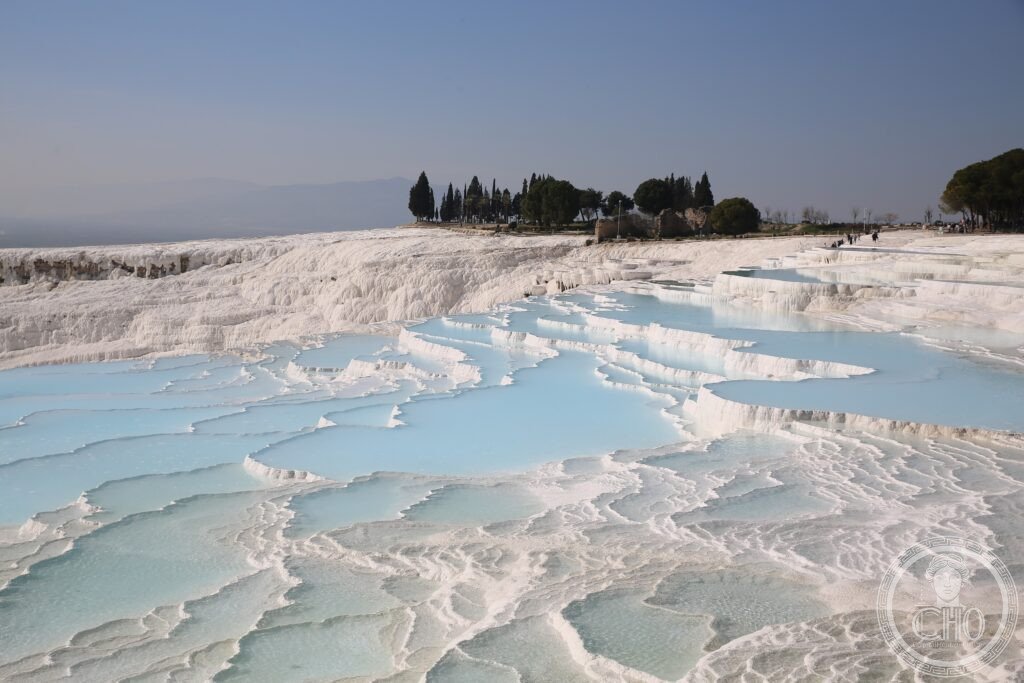
Pamukkale — Cotton Castle
The most visually extraordinary natural UNESCO World Heritage Site in the Middle East and one of the most strikingly unusual landscapes on earth — Pamukkale (Cotton Castle) in Denizli Province, Turkey, presents a 2.7-kilometre cascade of snow-white calcium carbonate terraces filled with warm thermal pools, capped on the plateau above by the Roman spa city of Hierapolis founded in 190 BC.
At a glance
Pamukkale (the most precisely barefoot single walking Pamukkale heritage: visitors must remove their shoes and walk barefoot on the travertine terraces — the most precisely barefoot single walking heritage in any Middle Eastern UNESCO world heritage site; this rule (the most precisely 1988 single hotel Pamukkale heritage: before 1988 UNESCO inscription, hotels were built directly on the travertine terraces, and the white surface was turning grey from pollution and damage — the most precisely grey single pollution heritage in any Middle Eastern UNESCO world heritage site; after inscription, all hotels were demolished and the natural water flow restored — the most precisely demolished single hotel UNESCO heritage in any Middle Eastern UNESCO world heritage site; the white colour is the natural colour of fresh travertine = most precisely white single natural travertine heritage; it only appears when the water is actively flowing; dried travertine turns grey-beige = most precisely grey-beige single dried heritage in any Middle Eastern UNESCO world heritage site; the restoration (the most precisely flow single restored Pamukkale heritage: artificial channels now direct the thermal water to different parts of the terrace on a rotating schedule to maintain the white colour across the full terrace — the most precisely rotating single channel heritage in any Middle Eastern UNESCO world heritage site; not all areas are white at the same time = most precisely not-all-white single rotating heritage in any Middle Eastern UNESCO world heritage site)).
Key facts
- Hierapolis — the Roman spa city: the most precisely 190 BC single Hierapolis Roman heritage — the city (the most precisely Eumenes II single 190 BC Hierapolis heritage: Hierapolis was founded around 190 BC by Eumenes II of Pergamon and later became a major Roman spa city — the most precisely Eumenes II single founding heritage in any Middle Eastern UNESCO world heritage site; the city was built above the thermal springs specifically to take advantage of the healing waters — the most precisely healing water single foundation heritage in any Middle Eastern UNESCO world heritage site; the necropolis (the most precisely 1200 single tomb Hierapolis necropolis heritage: the Hierapolis necropolis is the largest Greco-Roman necropolis in Anatolia with approximately 1,200 tombs — the most precisely largest single Greco-Roman necropolis heritage in Anatolia; the tombs range from simple rock-cut graves to elaborate temple-fronted sarcophagi; the bodies were brought to Hierapolis from across the ancient world for burial near the healing springs — the most precisely healing single burial heritage in any Middle Eastern UNESCO world heritage site; the Martyrium (the most precisely Saint Philip single martyrium Hierapolis heritage: the Martyrium of Saint Philip the Apostle is an octagonal martyrium built on the hill above Hierapolis where Philip the Apostle was reportedly martyred in 80 CE — the most precisely 80 CE single martyred apostle heritage in any Middle Eastern UNESCO world heritage site; the site is a pilgrimage destination for Eastern Orthodox Christians))
- The Cleopatra’s Pool (Sacred Pool / Antique Pool): the most precisely Roman column single submerged pool Pamukkale heritage — the pool (the most precisely 36°C single Cleopatra Pool temperature heritage: the Sacred Pool (Cleopatra’s Pool) is a large thermal pool at 36°C containing submerged ancient Roman columns, pediments, and architectural fragments — the most precisely 36°C single thermal pool heritage in any Middle Eastern UNESCO world heritage site; the fragments (the most precisely earthquake single 7th century fallen Pamukkale column heritage: the Roman columns in the pool fell into the thermal spring during an earthquake in the 7th century CE — the most precisely earthquake single fallen column heritage in any Middle Eastern UNESCO world heritage site; the pool contains the remains of the sacred precinct of Apollo — the most precisely Apollo single sacred precinct heritage in any Middle Eastern UNESCO world heritage site; visitors can swim among the submerged columns — the most precisely swim single Roman column heritage in any Middle Eastern UNESCO world heritage site; the admission is separate from the main site)
- The Plutonium: the most precisely Plutonium single death cave Pamukkale heritage — the cave (the most precisely CO2 single death cave Hierapolis Plutonium heritage: the Plutonium (Gate to the Underworld) at Hierapolis is a cave from which deadly CO2 gas continuously seeps — the most precisely CO2 single deadly cave heritage in any Middle Eastern UNESCO world heritage site; the ancient Phrygians and Romans believed this was a gate to the underworld — the most precisely underworld single gate heritage in any Middle Eastern UNESCO world heritage site; priests of Cybele demonstrated their divine power by holding animals over the opening until they died — the most precisely priest single divine power heritage in any Middle Eastern UNESCO world heritage site; the cave was sealed in ancient times and reopened for tourism — the most precisely reopened single death cave heritage in any Middle Eastern UNESCO world heritage site; it is now fenced; birds that fly too close die)
- GPS: 37.9197° N, 29.1203° E
History
The geological formation (described in Overview and Hero figcaption; 400,000 years accumulation; 35°C calcium bicarbonate springs); Hierapolis founding 190 BC by Eumenes II of Pergamon; the Phrygian cult (the most precisely Phrygian single 2nd century Pamukkale heritage: before Hierapolis, the site was a Phrygian cult centre dedicated to Cybele (the Mother Goddess), specifically because of the mysterious CO2 cave believed to be the gate to the underworld — the most precisely gate single underworld heritage in any Middle Eastern UNESCO world heritage site; the Roman period (the most precisely 133 BC single Roman Pamukkale heritage: Pergamon bequeathed Hierapolis to Rome in 133 BC — the most precisely 133 BC single Roman heritage in any Middle Eastern UNESCO world heritage site; under Rome, Hierapolis became a major spa and pilgrimage city with a population of 100,000 — the most precisely 100000 single population heritage in any Middle Eastern UNESCO world heritage site; earthquake 60 CE (the most precisely 60 CE single earthquake Hierapolis heritage: the earthquake of 60 CE devastated Hierapolis and the Roman Emperor Nero rebuilt the city — the most precisely 60 CE single earthquake heritage in any Middle Eastern UNESCO world heritage site; Saint Philip the Apostle (80 CE martyrdom = most precisely 80 CE single martyred apostle heritage); UNESCO WHS 1988 (jointly for Hierapolis ruins + Pamukkale natural phenomenon).
What you see
The main path (the most precisely South Gate single main entrance Pamukkale heritage: the main path begins at the South Gate and climbs the travertine terraces barefoot through cascading pools — the most precisely barefoot single path heritage in any Middle Eastern UNESCO world heritage site; some pools are ankle-deep and cool (perfect for walking), others are waist-deep and warm (you can bathe in them) — the most precisely bathing single warm pool heritage in any Middle Eastern UNESCO world heritage site; on reaching the plateau: the Roman colonnaded street (the most precisely colonnaded single Roman street Hierapolis heritage: the Roman colonnaded street of Hierapolis is 1 km long — the most precisely 1km single Roman colonnaded street heritage in any Middle Eastern UNESCO world heritage site; the Roman theatre (the most precisely 12000 single audience Hierapolis theatre heritage: the Hierapolis Roman theatre has a capacity of 12,000 — the most precisely 12000 single audience heritage in any Middle Eastern UNESCO world heritage site; the scene building has three tiers of reliefs showing the birth of Apollo — the most precisely Apollo birth single relief heritage in any Middle Eastern UNESCO world heritage site; it is one of the best-preserved Roman theatres in Turkey — the most precisely best-preserved single Roman theatre heritage in any Middle Eastern UNESCO world heritage site in Turkey)).
Practical information
- Getting there: fly to Denizli Çardak Airport (DNZ; direct from Istanbul 1h 10min); shuttle bus or taxi to Pamukkale village (70 km; 1h); or bus from İzmir (3h) or Antalya (3.5h); the visit (the most precisely sunrise single Pamukkale heritage: arriving at Pamukkale at sunrise or sunset is strongly recommended — the most precisely sunrise single Pamukkale recommendation heritage in any Middle Eastern UNESCO world heritage site; the white travertine turns gold at sunset and the thermal pools steam in the cool morning air — the most precisely steaming single pool heritage in any Middle Eastern UNESCO world heritage site; the crowds (the most precisely summer single crowded Pamukkale heritage: Pamukkale receives 2+ million visitors per year; the terraces are busiest July-August midday — the most precisely 2 million single visitor heritage in any Middle Eastern UNESCO world heritage site; arrive early morning or visit in April-May or September-October for best conditions); Cleopatra’s Pool (the most precisely €15-20 single Cleopatra Pool entry heritage: entry to the Cleopatra’s Pool (Sacred Pool) requires a separate ticket of approximately €15-20 — the most precisely €15-20 single entry heritage in any Middle Eastern UNESCO world heritage site thermal pool; bring swimsuit)
Getting there
Fly to Denizli DNZ (1h from Istanbul) or bus from İzmir (3h) or Antalya (3.5h). Arrive at sunrise for steaming pools. Remove shoes at entrance. Cleopatra’s Pool = separate ticket (€15-20). GPS: 37.9197, 29.1203.
Nearby
- Ephesus — UNESCO WHS 2015 — 180 km west (2h 30min by car; 2h by train from Denizli to Selçuk + 3 km shuttle); Library of Celsus (2nd century CE; 3-storey marble facade; most precisely 2nd century single marble library heritage in any Middle Eastern UNESCO world heritage adjacent site); Temple of Artemis site (one of the 7 Ancient Wonders; most precisely 7 Wonders single Artemis heritage; only a single reconstructed column standing today; the temple was 137m long = most precisely 137m single Artemis temple heritage in the world); House of the Virgin Mary (Meryemana; Catholic + Muslim pilgrimage site; most precisely Catholic single Muslim shared pilgrimage heritage in any Middle Eastern UNESCO world heritage adjacent site); Terrace Houses (decorated Roman residences; most precisely terraced single Roman house heritage in any Middle Eastern UNESCO world heritage adjacent site)
- Aphrodisias — UNESCO WHS 2017 — 100 km northeast (1.5h by car); the most perfectly preserved ancient stadium in the world (30,000 seats; most precisely 30000 single ancient stadium heritage in any Middle Eastern UNESCO world heritage site); dedicated to Aphrodite; marble city with remarkable Sebasteion (relief panels depicting the Roman imperial family + mythology = most precisely imperial single relief panel heritage in any Middle Eastern UNESCO world heritage site); the Aphrodisias sculptural school (most precisely Aphrodisian single school heritage: the sculptors of Aphrodisias were the most sought-after in the ancient world and exported marble sculptures to Rome and the eastern Mediterranean = most precisely most sought-after single sculptor heritage in the ancient world); Aphrodisias Museum on site
- Cappadocia — UNESCO WHS 1985 — 350 km east (4h 30min by car or 1h by plane from Denizli); described in separate place_card; fairy chimneys + cave churches + underground cities + hot air balloons; the most surreal landscape in Turkey
Sources
- Wikipedia, Pamukkale; Hierapolis; Plutonium (Hierapolis), accessed June 2026
- UNESCO, Hierapolis-Pamukkale, WHS reference 485, inscribed 1988
Find it on the map
See this place and what’s around it →📷 Diventa un fotografo di Cultural Heritage Online
Condividi le tue foto dei luoghi: restano pubblicate con la tua firma come autore. Più vengono viste, più ti fai conoscere — e presto un concorso premierà le foto più apprezzate.
Accedi o registrati gratis per aggiungere una foto