
Archaeological Site • Iran • UNESCO World Heritage Site
Takht-e Soleyman
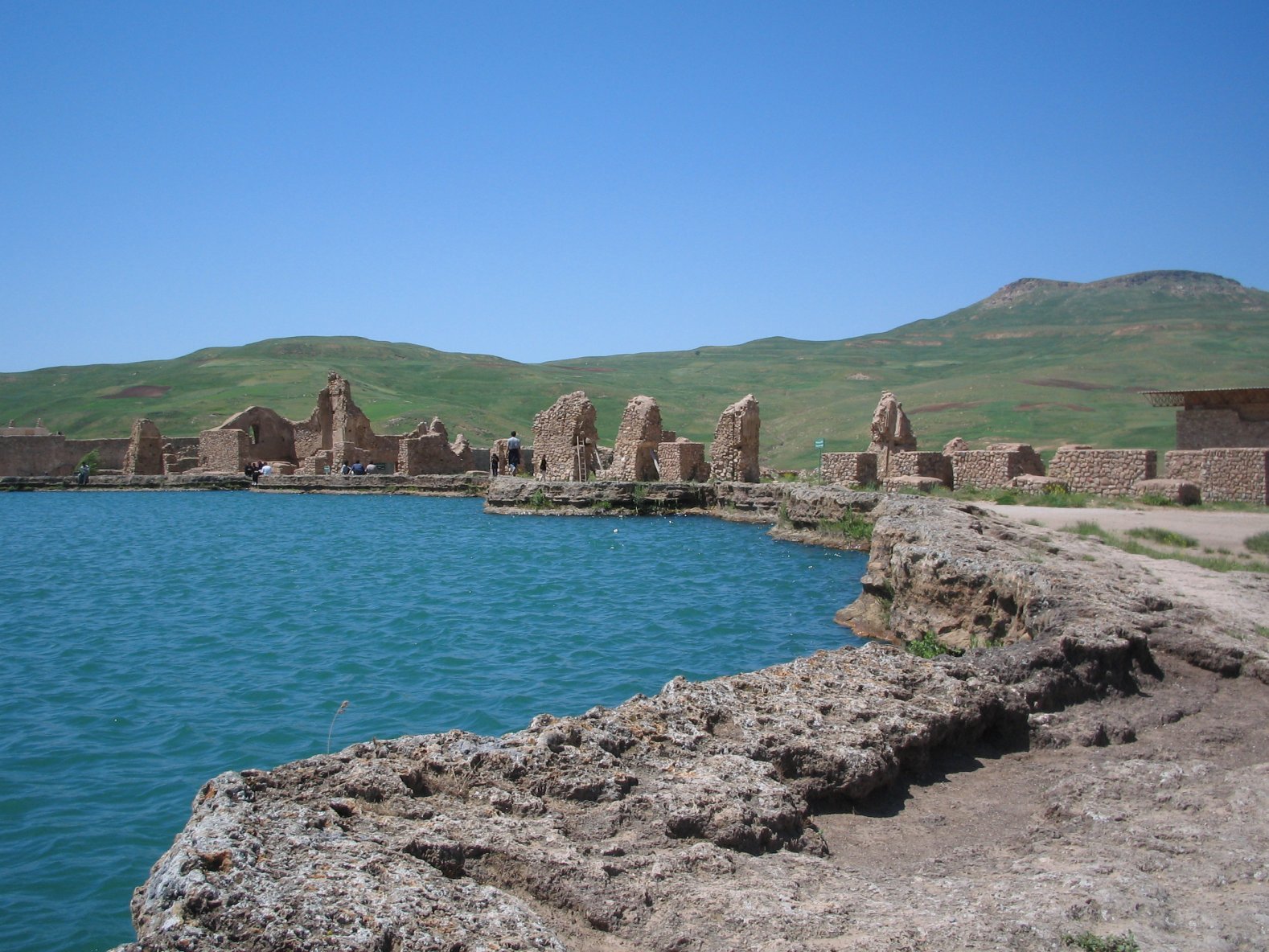
At 2,200 metres in the mountains of West Azerbaijan, a volcanic crater lake of mineral-blue water has been rising slowly for millennia — building up its own limestone rim, never overflowing. Around it, Zoroastrian kings kept one of their three sacred fires burning for centuries, and Sasanian shahs came to pray here before claiming their thrones.
At a Glance
- Location: Near Takab, West Azerbaijan Province, northwestern Iran
- Coordinates: 36.6031° N, 47.2330° E
- Altitude: 2,200 m above sea level
- Period: Achaemenid use; main complex 5th–7th century AD (Sasanian Empire); Mongol additions 13th century
- UNESCO inscription: 2003
- Best visited: June to September (snow-covered in winter)
Key Facts
- The volcanic lake
- A mineral spring-fed crater lake approximately 100 m deep and 120 m in diameter; heavy carbonate chemistry means water evaporates and deposits before it can overflow, building the natural dam wall higher every century
- Adur Gushnasp
- One of the three great Zoroastrian sacred fires, representing the warrior caste — equivalent in sanctity to the most important Christian cathedrals; kept burning here from at least the 5th century AD until the Islamic conquest of the 7th century
- Coronation pilgrimage
- Sasanian kings, including Khosrow I and Khosrow II, made the journey on foot to Takht-e Soleyman before and after their coronations — a royal ritual without parallel in the ancient world
- Mongol palace
- Abaqa Khan, son of Hulagu, built a winter hunting palace here in the 1270s; Byzantine architectural spolia captured from Nicaea were incorporated into the construction
History
The site’s strategic position — a natural lake surrounded by defensible highland terrain — attracted human attention from the Achaemenid period onward. But it was the Sasanian Empire (224–651 AD) that transformed it into a sanctuary of imperial importance. The fire of Adur Gushnasp, one of the three fires that together represented the three estates of Zoroastrian society (priests, warriors, farmers), was installed in a dedicated fire temple whose structure survives in substantial remains.
Sasanian shahs Khosrow I (531–579 AD) and Khosrow II (590–628 AD) both made royal pilgrimages here — a journey of hundreds of kilometres undertaken on foot as an act of devotion. The Arab conquest of 642 AD extinguished the sacred fire, but the site was not forgotten. In the 13th century the Mongol Ilkhanate ruler Abaqa Khan built a palace complex using materials including Byzantine column capitals brought from Nicaea, creating an unexpected architectural palimpsest.
Islamic legend gave the site its current name: “Throne of Solomon,” interpreting the lake as a pool created by Solomon’s supernatural power. Iranian-Polish excavations in the 1960s–70s uncovered the Sasanian fire temple, the fortification walls, and the Mongol palace.
What You See Today
The walk to the crater’s edge reveals the lake in stages — first a shimmer through the ruins, then the full shock of the water: crystalline blue-green, unnaturally still, circled by the ancient walls as if held in a stone cup. The lake does not smell of sulphur; the spring water is cold and mineral, tasting of stone rather than heat. This quality of stillness, at altitude, in a place of specific religious purpose, makes Takht-e Soleyman among the most atmospheric UNESCO sites in Iran.
The fire temple foundations, the inner and outer fortification walls, and the Mongol palace arcade are all visible. The contrast between the Sasanian precision stonework and the rougher Mongol reuse of Byzantine capitals tells several centuries of history in a single glance.
The Zoroastrian Sacred Fires
Zoroastrianism maintained three great fires, each representing a social caste: Adur Farnbag for priests (in Fars), Adur Burzen-Mihr for farmers (in Khorasan), and Adur Gushnasp for warriors — the fire kept at Takht-e Soleyman. These were not merely symbolic: the fires burned without interruption, tended by priests whose sole function was maintenance of the flame. The warrior-fire’s connection to the Sasanian royal house made Takht-e Soleyman the most politically important of the three sanctuaries.
Practical Information
- Opening hours: Daily, daylight hours; staffed site
- Entry fee: Iranian rial; ticket office at the entrance
- Best season: June–September; the site is under snow from November to April
- Visitor center: On-site with contextual displays about Zoroastrian history and Sasanian architecture
- Photography: Permitted throughout; the lake is best photographed mid-morning
Getting There
- By road: 42 km west of Takab; follow the road toward Nosratabad; the site is signposted from Takab
- By bus: Takab is served by buses from Tabriz (180 km northwest) and Zanjan (180 km northeast); taxis available from Takab
- Nearest airports: Urmia Airport (165 km west); Tabriz International Airport (180 km northwest)
- Note: Guided tours from Tabriz or Tehran require advance booking; independent travel is feasible with a rental car
Nearby
- Zendan-e Soleyman (Prison of Solomon) — an extinct volcanic cone 3 km northwest; associated in legend with the same Solomonic mythology as the main site
- Takab — Nearest town (42 km); basic accommodation and local markets
- Tabriz — Major city with historic bazaar (UNESCO), Blue Mosque, and Azerbaijan Museum; 180 km northwest
- Maragheh Observatory ruins — 13th-century Mongol astronomical observatory, 130 km northwest
Sources
- UNESCO World Heritage — Takht-e Soleyman
- Wikipedia — Takht-e Soleyman
- Boyce, Mary. Zoroastrians: Their Religious Beliefs and Practices. Routledge, 1979.
- Naumann, Rudolf. Die Ruinen von Tacht-e Suleiman und Zendan-e Suleiman. Deutsches Archäologisches Institut, 1977.
Find it on the map
See this place and what’s around it →📷 Become a Cultural Heritage Online photographer
Share your photos of places: they stay published under your name as the author. The more they're seen, the more you get noticed — and soon a contest will reward the most appreciated photos.
Log in or sign up free to add a photo