
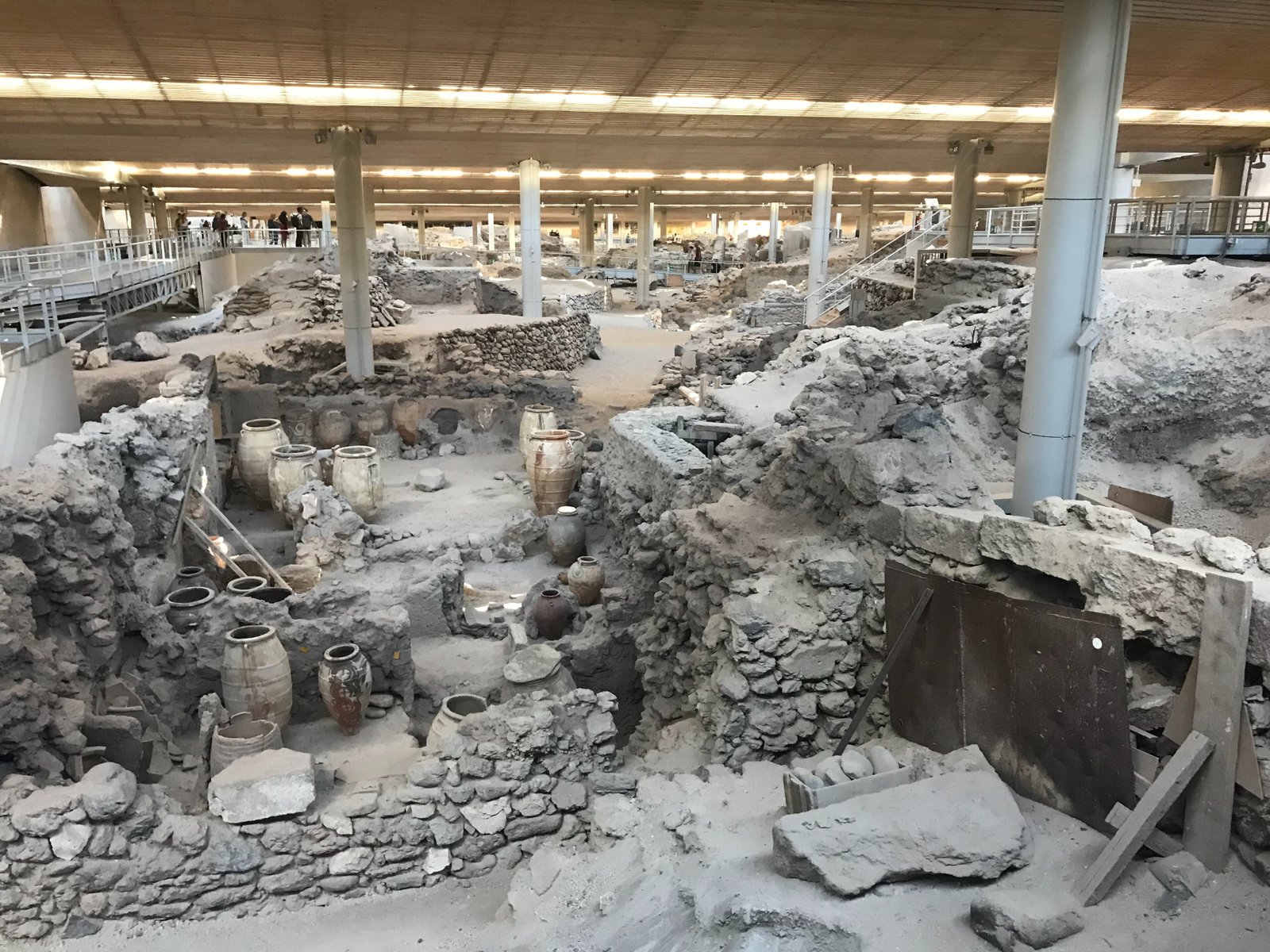
The “Pompeii of the Aegean” — a thriving Minoan port city buried under volcanic ash around 1620 BC, preserving multi-storey buildings, advanced plumbing, and vivid frescoes that remain among the most extraordinary survivals of the Bronze Age world.
At a glance
Akrotiri lies on the southern tip of Santorini, preserved beneath metres of volcanic tephra deposited by the catastrophic Theran eruption of c. 1620 BC. The site reveals a sophisticated Minoan settlement with multi-storey stone buildings, paved streets, a complex drainage network — including hot and cold running water, unique in the prehistoric world — and indoor toilets. The absence of human remains suggests the population evacuated before the eruption. Excavations begun by Spyridon Marinatos in 1967 and continuing today have uncovered only a fraction of the ancient city; radar imaging conducted in 2023 suggests the settlement extends far beyond the currently excavated area.
Key facts
- Period: c. 3700–1620 BC (Late Cycladic I / Minoan; occupied from the Early Bronze Age)
- Buried: c. 1620 BC, Theran (Minoan) eruption; one of the largest volcanic events in the last 10,000 years
- Excavation: Spyridon Marinatos from 1967 (died and was buried on site, 1974); work continues today
- UNESCO status: Nominated; not yet inscribed as a standalone WHS
- Notable: No human remains found — population apparently evacuated in time; hot and cold running water is unique in prehistoric Europe
- Frescoes: Removed to the National Archaeological Museum, Athens; replicas displayed on site
History
By the mid–second millennium BC, Akrotiri had grown into one of the major ports of the Aegean, trading with Minoan Crete, mainland Greece, Egypt, and the Levant. Its merchants were prosperous enough to commission multi-storey buildings clad in plaster and decorated with elaborate fresco cycles; its engineers had solved the problem of running water — both hot, presumably heated geothermally, and cold — to individual structures, a level of plumbing sophistication that would not reappear in Europe for more than a thousand years.
Around 1620 BC — the exact date is still debated by volcanologists and archaeologists — the Theran volcano erupted with catastrophic force, depositing several metres of pumice and ash across the island. The city was entombed. Unlike Pompeii, where the eruption killed inhabitants where they stood, Akrotiri contains no human remains: the population had time to leave. What they could not carry — their architecture, their frescoes, the ceramic vessels on every shelf — was sealed intact.
The site was unknown to the modern world until informal digging in the 19th century, and remained only partially understood until the Greek archaeologist Spyridon Marinatos began systematic excavations in 1967. Marinatos died on site in 1974 and, at his own request, was buried there. The excavations have continued under a purpose-built bioclimatic shelter erected in 2012, replacing an earlier structure that collapsed in 2005, killing a visitor. In 2023, ground-penetrating radar surveys revealed that the buried city extends far beyond the currently excavated area, suggesting Akrotiri may have been considerably larger than previously estimated.
The eruption’s scale has linked Akrotiri to broader ancient narratives. Some scholars have connected the catastrophic destruction of an Aegean island civilisation to Plato’s account of the sunken continent of Atlantis, and the environmental effects of the eruption — atmospheric cooling, crop failures across the eastern Mediterranean — have been proposed as contributing factors in the sequence of plagues recorded in the biblical book of Exodus.
What you see
The bioclimatic shelter allows visitors to walk above the excavations on elevated walkways, looking down into Bronze Age streets and into the ground floors of buildings that still stand two storeys high. The West House, identified by its concentration of nautical frescoes, preserves the spatial logic of a prosperous Minoan residence: storerooms at ground level, living and ceremonial spaces above. The drainage system running beneath the streets — stone-built channels connecting individual buildings to a main sewer — is visible in section, a reminder that the people who lived here were not primitive.
The most celebrated finds from Akrotiri are its frescoes, now held at the National Archaeological Museum in Athens. The “Spring Fresco” from Room Delta 2 of Xeste 3 shows swallows in flight above fields of red lilies — a scene of such fresh, particular beauty that it reads less like decoration than like a window left open. The “Boxing Children” fresco depicts two adolescents sparring, their golden jewellery and assured posture suggesting a confident, physically active culture. The “Blue Monkeys” fresco, with its dancing primates against a red ground, represents an Aegean interpretation of Egyptian decorative conventions. The “Flotilla Fresco,” running along an entire wall of the West House, depicts a fleet of ships sailing between towns, possibly recording a specific historical journey.
On site, the Mill House and the Pillar Shaft area preserve agricultural and industrial infrastructure. Storage pithoi — large ceramic jars — remain in position in storerooms, still containing, in some cases, residues of the goods they last held three and a half thousand years ago.
Practical information
- Opening hours: Typically April–October daily 08:00–20:00; November–March 08:00–15:00. Verify current hours before visiting as they vary seasonally.
- Best time to visit: Early morning in summer to avoid cruise-ship crowds; spring (April–May) for mild weather and fewer visitors
- Duration: Allow 1–2 hours for the excavation site; plan a separate trip to Athens to see the frescoes at the National Archaeological Museum
- Shelter: The bioclimatic steel-and-glass canopy (2012) protects the site and visitors; comfortable even in summer heat
Getting there
Akrotiri is on the southwestern coast of Santorini, approximately 12 km from Fira (the island’s main town). By bus, take the line from the Fira central bus station toward Akrotiri village (journey time approximately 30 minutes). By car or scooter, follow the coastal road south from Fira through Pyrgos. Santorini is reached by ferry from Piraeus (Athens) — a 5–8 hour crossing depending on the service — or by direct flight to Santorini Airport (JTR) from Athens, several European hubs, and many international charters in summer.
Nearby
- Red Beach — 1 km northeast; striking volcanic landscape formed by the same eruption that buried Akrotiri
- Ancient Thera — 15 km north on Mesa Vouno ridge; Hellenistic and Roman remains above Perissa and Kamari beaches
- Fira — 12 km north; the island’s capital, with the Museum of Prehistoric Thera displaying original Akrotiri artefacts (separate from the Athens collection)
- Caldera viewpoints (Oia, Imerovigli) — 15–25 km north; the caldera itself is the sunken remnant of the Theran volcano
- National Archaeological Museum, Athens — off-island; holds the major fresco panels excavated at Akrotiri, including the Spring Fresco and the Flotilla Fresco
Sources
- Wikipedia — Akrotiri (prehistoric city)
- Greek Ministry of Culture — Akrotiri Excavation
- Doumas, C. (1983). Thera: Pompeii of the Ancient Aegean. Thames & Hudson.
Find it on the map
See this place and what’s around it →📷 Become a Cultural Heritage Online photographer
Share your photos of places: they stay published under your name as the author. The more they're seen, the more you get noticed — and soon a contest will reward the most appreciated photos.
Log in or sign up free to add a photo