
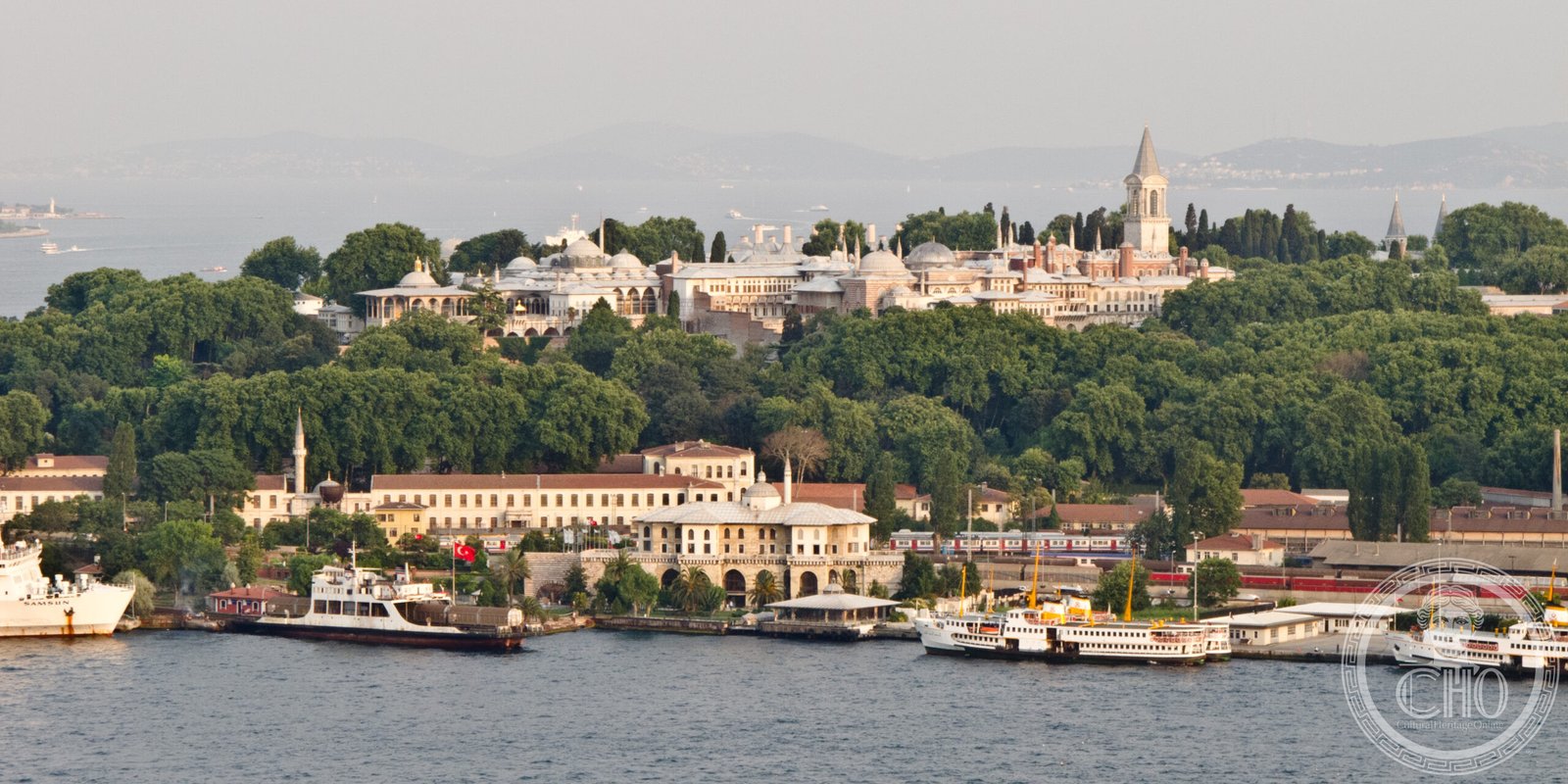
The Topkapı Palace served as the administrative heart and primary residence of Ottoman sultans for nearly four centuries, from the 1460s until the court relocated to Dolmabahçe in 1853. Today it stands as a museum housing imperial treasures, manuscripts, and intimate chambers that reveal the structures of power and family life within the Ottoman Empire.
At a glance
A sprawling palace complex in eastern Istanbul comprising four main courtyards and hundreds of rooms, now a museum administered by Turkey’s Ministry of Culture and Tourism. The complex preserves Ottoman imperial art, arms, regalia, and architectural heritage spanning five centuries of continuous occupation and renovation.
History
Sultan Mehmed the Conqueror ordered construction to begin in 1459, six years after the Ottoman conquest of Constantinople. Originally called the “New Palace” to distinguish it from the older Eski Saray in Beyazıt Square, it acquired the name Topkapı—meaning Cannon Gate—in the 19th century.
The palace endured major reconstructions following the 1509 earthquake and the 1665 fire. After the 17th century, sultans increasingly favored residences along the Bosphorus, and Topkapı’s political significance gradually declined. In 1856, Sultan Abdulmejid I moved the imperial court to the newly completed Dolmabahçe Palace, though Topkapı retained the imperial treasury, library, and mint. A government decree dated April 3, 1924 transformed the complex into a public museum following the fall of the Ottoman Empire in 1923.
What you see
The palace comprises four interconnected courtyards and numerous ancillary buildings arranged around enclosed gardens and open courts. The Harem—the private quarters of the Sultan’s family—provides insight into domestic arrangements and hierarchies within the imperial household. The Imperial Council building housed meetings of the Grand Vizier and state officials.
Public access extends to the Ottoman Imperial Harem, the imperial treasury (hazine), and selected chambers displaying armor, weapons, Ottoman textiles, miniatures, and calligraphy. The Spoonmaker’s Diamond and the Topkapi Dagger rank among the most celebrated objects on view.
Cultural significance
Topkapı Palace embodies five centuries of Ottoman governance and court ceremony. Its architecture, collections, and layout document the evolution of imperial administration, military technology, artistic patronage, and domestic life. The surviving manuscripts, including the Topkapı manuscript, represent the empire’s sophisticated literary and scholarly traditions.
The palace forms part of the Historic Areas of Istanbul, recognized by UNESCO as a World Heritage Site in 1985, cementing its status as essential evidence of Ottoman civilization at its height.
Key facts
- Country: Turkey
- City: Istanbul
- Coordinates: 41.013°N, 28.984°E
- Construction began: 1459
- Primary residence until: 1853
- Converted to museum: April 3, 1924
- UNESCO World Heritage Site: Historic Areas of Istanbul (1985)
Practical information & getting there
Topkapı Palace is located in the Fatih district on Istanbul’s European shore. As of 2020, only the most significant rooms and chambers are open to public visitation. Armed guards and ministry officials secure the complex. For current hours, ticket prices, and access details, consult official Turkish tourism resources before your visit.
Sources & resources
Find it on the map
See this place and what’s around it →
Events here — now on & upcoming
- Death of Mehmed II (1481) — Topkapı Palace03 May 2027See the event →
- Born 30/03/1432 — Mehmed II (594th anniversary)30 Mar 2027See the event →
📷 Become a Cultural Heritage Online photographer
Share your photos of places: they stay published under your name as the author. The more they're seen, the more you get noticed — and soon a contest will reward the most appreciated photos.
Log in or sign up free to add a photoIs this page about you?
This page is read by travellers and heritage enthusiasts who find it on Google. Tell us how you are connected to this place and we will take it from there.