
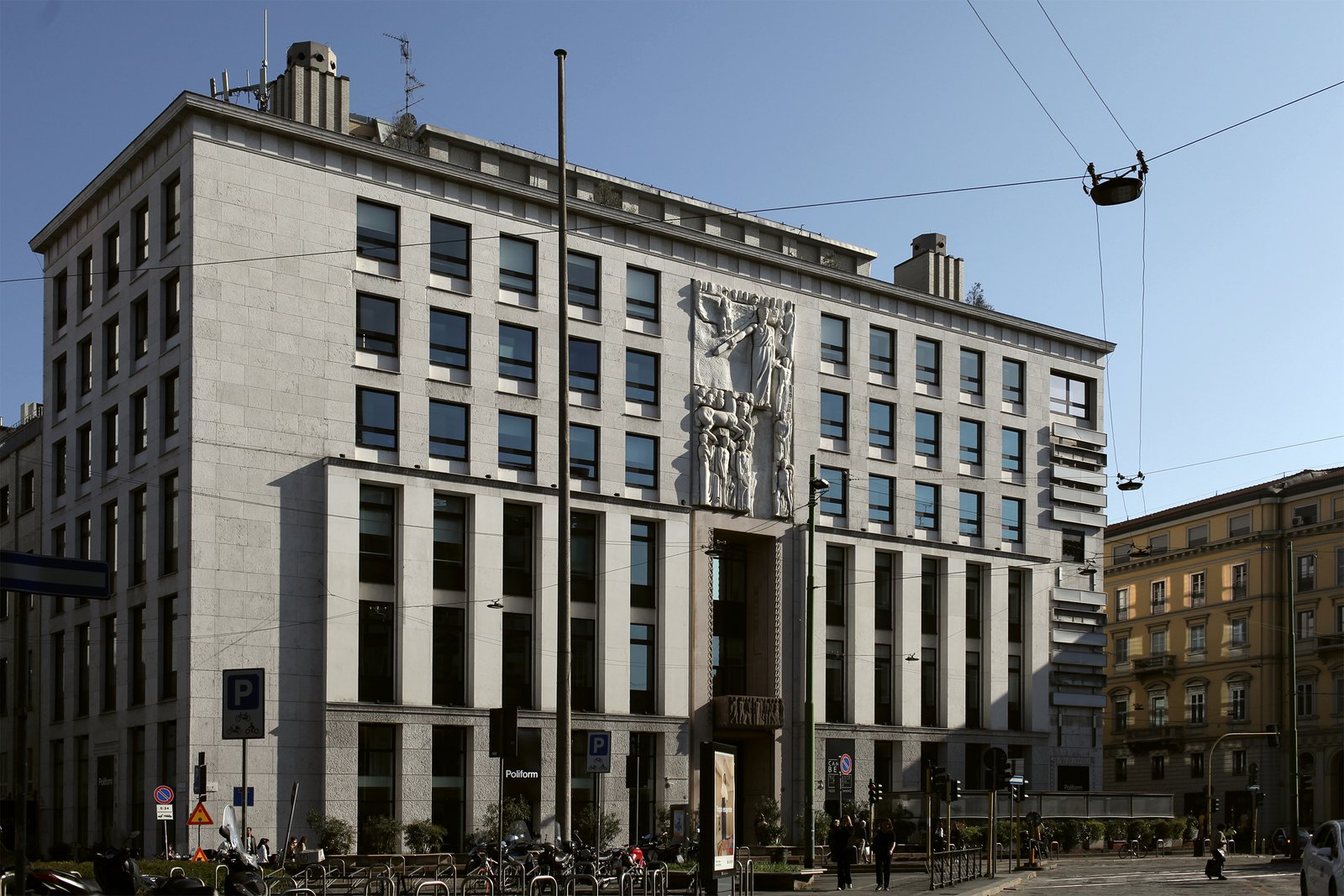
A monumental bas-relief created by sculptors Carlo Sacchi and Mario Sironi adorns the Palazzo dell’Informazione in Milan’s Piazza Cavour, executed between 1938 and 1942. The relief forms part of the palace’s architectural programme under architect Giovanni Muzio, whose Rationalist design represents a significant expression of interwar modernism in Lombardy.
The palazzo itself was conceived as a modern institutional building, its streamlined forms and sculptural embellishments reflecting the architectural vocabulary of the period. Sacchi and Sironi’s bas-relief demonstrates the integration of sculpture with contemporary building design, employing geometric abstraction and monumental scale characteristic of 1930s artistic practice in Italy.
About the Palazzo dell’Informazione
The building, originally commissioned as the Palazzo del Popolo d’Italia, stands in central Milan at Piazza Cavour, 2. Designed by architect Giovanni Muzio in Rationalist style, it was completed in 1942. The structure has since served as the Palazzo dell’Informazione, or Palazzo dei Giornali, functioning as a significant cultural and institutional landmark.
Details
- Sculptors: Carlo Sacchi and Mario Sironi
- Architect: Giovanni Muzio
- Date: 1938–1942
- Location: Piazza Cavour 2, Milan
- Type: Monumental bas-relief
- Architectural style: Rationalism
Frequently asked questions
Who created this relief?
The bas-relief was created by sculptors Carlo Sacchi and Mario Sironi as part of the palace’s decorative programme between 1938 and 1942.
Where is the Palazzo dell’Informazione located?
The palazzo stands at Piazza Cavour 2 in central Milan.
What architectural movement does it represent?
The palazzo and its sculptural elements exemplify Rationalist design, the dominant modernist architectural approach in Italy during the interwar period.
.jpg?w=768&resize=768,0&ssl=1 "Colonia Marina Rosa Maltoni Mussolini, Tirrenia, by Angiolo Mazzoni (1933)")

.jpg?w=768&resize=768,0&ssl=1 "Triumphal Arch and War Memorial, Genoa by Marcello Piacentini")