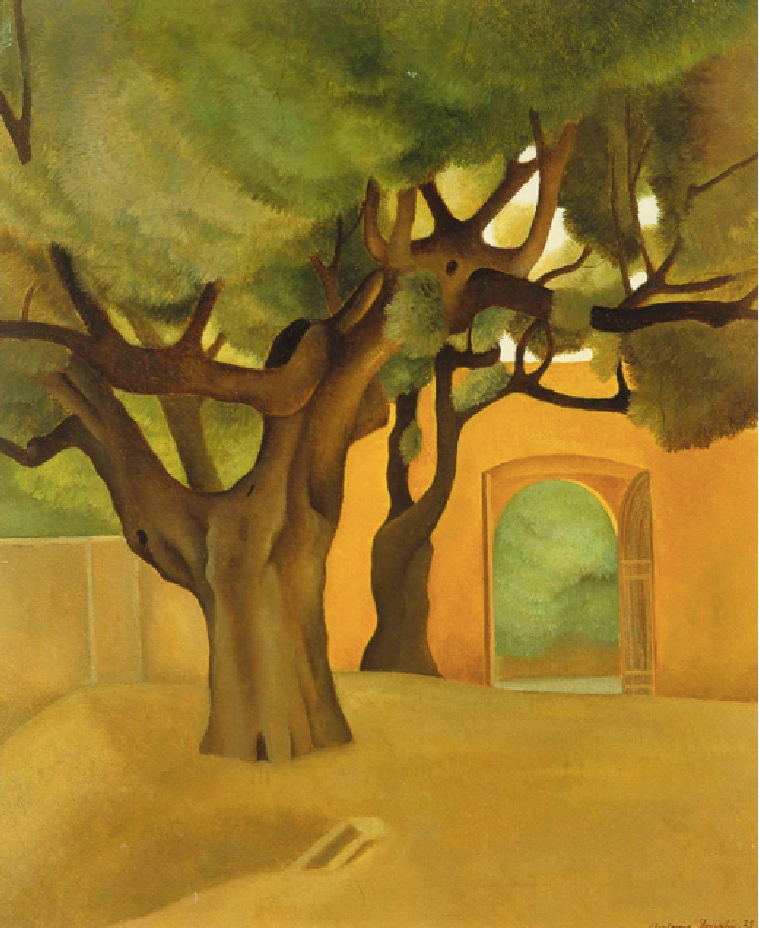
Piazzale alberato is a 1925 painting by Antonio Donghi, the Roman painter who became a leading figure in Italy’s neoclassical movement of the interwar years. The work represents a tree-lined public square, rendered with the spatial clarity and refined compositional technique for which Donghi was renowned.
Donghi’s approach to contemporary subjects—here the modest urban landscape—echoed the practices of Henri Rousseau and Georges Seurat, artists whose scenes of modern life carried subtle humor and formal precision. His figures and spatial arrangements possess an archaic gravity reminiscent of Piero della Francesca. In 1925, the critic Franz Roh identified Donghi among Italy’s major artists working in the emerging magic realism tendency, a recognition that would be consolidated by his First Prize win at the Carnegie Institute International Exhibit two years later.
About Antonio Donghi
Born in Rome in 1897 and trained at the Instituto di Belle Arti from 1908 to 1916, Donghi served in the First World War before pursuing further study in Florence and Venice. His work combined populist subject matter with extreme technical refinement and strong compositional structure, earning him both critical and popular success during the 1920s and 1930s.
Details
- Artist: Antonio Donghi
- Year: 1925
- Movement: Italian Neoclassicism
- Subject: Urban landscape, tree-lined square
Frequently asked questions
Who was Antonio Donghi?
Antonio Donghi (1897–1963) was an Italian painter of popular scenes, landscapes, and still life who became one of the leading figures in Italy’s neoclassical movement of the 1920s. He was recognized by critics Franz Roh in 1925 and won First Prize at the Carnegie Institute International Exhibit in 1927.
What characterized Donghi’s artistic approach?
Donghi favored strong composition, spatial clarity, and populist subject matter rendered with refined technique. His figures possessed an archaic stiffness recalling Piero della Francesca, and critics compared his contemporary scenes to those of Henri Rousseau and Georges Seurat.
What does Piazzale alberato depict?
Piazzale alberato depicts a tree-lined public square, exemplifying Donghi’s neoclassical style and his treatment of everyday urban subjects with formal precision and spatial organization.