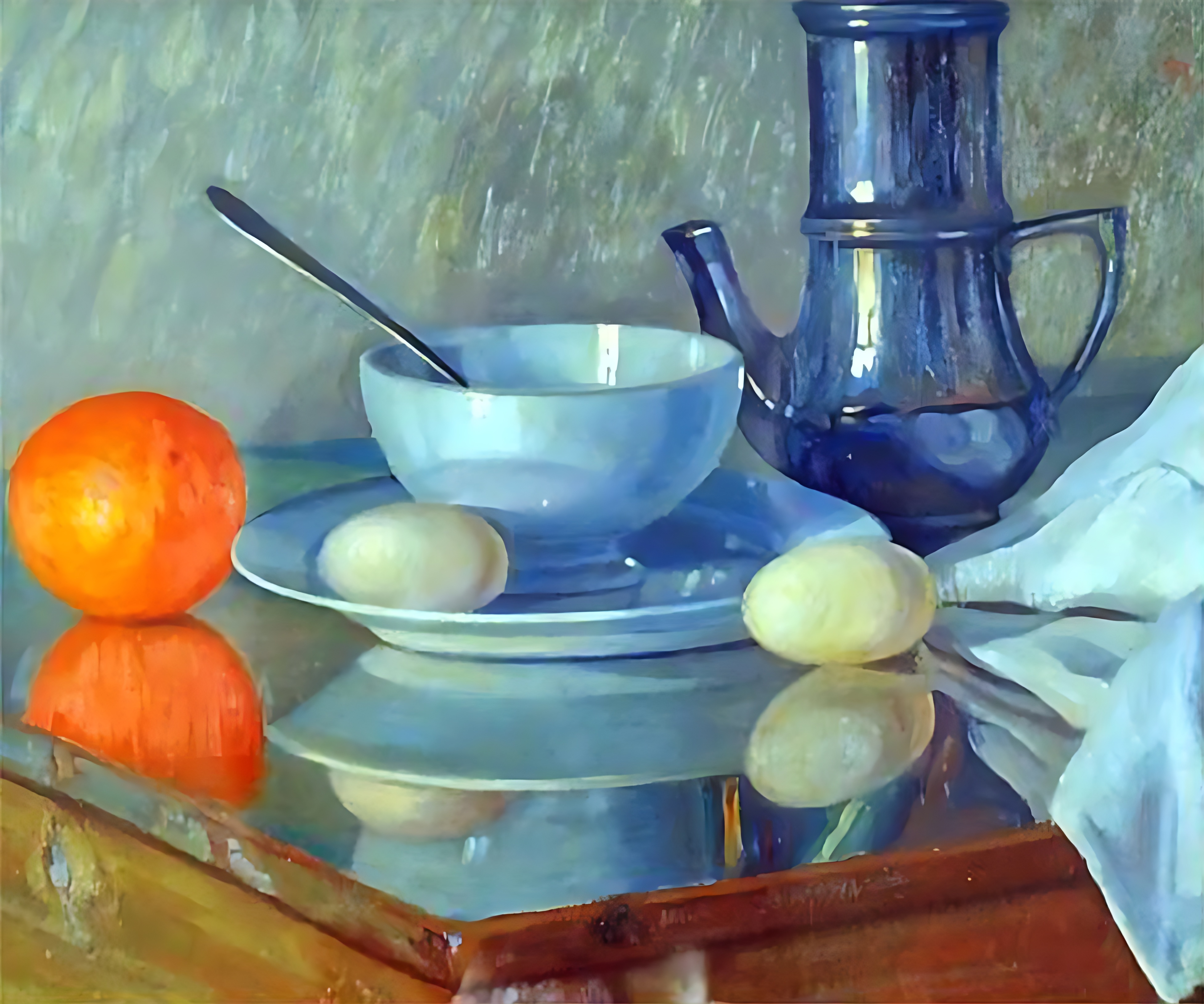
Natura morta con ciotola, uova, arancia is a still life painting by Archimede Santi, completed in 1925. The work presents a modest arrangement of domestic objects—a bowl, eggs, and an orange—rendered with the painter’s characteristic attention to form and composition.
Santi was an Italian painter born in Pergola in 1876 and trained across the Marches and Emilia-Romagna regions. His artistic education included study at the Regio Istituto di Belle Arti in Urbino and professional training in Bologna, where he attended ornamental drawing lessons under Achille Casanova. By the early twentieth century, Santi had established himself as both educator and artist, teaching drawing and design while contributing regularly to major contemporary periodicals including L’artista Moderno, Emporium, and Roma: rassegna illustrata.
About Archimede Santi
Santi began teaching in 1902, initially in his native Pergola before posts in Sicily and Alessandria. Throughout his career he maintained an active practice as a painter and illustrator, publishing work in prominent magazines of the period. He died in Pergola in 1947.
Details
- Artist: Archimede Santi (1876–1947)
- Year: 1925
- Genre: Still life painting
- Medium and support: Oil on canvas (dimensions not documented)
Frequently asked questions
Who was Archimede Santi?
Archimede Santi was an Italian painter and educator born in Pergola in 1876. He trained at the Regio Istituto di Belle Arti in Urbino and in Bologna, and spent his career teaching drawing and design at various institutions while working as a professional artist and contributor to contemporary art magazines.
What was Santi’s artistic background?
Santi studied ornamental drawing under Achille Casanova in Bologna and received formal training in fine arts at institutions in Urbino and Parma. His career combined teaching with active publication in major Italian periodicals of the early twentieth century.
When did Santi paint this still life?
The work was painted in 1925, during the interwar period of Italian art, when the still life remained a significant genre for exploring form and domestic subject matter.