
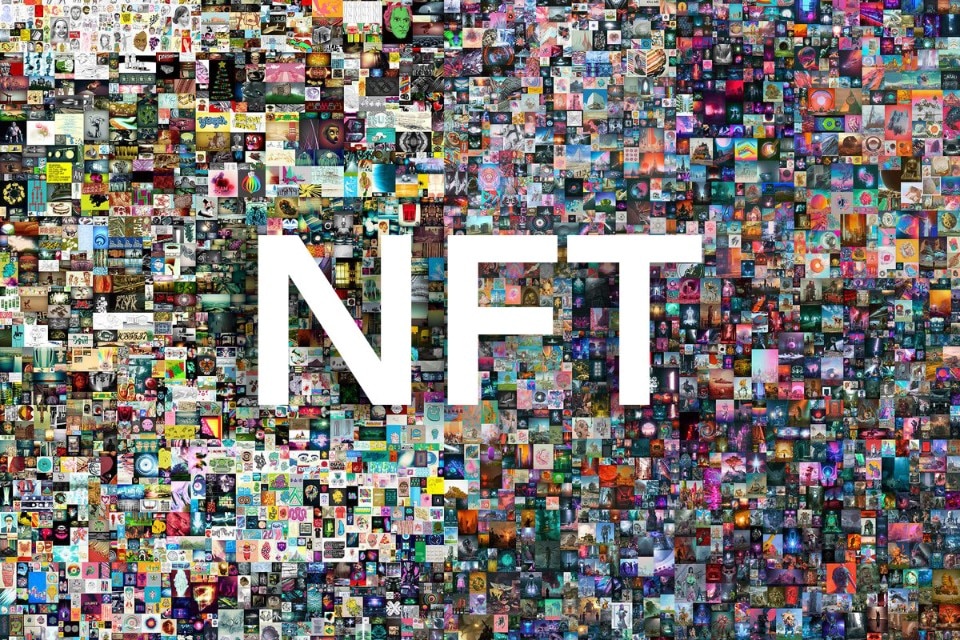
In September 2021, the art world was reckoning with the emergence of NFTs—non-fungible tokens—as a new market segment in contemporary art. The catalyst for widespread attention was the sale of “The First 5,000 Days” by Beeple (Mike Winkelmann, a graphic designer and digital artist from Charleston, South Carolina) at Christie’s for 69.3 million dollars. The JPEG collage, assembled over thirteen years from May 1, 2007, to January 7, 2021, prompted Beeple’s own reaction: an expletive-laden tweet as the price climbed from 4 million dollars to nearly 70 million.
What is an NFT?
An NFT is a cryptographic certificate of authenticity for a digital work—whether artwork, video, text, or music file. It is not the artwork itself but rather a unique, non-reproducible attestation stored on a blockchain. Legally and philosophically, questions remain about ownership, though the mechanism is clear: the NFT functions as a matrix containing a JPEG, MP4, or GIF file, with its uniqueness encoded permanently in metadata. Unlike fungible tokens such as Bitcoin, which are interchangeable and divisible, an NFT is singular yet tradeable.
The technology rests on the blockchain, a shared digital ledger of data blocks arranged chronologically and secured by encryption. Once recorded, the contents cannot be altered retroactively without consensus from the majority of the network. Transactions in cryptocurrency move between addresses toward exchanges—platforms operating in regions such as the EU that must comply with anti-money-laundering regulations and record purchaser identities.
Notable Sales and Market Speculation
Beyond Beeple’s landmark sale, other significant NFT transactions captured attention. Jack Dorsey’s first tweet sold for approximately 2.915 million dollars. A musical composition by Morgan was auctioned on OpenSea, and a video of basketball player LeBron James fetched 200,000 dollars. Vigenesh Sundaresan, a Singapore-based blockchain entrepreneur and founder of BitAcess, purchased Beeple’s work; Sina Estavi, head of Bridge Oracle, acquired Dorsey’s tweet. The question prompted by such purchases: why pay millions for digital content visibly accessible anywhere online?
The phenomenon appears to attract very wealthy individuals betting that NFT values will appreciate upon resale. This dynamic suggests pure financial speculation rather than artistic or cultural advancement. The risk of a market bubble is substantial, though technological development could alter this assessment.
Art, Technology, and Uncertainty
NFTs and cryptocurrency share theoretical and technical foundations, both viewed generally as speculative instruments. Yet two factors merit consideration. First, technological development remains unpredictable. Second, major global financial institutions are seriously studying cryptocurrency. The massive injection of traditional fiat currency into the global economy has drawn attention to the structural similarity between electronic money without real underlying value and increasingly digital traditional currency. Coinbase, a cryptocurrency exchange platform, was listed on the Nasdaq at approximately 100 billion dollars; Bitcoin achieved nearly 900 percent growth in value over twelve months.
The original innovation attributed to NFTs—the disintegration of intermediation chains between producer and consumer, bypassing galleries, auction houses, and dealers—remains noteworthy. Yet as a phenomenon, NFTs currently resemble Churchill’s description of the Soviet Union: “a riddle wrapped in a mystery inside an enigma.” Without regulation and clear authority, participants risk unforeseen consequences.
Frequently asked questions
What is the difference between an NFT and a fungible token?
A fungible token, like Bitcoin, is divisible and interchangeable with other identical units. An NFT is unique, non-reproducible, and identified by immutable metadata that serves as a certificate of authenticity, though it remains tradeable and can be bought or sold.
Why would someone pay millions for an NFT if the artwork is visible online for free?
Purchasers appear motivated by speculation, betting that the NFT’s value will increase upon resale. This suggests the market is driven by financial speculation rather than artistic merit or the exclusivity of the digital work itself.
How does blockchain technology secure an NFT?
The blockchain is an immutable digital ledger where data is organized into blocks arranged chronologically. Once recorded, content cannot be altered retroactively without modifying all subsequent blocks and obtaining network consensus, making the NFT’s ownership history and authenticity cryptographically permanent.