
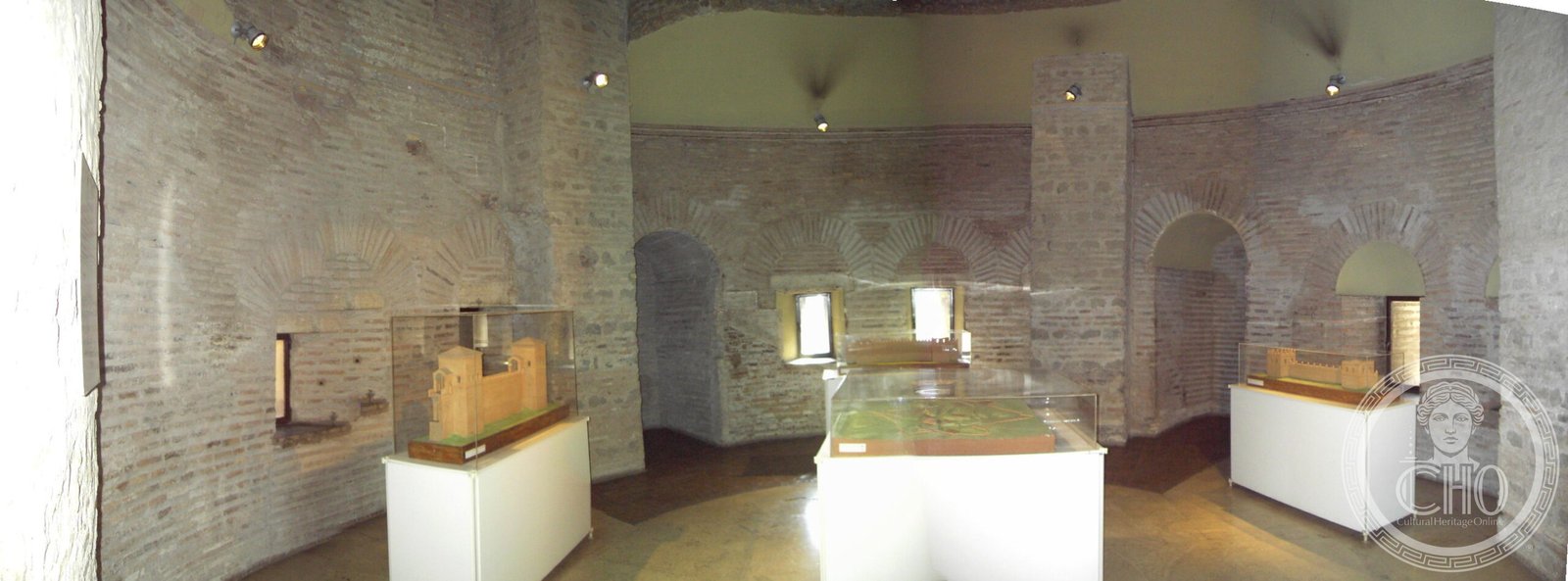
Housed within the monumental Porta San Sebastiano, this museum traces the construction, defense, and evolution of Rome’s Aurelian walls across seven interconnected rooms and a restored walkway.
At a glance
The Museum of the Walls occupies the Porta San Sebastiano (also known as Porta Appia), one of Rome’s principal ancient gateways. Seven galleries and an elevated walkway document the pomerium, wall construction techniques, defensive strategies, and medieval and modern interventions spanning sixteen centuries.
History
In 1939, the Antiquities and Fine Arts Department prevented the conversion of Porta San Sebastiano into an artist studio by commissioning restoration work; architect Luigi Moretti oversaw these early interventions. After World War II, the gate reopened to the public with plans for a dedicated wall museum. Rooms were transferred to the Ministry of Education in 1960 for administrative and exhibition purposes, then returned to Rome’s municipality a decade later.
A small museum of the walls opened in 1971 with a Sunday-only schedule and a walkway extending toward Via Cristoforo Colombo, but closed until 1984 when it featured in an “Underground Rome” exhibition. The Museum of the Walls was formally established in 1989, though regional law had recognized it since 1975. The current arrangement dates to 1990.
What you see
Room I (western tower) displays a tricolor mosaic from 1940–1943 depicting a tiger attacking deer in a flowering woodland, alongside audiovisual facilities. Room II (first floor, connecting towers) presents panels on the pomerium, Aurelian construction techniques, doorway types, and siege methods; a 1940s two-color mosaic shows a mounted leader with soldiers.
Room III (east tower) houses four scale models and a map showing the complete wall circuit. Room IV (west tower) documents the architectural phases of Porta San Sebastiano and other gates through panels and plaster casts. Room V (west tower) offers reconstructive models of gates and information on the nearby Via Appia.
Room VI (second floor, central structure) covers medieval and modern periods, detailing papal interventions from the 16th to 20th centuries. Room VII (east tower) displays the model of the Ardeatino Bastion, designed by Antonio da Sangallo the Younger, and preserves charcoal sketches possibly made for Charles V’s 1536 passage.
The restored walkway, approximately 350 meters long and rebuilt for the 2000 Jubilee, remains accessible from Room VII, revealing original paving and a Madonna and Child image carved into the lunette.
Cultural significance
The Museum of the Walls transforms the Porta San Sebastiano from a defensive landmark into a comprehensive archive of Roman military engineering and urban protection. Its seven-room narrative charts not merely the Aurelian walls’ construction but also the adaptive strategies of successive medieval and modern administrations, offering insight into how Rome sustained and modified its boundaries across epochs.
Key facts
- Address: Via di Porta San Sebastiano, 18, Rome
- Coordinates: 41.8734634, 12.5014081
- Official website: http://www.museodellemuraroma.it/
- Phone: 060608
- Established: 1989 (current arrangement 1990)
- Walkway length: Approximately 350 meters
Practical information
Opening hours are not listed here; consult the official website or phone the museum directly. The walkway is accessible from Room VII only. Visitors should plan to spend at least two hours exploring the seven galleries and elevated circuit.
Getting there
The museum is located at the Porta San Sebastiano on the Appian Way district of Rome. You can reach it via public transportation or private vehicle; check the official website for specific directions and parking information.
See the place
Sources & resources
Find it on the map
See this place and what’s around it →Historical events at this place (6)
- 2018 Visita guidata al Tramonto al Museo delle Mura
- 2018 Tramonto al Museo delle Mura - Visita guidata
- 2019 Visita guidata alla PORTA S. SEBASTIANO e al MUSEO delle MURA
- 2019 Ra-ta-ta-ta, bang-bang, si gioca
- 2020 Alla scoperta della PORTA ed il MUSEO della VIA OSTIENSE
- 2021 Porta San Sebastiano e il Museo delle Mura
📷 Become a Cultural Heritage Online photographer
Share your photos of places: they stay published under your name as the author. The more they're seen, the more you get noticed — and soon a contest will reward the most appreciated photos.
Log in or sign up free to add a photoIs this page about you?
This page is read by travellers and heritage enthusiasts who find it on Google. Tell us how you are connected to this place and we will take it from there.