
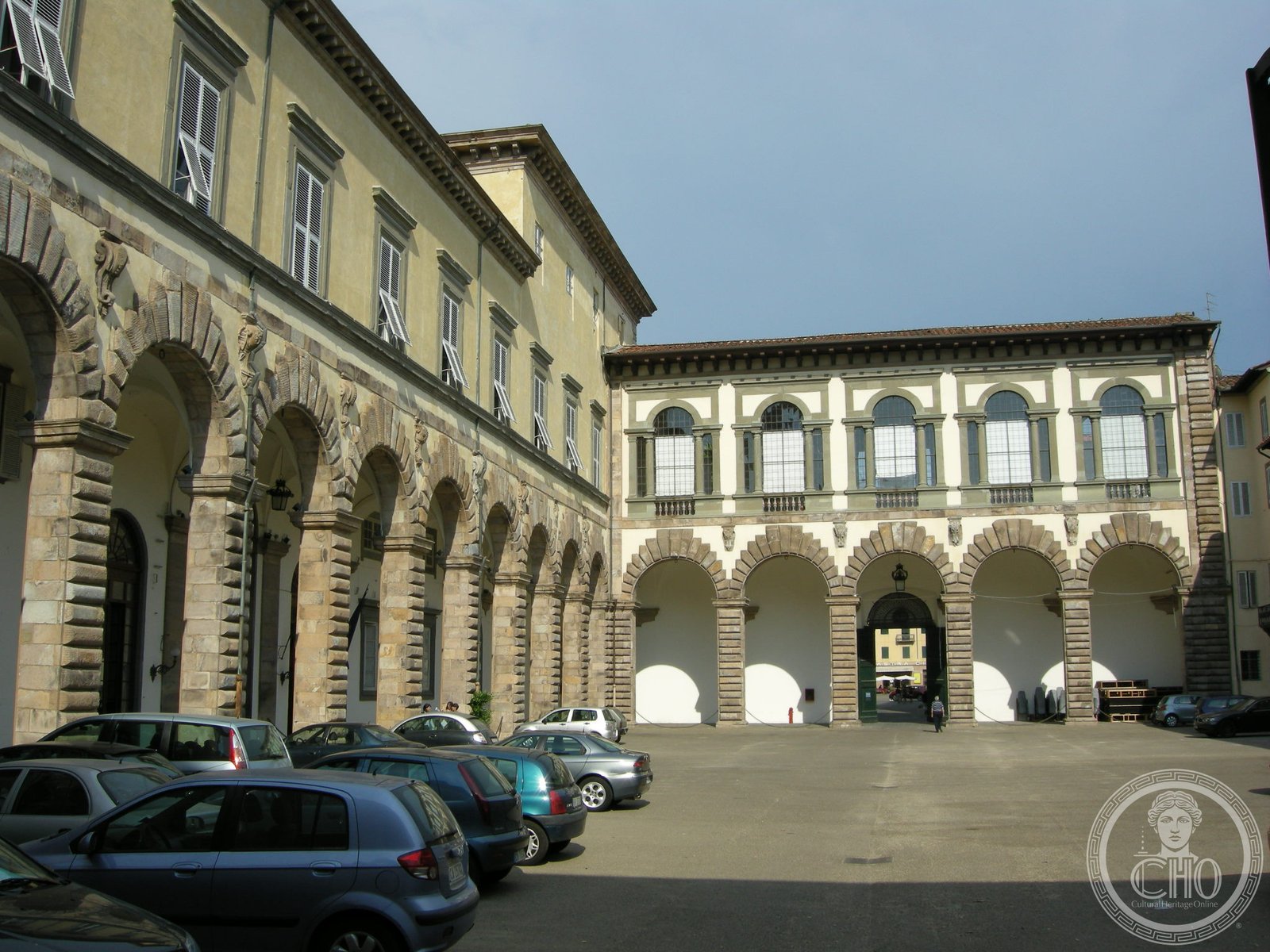
The seat of Lucca’s government for nearly five centuries, this sprawling palace evolved from a medieval fortress into a monumental civic center, reshaped by Renaissance masters and dynastic rule.
At a glance
The Ducale Palace dominates the west side of Piazza Napoleone, its present form a palimpsest of military stronghold, republican headquarters, and ducal residence. Originally built within Castruccio Castracani’s Augusta Fortress—a vast complex attributed to Giotto—the palace survived demolitions and transformations to remain Lucca’s principal seat of power until 1847.
History
Before Castracani’s rule, Lucca’s government convened in Piazza San Michele. Castracani commissioned the Augusta Fortress, a sprawling military citadel that occupied roughly one-fifth of the city. Following Emperor Charles IV’s grant of freedom to the Republic in 1370, popular sentiment led to the fortress’s destruction—yet its central palace survived, continuing as republican headquarters.
Under Paolo Guinigi, a new fortress called the Citadel encircled the palace. Its dismantling in 1430 did not dislodge the government; the palace remained the seat of power through the 15th and 16th centuries, accumulating administrative buildings piecemeal. A powder magazine explosion in 1586 prompted the Republic to commission Bartolomeo Ammannati, whose 1578 renovation brought Renaissance order to the chaotic medieval structure. Francesco Pini added the right wing in 1728, while Lorenzo Nottolini enriched the complex during the Duchy of Lucca in the early 1800s. The palace served as ducal residence and state seat until Lucca’s annexation to the Grand Duchy of Tuscany in 1847.
What you see
The palace’s present appearance owes primarily to Ammannati’s intervention. The left side features a refined loggia with serliane—slender columns framing arched openings—and a central door articulating the Renaissance façade. Pini’s 1728 right wing echoes Ammannati’s vocabulary while amplifying the building’s monumental character. The nineteenth-century enhancements by Nottolini added further layers of refinement to this composite structure.
Cultural significance
The Ducale Palace embodies Lucca’s transition from independent republic to regional player. Its architecture charts the city’s political transformations: from Castracani’s autocratic militarism through republican restoration, Guinigi patronage, and finally ducal governance. The convergence of Giotto’s attributed design, Ammannati’s Renaissance principles, and Pini’s Baroque sensibility makes this palace a textbook of Tuscan architectural ambition.
Key facts
- Address: Cortile Carrara, 1, 55100 Lucca
- Coordinates: 43.84125561190223, 10.501878261566162
- Website: https://www.palazzoducale.lucca.it/
- Phone: 0583 4171
Practical information
The palace now houses the Province of Lucca. Visiting hours and admission details are available through the official website and phone line listed above.
Getting there
The Ducale Palace occupies Piazza Napoleone, Lucca’s principal civic square in the historic center. Public transport and local signage provide easy access from Lucca’s main railway station and surrounding streets.
See the place
Sources & resources
Find it on the map
See this place and what’s around it →📷 Become a Cultural Heritage Online photographer
Share your photos of places: they stay published under your name as the author. The more they're seen, the more you get noticed — and soon a contest will reward the most appreciated photos.
Log in or sign up free to add a photoIs this page about you?
This page is read by travellers and heritage enthusiasts who find it on Google. Tell us how you are connected to this place and we will take it from there.