
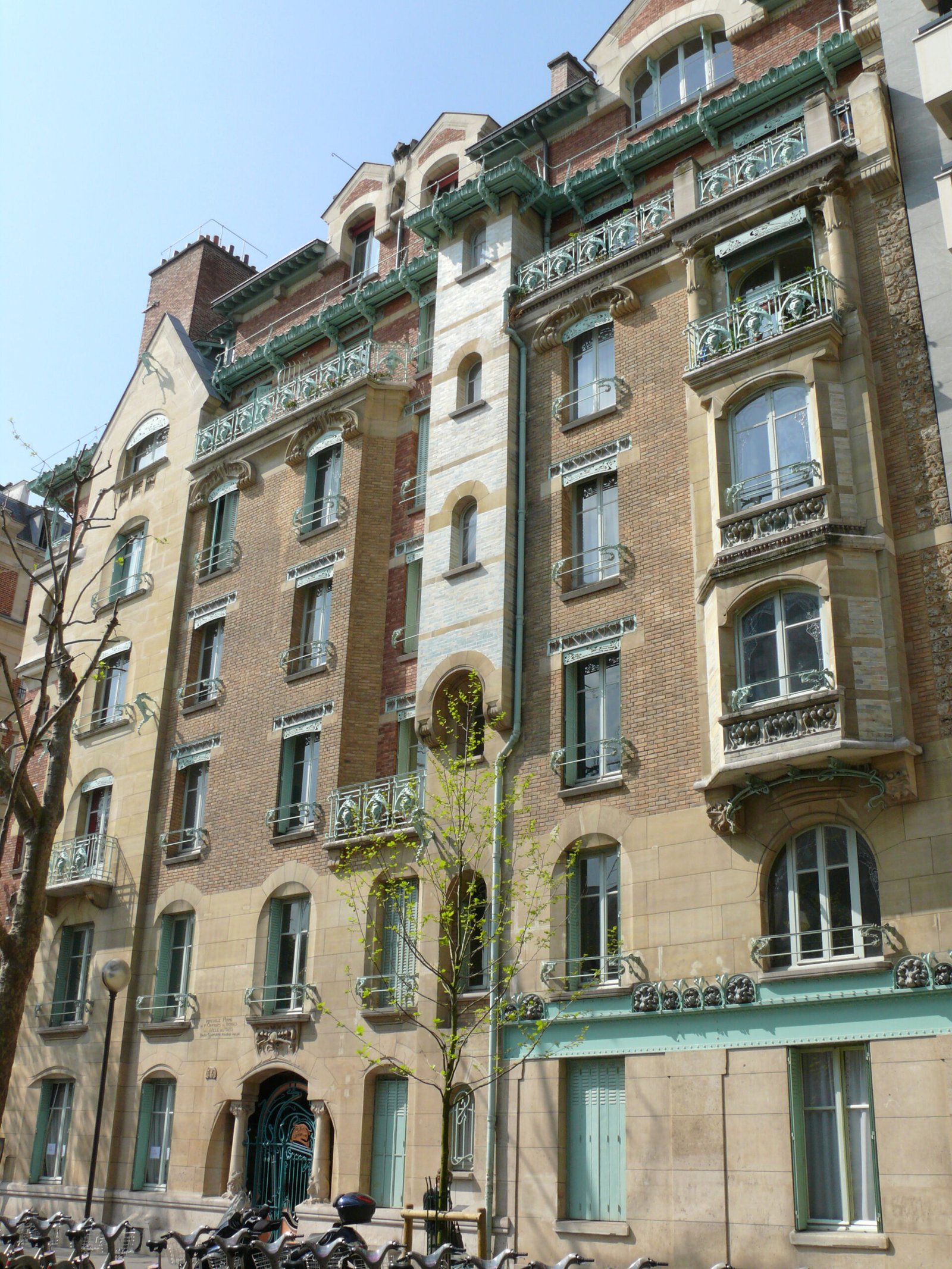
Hector Guimard’s first manifesto in brick, stone and cast iron: thirty-six apartments behind a façade so unconventional that Parisians nicknamed it the “Castel Dérangé” — then awarded it the city’s façade prize.
At a glance
Built between 1895 and 1898 at 14 rue Jean-de-La-Fontaine, in the Auteuil quarter of the 16th arrondissement, Castel Béranger was the first apartment building in Paris designed in the Art Nouveau style. Hector Guimard was not yet thirty when the work began. He had started with a more conventional design; a journey to Brussels, where he saw Victor Horta’s Hôtel Tassel, redirected him entirely. He redrew the building around iron, asymmetry and organic line. The thirty-six rental apartments won the Ville de Paris façade competition in 1898 — the first time the prize went to a building this radical. Unconvinced neighbours called it the “Castel Dérangé,” the deranged castle.
Key facts
- Built: 1895–1898
- Architect: Hector Guimard (1867–1942)
- Style: Art Nouveau — the first residential example in Paris
- Address: 14 rue Jean-de-La-Fontaine, 75016 Paris, France
- GPS: 48.852400, 2.274580 — Open in Google Maps
- Distinction: Winner, Concours de façades de la Ville de Paris, 1898
- Status: Listed monument historique; private residential building (interior not open)
History
Guimard received the commission in the mid-1890s for a residential block on a plot in Auteuil. His first drawings were comparatively restrained. Then, in 1895, he travelled to Brussels and visited Victor Horta, whose Hôtel Tassel had just shown what iron and curved line could do for a private house. Guimard returned and reworked the project from the ground up, designing not only the structure but the gates, the interior fittings, the wallpaper, the carpets and the door handles — a building conceived as a single object.
The 1898 façade competition organised by the City of Paris had always rewarded sober, academic fronts. That year the jury gave the prize to Castel Béranger, and the decision was contested in the press. The nickname “Castel Dérangé” stuck. But the award legitimised the new style in the capital and made Guimard’s reputation: within two years the Compagnie du Métropolitain handed him the commission that would put his ironwork at the entrance of nearly every station in Paris.
Guimard documented the building himself in a 1898 portfolio, Le Castel Béranger, reproducing his designs down to the smallest catch and hinge. The building has remained private apartments ever since; its façade and roof carry monument historique protection. Much of the original interior decoration survives behind the street front.
What you see
The street façade mixes materials the way a painter mixes a palette: brick, Hauteville limestone, rough meulière stone, cast iron, copper and panels of glazed stoneware. No two bays repeat. Windows shift in size and position, balconies bulge on brackets shaped like sea-creatures and abstract masks, and the whole front reads as something grown rather than drawn. The ceramic panels were fired by Alexandre Bigot, the period’s leading architectural ceramicist.
The set-piece is the entrance gate: a screen of wrought and cast iron in oxidised copper-green, its bars twisted into the whiplash curves that would become Guimard’s signature — and, two years later, the visual language of the Métro. Look for the seahorse motif on the balcony rails and the stylised faces worked into the stonework. The interior courtyard and lobby, glimpsed through the gate, carry the same line into mosaic, glass and iron.
Practical information
- Access: Private residential building; the interior is not open to the public
- Exterior: The façade and the famous entrance gate are visible from rue Jean-de-La-Fontaine at any time, free of charge
- Best light: Morning, when the sun reaches the street front
- Time needed: 15–20 minutes, including the gate and the lower balconies
- Combine with: Other Guimard works on the same street and around rue Agar nearby
Getting there
Castel Béranger is at 14 rue Jean-de-La-Fontaine, in the Auteuil district of the 16th arrondissement. The nearest Métro is Jasmin (line 9), a two-minute walk; Église d’Auteuil and Michel-Ange–Auteuil (also line 9) are a short distance further. From the centre of Paris, take line 9 westbound. The street itself is a Guimard itinerary: the Hôtel Mezzara, also by Guimard, stands further along at number 60, and more of his buildings cluster around the nearby rue Agar.
Nearby
- Hôtel Mezzara — Guimard, 60 rue Jean-de-La-Fontaine
- Guimard buildings around rue Agar and Square Jasmin
- Maison de la Radio et de la Musique, on the Seine
- Paris — Belle Époque, Art Nouveau & Modernism (city guide)
Sources
- Plateforme Ouverte du Patrimoine (POP) / base Mérimée — monument historique record, Ministère de la Culture
- Musée d’Orsay — Hector Guimard collections and documentation
- Hector Guimard, Le Castel Béranger (Paris, 1898)
Find it on the map
See this place and what’s around it →Record researched and written by Luigi De Marchi for Cultural Heritage Online, 2026.
📷 Become a Cultural Heritage Online photographer
Share your photos of places: they stay published under your name as the author. The more they're seen, the more you get noticed — and soon a contest will reward the most appreciated photos.
Log in or sign up free to add a photoIs this page about you?
This page is read by travellers and heritage enthusiasts who find it on Google. Tell us how you are connected to this place and we will take it from there.