
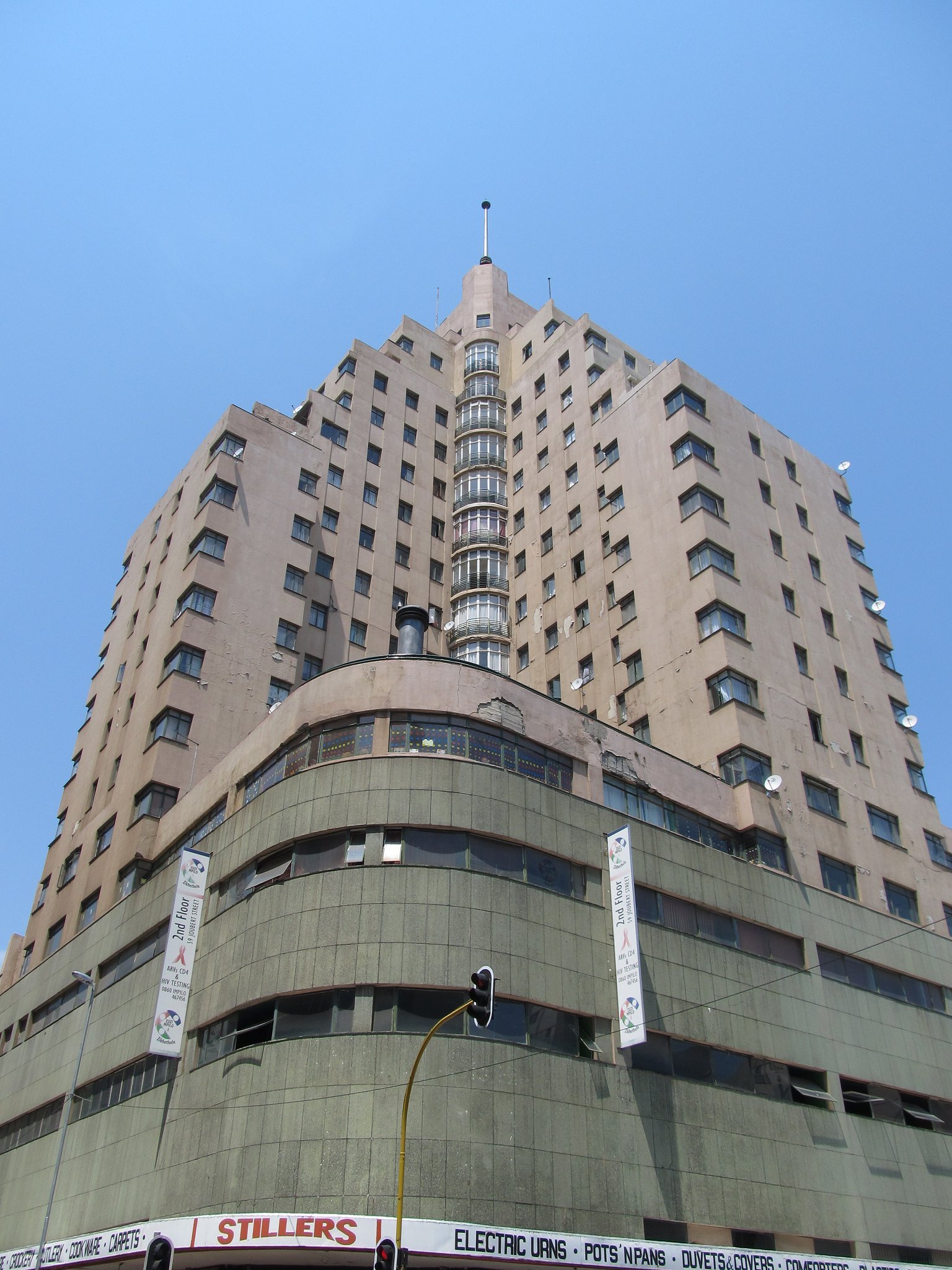
The gold money of the 1930s rose into stepped towers across the Johannesburg city centre. Anstey’s Building and Astor Mansions still hold the line, echoing the skyscrapers of New York.
At a glance
Johannesburg was barely fifty years old when its Art Déco moment arrived. Founded in 1886 after gold was discovered on the Witwatersrand reef, the settlement grew into a financial city at extraordinary speed, and by the 1930s its central business district was dense enough to build upward. Mining capital and a confident commercial class produced a short, intense wave of tall buildings dressed in the language of the era: stepped silhouettes, vertical piers and decorative crowns. The two best survivors stand only a few blocks apart in the old CBD. Astor Mansions, finished in 1932, was for three years the tallest building in the city. Anstey’s Building, completed in 1937, overtook it with a dramatic ziggurat profile. Together they read as a compact American skyline transplanted to the southern hemisphere.
Key facts
- Country: South Africa
- Key period: 1930s
- Essential sites: Anstey’s Building, Astor Mansions
- City founded: 1886, after the Witwatersrand gold discovery
- District: Central Business District (CBD), Johannesburg
History
Johannesburg owes its existence to gold. The main Witwatersrand reef was identified in the mid-1880s, and the city was established in 1886 to serve the rush that followed. Unlike older colonial centres, it had no slow founding period: it was a mining town that became a metropolis within a single generation. By the early twentieth century the wealth pulled out of the deep-level mines had concentrated in a tight grid of streets south of the Witwatersrand ridge, and that concentration of capital set the stage for the building boom that defined the city’s first true skyline.
The decisive decade was the 1930s. As the gold price held firm through the years of the global Depression, Johannesburg kept building while many cities abroad had stalled. Developers and architects looked outward for a model — and they looked, above all, to the United States. Astor Mansions, designed in 1931 by the firm Obel and Obel and completed in 1932, made the reference explicit: its curved zigzag crown openly recalls the Chrysler Building in New York, and even its name nodded to the Waldorf Astoria. At 102 metres and eleven floors it became, briefly, the tallest building in Johannesburg.
That title passed in 1937 to Anstey’s Building, begun in 1935 by the architects Emley & Williamson. Conceived as a department store with apartments above, it rose to twenty storeys and seventy-seven metres. Where Astor Mansions borrowed a New York crown, Anstey’s borrowed New York massing: a stepped, recessed tower that climbed in stages away from the street. These two buildings, more than any others, fixed the Art Déco character of the Johannesburg CBD.
What you see
The defining feature is the setback. Anstey’s Building is composed of two stepped wings set at right angles to each other, with the upper floors recessed from the street so that the tower appears to climb in deliberate stages — the ziggurat profile that American skyscraper codes had made fashionable. The effect is sculptural rather than ornamental: the drama comes from the shape against the sky rather than from applied decoration. Astor Mansions, by contrast, leans on a decorative crown, a curved zigzag motif that quotes the Chrysler Building and gives the eye a clear vertical climax.
The two buildings sit within a short walk of each other in the old central business district. Anstey’s stands at the corner of Joubert and Jeppe Streets; Astor Mansions a couple of blocks away at the corner of Jeppe and von Brandis. The CBD that surrounds them has changed profoundly since the gold-boom years, and the area rewards a planned, daytime visit rather than casual wandering, ideally with a local heritage walking guide who can open context as well as doors.
Practical information
- Both landmark buildings stand in the Johannesburg Central Business District, within walking distance of one another.
- Anstey’s Building is at the corner of Joubert and Jeppe Streets; Astor Mansions at the corner of Jeppe and von Brandis Streets.
- Anstey’s Building is a recognised South African heritage site and is largely residential today; respect that it is private property.
- Visit by day and consider a guided heritage walking tour of the inner city for safety and context.
- The buildings are best appreciated from the street; interiors are not generally open to the public.
Getting there
Johannesburg is served by O.R. Tambo International Airport (JNB), the main gateway to South Africa, east of the city. From the airport the Gautrain rapid-rail link runs toward Sandton and central Johannesburg, and is the most straightforward way to reach the city from the terminal. The Art Déco landmarks lie within the Central Business District; reaching them is best arranged through a metered service or an organised inner-city tour rather than on foot from a distance.
Related in CHO
- Miami — South Beach and Tropical Art Déco
- Mumbai — Marine Drive and the Art Déco Ensembles
- Napier — The Art Déco Town Rebuilt After the Earthquake
Sources

Find it on the map
See this place and what’s around it →Record researched and written by Luigi De Marchi for Cultural Heritage Online, 2026.
📷 Become a Cultural Heritage Online photographer
Share your photos of places: they stay published under your name as the author. The more they're seen, the more you get noticed — and soon a contest will reward the most appreciated photos.
Log in or sign up free to add a photo