
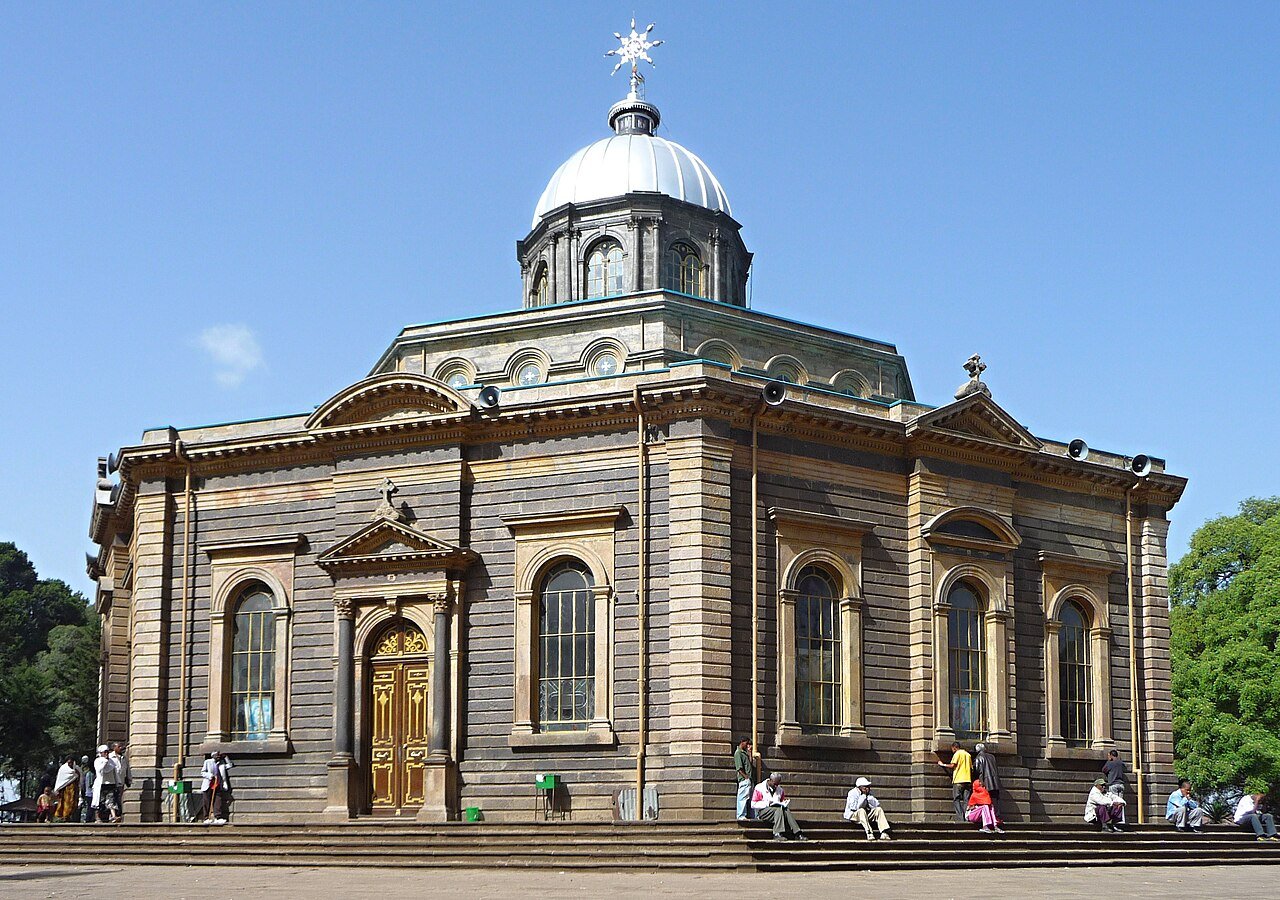
Ethiopia’s highland capital wears two early-modern faces: an eclectic city begun in 1886, and the buildings left by a five-year Italian military occupation that made it the seat of Italian East Africa.
At a glance
Addis Ababa sits at roughly 2,355 metres on the Ethiopian highlands, founded in 1886 when Empress Taytu Betul chose the valley below Mount Entoto and Emperor Menelik II moved his capital there. The city grew as an eclectic patchwork of palaces, churches and trading quarters. Between 1936 and 1941 it was occupied by Italy and made the capital of Italian East Africa, a period that overlaid the existing fabric with colonial planning and rationalist public architecture. The central Piazza district, on the high ground around St. George’s Cathedral, remains the clearest place to read both layers at once.
Key facts
- Country: Ethiopia
- Key periods: founded 1886; Italian military occupation 1936–1941
- Essential areas: the Piazza (Arada) district around St. George’s Cathedral
- Elevation: approximately 2,355 metres above sea level
- Coordinates: 9.0358° N, 38.7525° E
History
Settlement in the valley south of Mount Entoto began in 1886, in a place called Finfinne; the site was chosen by Empress Taytu Betul, who persuaded Emperor Menelik II to relocate the imperial capital there. The hot springs and milder climate of the lower ground gave the city its name — Addis Ababa, “new flower.” Over the following decades it filled with imperial palaces, churches and a polyglot commercial quarter, an architecture that borrowed freely from Ethiopian, Greek, Armenian and Italian hands rather than following any single style.
On 5 May 1936 Italian troops entered the city, ending the Second Italo-Ethiopian War. On 1 June 1936 Benito Mussolini proclaimed Italian East Africa, uniting the conquered Ethiopian Empire with Italian Eritrea and Italian Somaliland; Addis Ababa became its capital. The occupation was a military one, enforced and resisted: by 1939 the city held roughly 38,486 Italian colonists, and the colonial authorities drew up an ambitious master plan, drawing on a team of architects, to recast the centre with European axes and monumental public buildings.
Italian rule was short. After the British-led campaign of 1941 and the Battle of Gondar in November 1941, the former Italian East African territories passed to British military administration and Haile Selassie was restored. The Italian-period buildings stayed, absorbed into a capital that has since become the seat of the African Union and the UN Economic Commission for Africa.
What you see
The heart of the historic city is the Piazza, the high district whose Italian name itself records the occupation years. Its anchor is St. George’s Cathedral, an octagonal church at the northern end of Churchill Road, designed and built by the Italian engineer Sebastiano Castagna in 1911 and described in 1938 as a European interpretation of Ethiopian church design. The Fascist authorities set it on fire in 1937; it was restored after liberation in 1941, and it still displays trophies from the wars against Italy.
Around the Piazza the streetscape mixes pre-occupation eclectic buildings with the rationalist public architecture of the late 1930s — clean masses and regular façades typical of Italian colonial construction, rather than the older decorated fronts. Elsewhere in the city the imperial layer survives in the Menelik Palace, the Holy Trinity Cathedral and the Lion of Judah monument. Visitors should treat the colonial buildings soberly: they are the physical residue of an occupation, not a celebration of it.
Practical information
- Start in the Piazza (Arada) district, the most walkable concentration of historic buildings.
- St. George’s Cathedral and its small museum sit at the northern end of Churchill Road.
- The city stands at high altitude; allow time to acclimatise and carry sun protection.
- Amharic is the working language; English is widely used in central institutions.
- Photograph churches and museums respectfully and ask before photographing people.
Getting there
Addis Ababa is served by Bole International Airport (ADD), the principal gateway to Ethiopia and a major regional hub on the east African network. From the airport the historic Piazza district lies a short drive north into the city centre; taxis and ride apps are the simplest way in for first-time visitors.
Related in CHO
- Cinema Italia (Cinema Ethiopia) — the Piazza’s super-cinema of 1937
- Asmara — Africa’s Modernist City and Italian Rationalism
- Massawa — The Red Sea Port of Italian Eritrea
- Rome — Liberty Romano, EUR and Italian Rationalism
Sources
Find it on the map
See this place and what’s around it →📷 Become a Cultural Heritage Online photographer
Share your photos of places: they stay published under your name as the author. The more they're seen, the more you get noticed — and soon a contest will reward the most appreciated photos.
Log in or sign up free to add a photo