
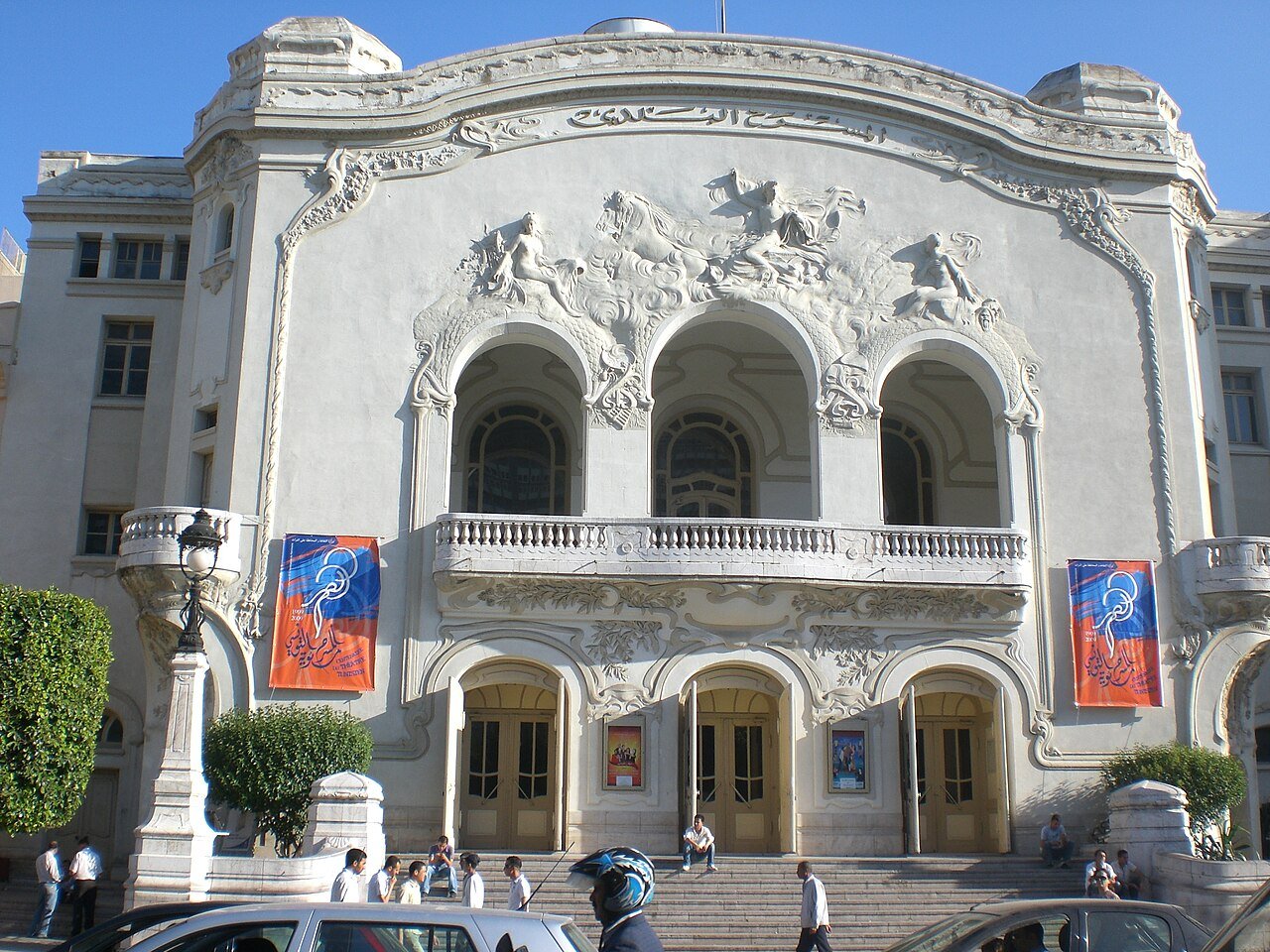
East of the medina, French planners laid out a new town of wide boulevards. Along Avenue Habib Bourguiba, a white Art Nouveau theatre and 1930s apartment blocks still hold their ground.
At a glance
When the French Protectorate took hold after 1881, Tunis grew eastward from its walled medina toward the Lake of Tunis. The expansion produced a Ville Nouvelle of straight avenues and European-style facades, with one boulevard at its centre. Originally the muddy Promenade de la Marine, then Avenue Jules-Ferry, and since 1956 Avenue Habib Bourguiba, this 1,500-metre artery became the city’s stage for cafés, cinemas and commerce. Its buildings record the turn-of-the-century taste for Art Nouveau, the 1930s appetite for Art Déco, and a parallel neo-Moorish vocabulary used on public works. The result is a working downtown where heritage facades survive in daily use.
Key facts
- Country: Tunisia
- Key period: 1900s–1930s
- Essential sites: Théâtre Municipal de Tunis (1902), Avenue Habib Bourguiba, the Colisée (1931), Hôtel Claridge (1932), Cathédrale Saint-Vincent-de-Paul (1897)
- Avenue length: 1,500 metres, 60 metres wide
- Styles: Art Nouveau, Art Déco, neo-Moorish (Mauresque)
History
Tunis spent centuries inside its medina, a dense quarter of souks and mosques. The establishment of the French Protectorate in 1881 redirected the city’s growth toward the lake, onto reclaimed ground that had been an unpromising shoreline. Contemporary accounts describe the future grand avenue as a poor road, muddy in winter and dusty in summer, called the Promenade de la Marine. Within a generation it was rebuilt as a tree-lined boulevard and renamed Avenue Jules-Ferry, becoming the social and commercial spine of the new European town.
The avenue’s signature monument arrived early. The Théâtre Municipal de Tunis, designed by the architect Jean-Émile Resplandy and opened on 20 November 1902, was conceived as a municipal casino before settling into its role as the city’s opera house. Built in full Art Nouveau, it remains among the very few theatres in that style anywhere in the world. The building was partly demolished in 1909 and reconstructed, reopening in January 1911 — an early sign of how often this downtown would be reworked rather than abandoned.
The interwar decades added a second layer. The Colisée opened in 1931 with galleries, cafés and cinemas, and the Hôtel Claridge followed in 1932, both carrying the cleaner geometry of Art Déco. Earlier, the Cathédrale Saint-Vincent-de-Paul had been completed in 1897 in a Romanesque-Byzantine manner at the western end of the avenue. After independence in 1956 the boulevard took the name of President Habib Bourguiba, the title it still carries.
What you see
The clearest landmark is the theatre’s facade: a pale, heavily ornamented front sometimes likened to a wedding cake, its curves and floral relief a textbook display of Art Nouveau in a Mediterranean setting. A short walk along the boulevard turns up the contrast of the 1930s — the Colisée and a run of apartment and commercial blocks whose stepped massing, rounded corners and shallow grilles belong to Art Déco. Interspersed are public buildings in a neo-Moorish idiom, borrowing horseshoe arches and tilework from local tradition.
Visiting is straightforward because the heritage is the street itself. The central island of Avenue Habib Bourguiba, planted with ficus trees, runs from Place de l’Indépendance near the cathedral down toward the Lake of Tunis, and the best approach is simply to walk it slowly, looking up. Many facades sit above shops and cafés still in use, so the architecture is read at first-floor level and above rather than behind museum walls.
Practical information
- The avenue is public and walkable at any hour; the planted central promenade is the prime vantage point.
- The Théâtre Municipal is a working opera house — exteriors are always viewable; interiors depend on the performance schedule.
- Cafés along the boulevard make natural stops for facade-watching.
- The western end meets Place de l’Indépendance and the cathedral; the eastern end opens toward the lake.
- Photography of the facades is unrestricted from the street.
Getting there
Tunis-Carthage International Airport (TUN) lies a few kilometres northeast of the centre and connects to the city by taxi and bus. From the downtown, the avenue is the natural hub: the TGM light rail links central Tunis to La Goulette and the suburbs along the lake, while the Métro léger (tram) network serves stops along and near the boulevard. Most of the Ville Nouvelle is best covered on foot once you reach Avenue Habib Bourguiba.
Related in CHO
- Casablanca — Art Déco and the Mauresque City
- Paris — Belle Époque, Art Nouveau & Modernism
- Nancy — The École de Nancy and French Art Nouveau
Sources

Find it on the map
See this place and what’s around it →Record researched and written by Luigi De Marchi for Cultural Heritage Online, 2026.
📷 Become a Cultural Heritage Online photographer
Share your photos of places: they stay published under your name as the author. The more they're seen, the more you get noticed — and soon a contest will reward the most appreciated photos.
Log in or sign up free to add a photo