
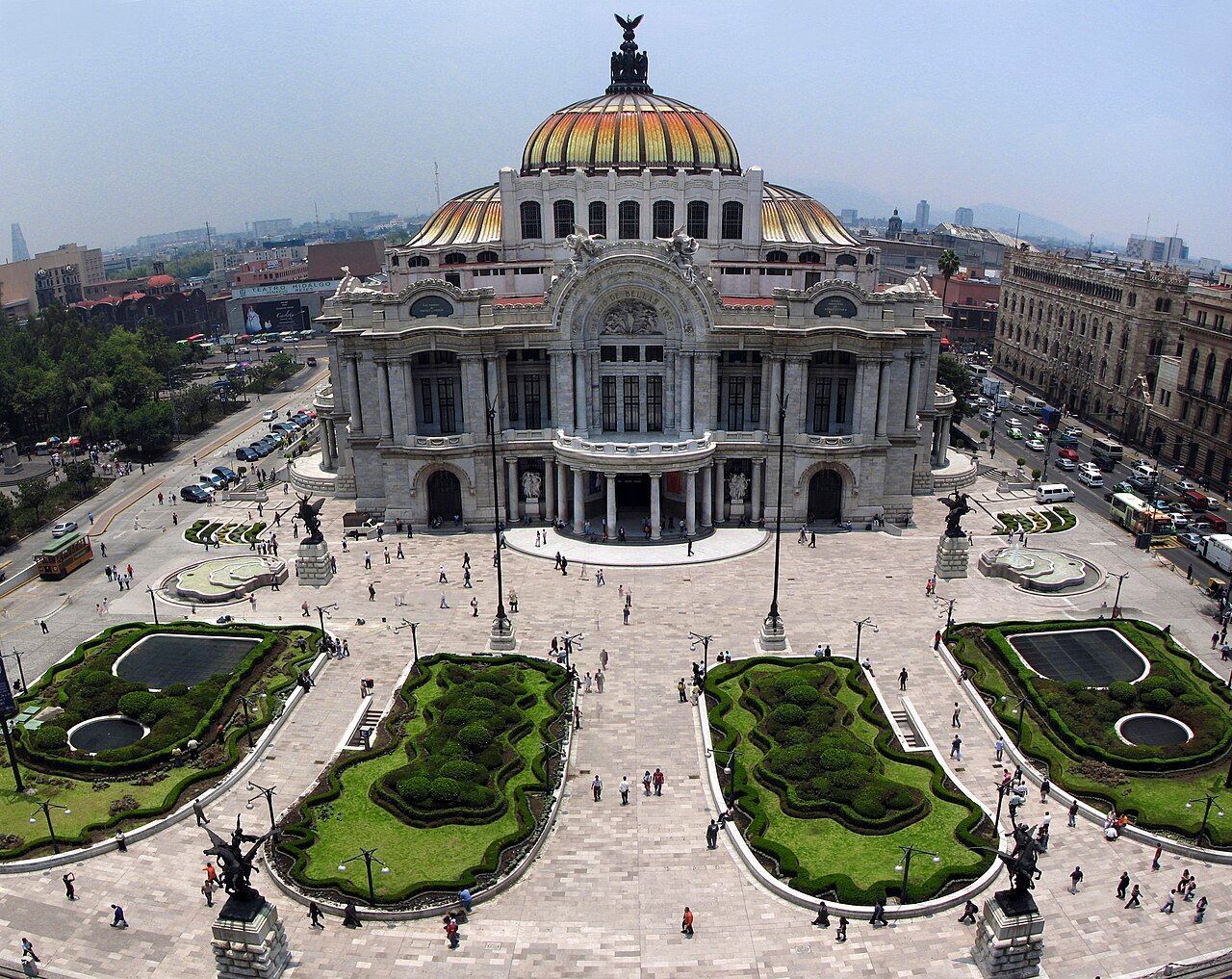
A theatre begun in marble under Porfirio Díaz and finished after a revolution, and a racetrack turned into a park ringed by Déco apartment houses. Mexico City wears the 1930s in stone and glass.
At a glance
Few cities carry the passage from Belle Époque to Art Déco as visibly as Mexico City. The Palacio de Bellas Artes, raised on the soft lakebed of the old Aztec capital, was conceived as a marble opera house and completed a generation later with a streamlined Déco interior. A short walk west, the residential colonias of Condesa and Hipódromo grew on the curve of a defunct horse-racing track, their apartment blocks and Parque México forming one of the most complete Déco ensembles in the Americas. Together they record a country remaking itself after the Revolution of 1910, reaching for a modern visual language without abandoning ornament.
Key facts
- Country: Mexico
- Key period: 1900s–1930s
- Key buildings: Palacio de Bellas Artes, Parque México ensemble (Colonia Hipódromo), Edificio La Nacional
- Architects: Adamo Boari (begun 1904), Federico Mariscal (completed 1934), Manuel Ortiz Monasterio (Edificio La Nacional, 1929–1932)
- Style: Art Nouveau / Neoclassical exterior, Art Déco interior and residential districts
History
The Palacio de Bellas Artes belongs to two eras. Construction began on 1 October 1904 to a design by the Italian architect Adamo Boari, who envisioned a sumptuous theatre in an Art Nouveau and Neoclassical idiom, clad in white Carrara marble. The project stalled: engineering trouble with the marshy subsoil, the outbreak of the Mexican Revolution in 1910, and Boari’s departure left the shell unfinished for two decades. Work resumed in the late 1920s under the Mexican architect Federico Mariscal, who completed the building in 1934 and gave its interior an emphatically Art Déco treatment. Since its inauguration the heavy structure has sunk roughly four metres into the lakebed.
While the theatre waited, the city expanded westward. The Colonia Condesa had been formally established in 1902, and in 1910 Porfirio Díaz himself inaugurated a private racetrack run by the Jockey Club Mexicano. The Revolution closed the track, and during a 1920s planning phase its grounds were reorganised around a new public park. Avenida Amsterdam still traces the oval of the old course. The surrounding Colonia Hipódromo filled with apartment blocks through the 1930s, a decade when Art Déco was the fashionable language of the rising middle class.
Downtown, the same years produced the Edificio La Nacional, built between 1929 and 1932 by Manuel Ortiz Monasterio for the Compañía Nacional de Seguros. At 56 metres and thirteen storeys it is considered the first building in Mexico City to exceed ten floors, a steel-framed Déco tower facing Bellas Artes that held the title of tallest in the city until 1937.
What you see
At Bellas Artes the contrast is the point. The exterior is pale marble, domed and sculptural in the manner of Boari’s Beaux-Arts training; the interior is geometric Déco, all stepped forms and stylised motifs. Its most famous object is the stage curtain, a foldable stained-glass panel made from nearly a million pieces of iridescent glass by Tiffany of New York, depicting the volcanoes Popocatépetl and Iztaccíhuatl. Overhead, a glass ceiling designed by the Hungarian Géza Maróti shows the muses with Apollo.
In Condesa and Hipódromo the architecture is domestic but no less deliberate. Parque México, formally Parque San Martín, opened on 13 December 1927 to a design by the architect Leonardo Noriega with the engineer Javier Stávoli. It holds the Fuente de los Cántaros by José María Fernández Urbina, lamp posts shaped like tree trunks, and the curving Foro Lindbergh open-air theatre. Around it, streets such as Amsterdam and Avenida México are lined with Déco facades best appreciated slowly, on foot.
Practical information
- The Palacio de Bellas Artes is a working theatre and houses a museum; the interior, including the Tiffany curtain, is seen on guided tours or at performances.
- The Museo Nacional de Arquitectura occupies the top floor of the Palacio.
- Condesa and Hipódromo are residential and best explored as a walking circuit around Parque México and Avenida Amsterdam.
- Edificio La Nacional stands on Avenida Juárez, directly across from the Palacio; it is admired from the street.
- Early morning gives the cleanest light on the marble facades and the quietest streets in Condesa.
Getting there
Mexico City International Airport (MEX) sits east of the centre, with taxis, ride-hail and metro connections into town. The Palacio de Bellas Artes has its own station, Bellas Artes, on metro lines 2 and 8, in the heart of the historic centre. Parque México and the Condesa colonias lie a few kilometres to the west and are easily reached by Metrobús, taxi or a pleasant walk through the Roma neighbourhood.
Related in CHO
- Miami — South Beach and Tropical Art Déco
- Buenos Aires — Belle Époque, Art Déco and the Paris of South America
- New York — Tiffany, the Gilded Age and Art Déco
Sources
Find it on the map
See this place and what’s around it →Record researched and written by Luigi De Marchi for Cultural Heritage Online, 2026.
📷 Become a Cultural Heritage Online photographer
Share your photos of places: they stay published under your name as the author. The more they're seen, the more you get noticed — and soon a contest will reward the most appreciated photos.
Log in or sign up free to add a photo