
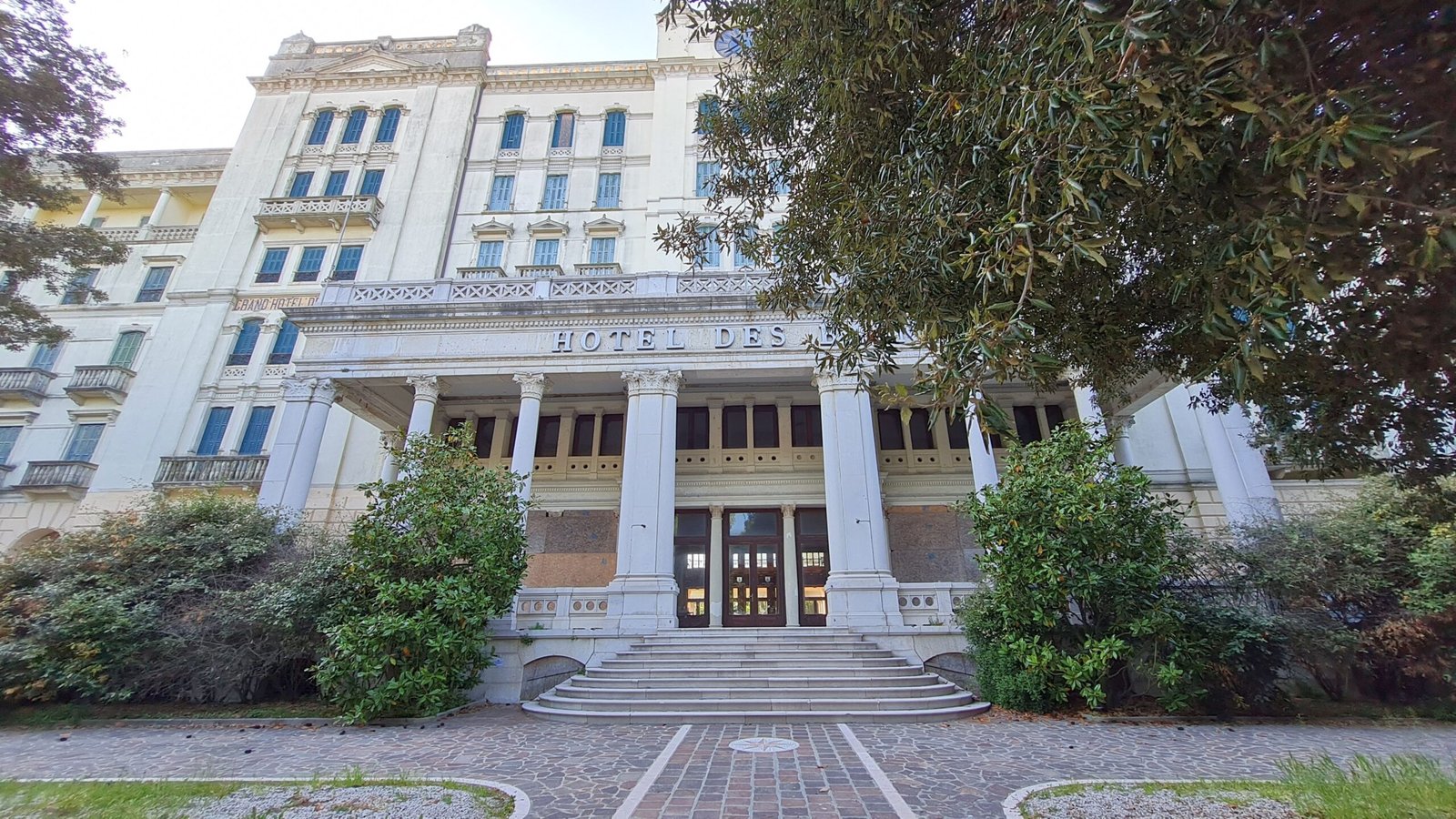
The grandest Belle Époque hotel on Venice’s Lido, opened in 1900 and immortalised by Thomas Mann and Luchino Visconti — now silent, awaiting a long-promised renaissance.
At a glance
Designed by the brothers Raffaello and Francesco Marsich and inaugurated on 5 July 1900, the Grand Hotel des Bains anchored the seaward edge of Lungomare Guglielmo Marconi for over a century. Its six-storey Liberty facade, ringed by a park of century-old trees, set the tone for the Lido’s transformation from fishing island to Europe’s most fashionable Adriatic resort. Mann stayed here in 1911 and drew inspiration for Death in Venice, published 1912; Visconti filmed it here in 1971. The building has stood empty since 2010, its conversion into private residences arrested midway. A €200 million restoration programme was announced in 2025, with COIMA and Eagle Hills as lead investors.
Key facts
- Opened: 5 July 1900
- Architects: Raffaello Marsich and Francesco Marsich (brothers, Province of Udine)
- Style: Italian Liberty (Belle Époque)
- Address: Lungomare Guglielmo Marconi 17, Lido di Venezia, Venice
- Literary connection: Thomas Mann stayed here in 1911, inspiring Death in Venice (1912)
- Film connection: Luchino Visconti shot Morte a Venezia on location here (1971)
- Current status: Closed since 2010; restoration to luxury resort planned (COIMA & Eagle Hills, €200 M, announced 2025)
History
When the Marsich brothers broke ground on the Lido in the late 1890s, the narrow sandbar separating the Venice lagoon from the Adriatic was still largely undeveloped. The brothers, trained in the ornate idiom then sweeping northern Italy’s resort towns, designed a structure whose scale was deliberately theatrical: a six-storey central block flanked by two five-storey wings, the whole composition stepping forward on a raised entrance platform supported by ten columns. A park of mature trees wrapped the landward side, giving guests the unusual sensation of standing between forest and sea.
The doors opened at seven in the evening on 5 July 1900. By the standards of the day the hotel was extraordinarily modern: electric lighting throughout, telephone connections, hydraulic lifts, private bathrooms, and refrigerated storage. The Lido season ran from June to September, and within a decade the des Bains had become a landmark of European aristocratic summer culture, welcoming delegations from Venice’s nascent film festival as well as artists, writers, and crowned heads.
The hotel’s most consequential guest arrived in the summer of 1911. Thomas Mann, already famous for Buddenbrooks, checked in with his wife and brother and observed, from the hotel terrace and beach, a young Polish boy whose beauty he found unsettling and magnetic. The notes he kept that summer became the novella Der Tod in Venedig, published the following year. Mann’s prose transformed the des Bains into a stage for the conflict between artistic discipline and sensuous surrender — a reading that would shape how European culture perceived the Lido for the rest of the century. A room on the upper floors was subsequently named the Thomas Mann Room in his honour.
The hotel closed during the First World War and reopened in 1919 to a changed Europe. The interwar decades brought a second golden age: the launch of the Venice International Film Festival in 1932 added a layer of cinematic glamour to the des Bains’s established literary prestige, and for decades the hotel served as the unofficial headquarters of the festival, hosting juries, premieres, and the kind of encounters that later became film industry legend.
Luchino Visconti returned to Mann’s source material in 1971, filming his adaptation Morte a Venezia extensively on location, with some interiors recreated at Cinecittà Studios in Rome. The des Bains itself played the hotel of the doomed composer Gustav von Aschenbach, its Liberty corridors and terraced beach providing images that became inseparable from the film. After the hotel’s eventual closure in 2010 — following an abortive attempt to convert it into a residential complex, the “Residenze des Bains”, that stalled partway through construction — the building entered a prolonged state of suspension. In June 2025 a €200 million joint venture between Italian asset manager COIMA and Abu Dhabi-based Eagle Hills was announced, with the stated aim of restoring the des Bains as a luxury resort while preserving its listed Belle Époque fabric.
What you see
The exterior presents the characteristic Liberty grammar of the early 1900s Veneto coast: curved window surrounds, wrought-iron balcony railings, and a pale rendered facade that catches the Adriatic light in changing tones of cream and ivory. The central volume projects slightly forward, emphasised by a colonnade of paired columns rising to a decorative cornice. The lateral wings step back symmetrically, their rhythm of windows and balconies giving the whole front a measured cadence rather than the exuberance of, say, Stile Floreale. The park to the rear, planted with holm oaks, contributes to the sense of a building embedded in rather than imposed upon its setting.
Since closure, the building has been in a state of partial deconstruction: scaffolding has appeared and disappeared, and the interior works associated with the failed residential conversion left some of the original room configurations altered. The formal gardens facing the lungomare retain their outline but have been left untended. Visitors today see it from the promenade: a substantial, melancholy Liberty pile whose condition speaks to the difficulty of finding viable uses for historic grand hotels far from city centres.
Practical information
- Current status: Closed to the public since 2010; exterior viewable from Lungomare Guglielmo Marconi. Not a functioning hotel.
- Future reopening: A €200 M restoration was announced in 2025 (COIMA & Eagle Hills); no confirmed reopening date as of mid-2026.
- Beach club: Des Bains 1900, adjacent to the hotel site, operates as a private beach club in summer and may be accessible separately.
- Nearest vaporetto: Line 5.1 / 5.2 — stop Lido, then ~15 min walk south along Lungomare Marconi; or Line 17 car ferry to Lido.
- Best time to visit: June–September for the Lido atmosphere; September for the Venice Film Festival context.
Getting there
The Lido is reached by vaporetto from Venice’s Sant’Elena or San Zaccaria stops. Line 5.1 and 5.2 serve the Lido stop in roughly 25 minutes from Piazza San Marco. From the Lido vaporetto stop, walk or cycle south along Gran Viale Santa Maria Elisabetta and then Lungomare Guglielmo Marconi for approximately 1.5 km; the hotel’s distinctive facade is visible from the promenade. Bicycles can be hired near the Lido landing stage. Water taxis are available from Venice but add significant cost.
Nearby
- Liberty Venezia — the broader Liberty and Novecento heritage of the Venetian lagoon and mainland
- Palazzo del Casinò del Lido di Venezia — the Rationalist casino and film festival venue, 1 km north along the lungomare
- Cimitero di San Michele — Venice’s island cemetery, where Stravinsky, Diaghilev, and Pound are buried, visible from the vaporetto crossing
- Villa Malpaga, Malamocco — older Venetian rural heritage at the southern end of the Lido island
Sources
- Visitvenezia.eu — The Hotel des Bains: one hundred years of history and the desire to continue to host (primary historical account; architects, opening date, Mann stay confirmed)
- Venetoinside.com — Death in Venice in Hotel des Bains at the Lido (Visconti film location confirmation)
- Travel and Tour World / Hospitality & Catering News, June 2025 — COIMA & Eagle Hills €200 M restoration announcement
- Hollywood Reporter — How Closing Hollywood’s Favorite Hotel Killed Venice Film Fest’s Social Scene (2010 closure and failed residential conversion)
- Wikidata Q1542607 — structured data cross-check for address and coordinates
Find it on the map
See this place and what’s around it →Record researched and written by Carla Szathvary for Cultural Heritage Online, 2026.
📷 Become a Cultural Heritage Online photographer
Share your photos of places: they stay published under your name as the author. The more they're seen, the more you get noticed — and soon a contest will reward the most appreciated photos.
Log in or sign up free to add a photoIs this page about you?
This page is read by travellers and heritage enthusiasts who find it on Google. Tell us how you are connected to this place and we will take it from there.