
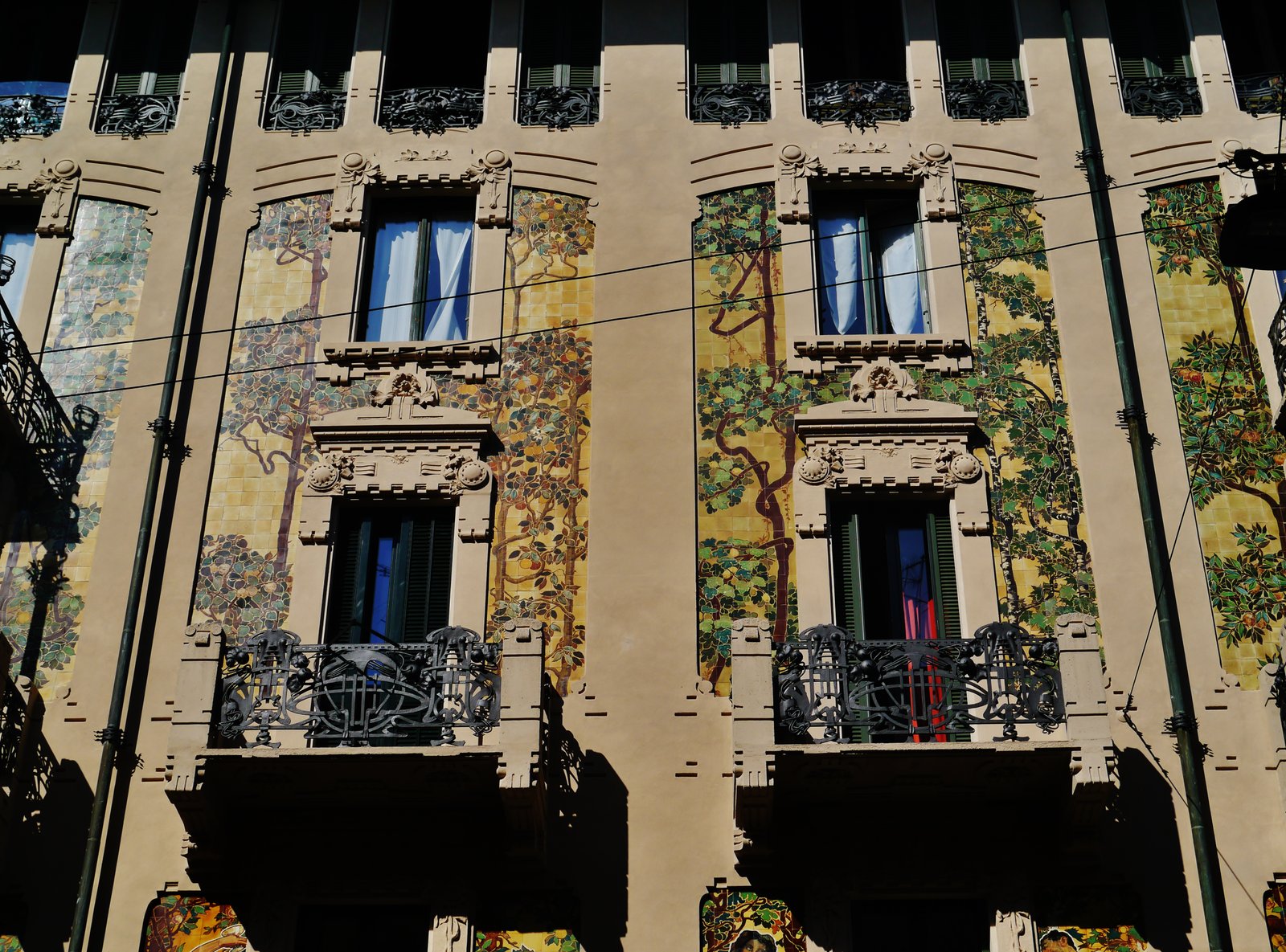
A residential building on Via Malpighi whose entire facade is sheathed in painted ceramic tiles, Casa Galimberti remains one of the most vivid expressions of the Liberty style ever built in Milan.
At a glance
Designed by Giovanni Battista Bossi and completed in 1905, Casa Galimberti stands at Via Malpighi 3 in the Buenos Aires–Porta Venezia district of Milan. The building rises five storeys over ground-level commercial spaces, its exterior entirely covered in polychrome majolica panels executed by a Milanese majolica workshop (the Brambilla e Pinzanti firm). The result is less a conventional apartment block than a sustained argument in colour: terracotta women in flowing robes, peacock-feather borders, floral scrollwork, and wrought-iron balconies work together into a composition that still stops pedestrians mid-stride. The building is protected as a listed monument and underwent conservation in recent years.
Key facts
- Architect: Giovanni Battista Bossi (1864–1924)
- Construction: c. 1904–1905
- Address: Via Marcello Malpighi 3, Milan (Municipio 3)
- Style: Liberty / Italian Art Nouveau
- Heritage status: Protected as a listed monument
- Access: Privately owned residential building; facade freely viewable from the street
History
The commission came from the Galimberti brothers, building contractors who wanted a residence that would also function as a demonstration of their craft. They hired Giovanni Battista Bossi, a Milanese architect active at the turn of the twentieth century, who submitted a design in which every surface of the facade would become a field for polychrome ceramic decoration. Construction ran c. 1904–1905, placing the project squarely within the brief window when Italian Liberty reached its most experimental phase—roughly a decade before the Rationalist movement would begin to close the door on ornament.
The painted-majolica panels were executed by a Milanese majolica workshop, the Brambilla e Pinzanti firm. Bossi himself designed the overall decorative programme, coordinating the ceramic work with the wrought-iron balconies and the cement floral reliefs. The integrated authorship shows: unlike buildings where applied ornament sits in uneasy tension with the underlying structure, here the decoration and the architecture read as a single intention.
The Italian state recognised the building’s exceptional value and granted it protection as a listed monument. Despite that status, decades of urban weathering had taken a toll on the facade by the early twenty-first century. A significant conservation campaign was carried out in recent years, stabilising the ceramic surface and restoring the original colour palette. Casa Galimberti now stands as a benchmark of Liberty preservation practice in northern Italy.
What you see
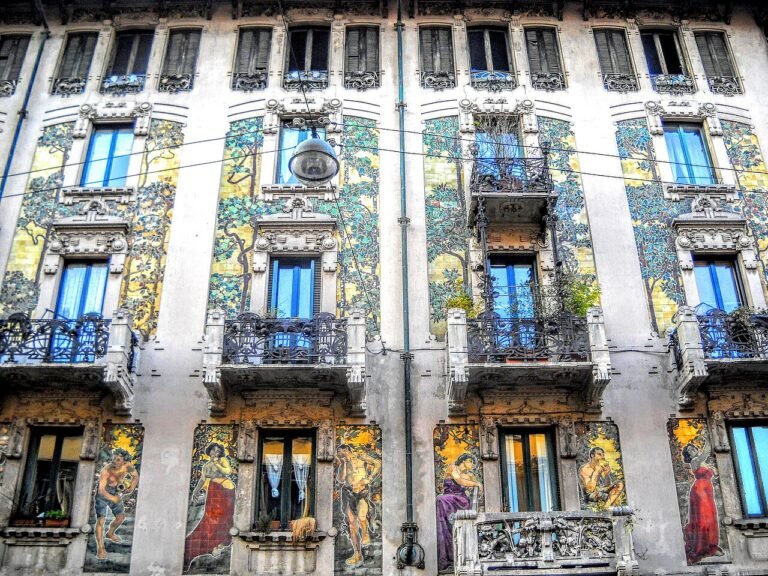
The facade is divided vertically into three bays. Look past the movement at street level and the first thing that registers is warmth: the terracotta ground of the ceramic panels reads almost amber in morning light, shifting to deep ochre by afternoon. Above the second-floor cornice, each bay is anchored by two tall female figures modelled in relief—draped loosely, hair unbound, arms curving into the floral borders at their sides. Between them, smaller panels carry peacock motifs, stylised irises, and interlocking vines. The wrought-iron balcony railings mirror the same plant vocabulary in a different medium: cast stems and forged leaves echo the painted flowers behind them, so that the facade seems to breathe outward from wall to railing.
At ground level the logic shifts. Shop fronts have been altered over the decades, as they always are, and the pavement view is dominated by more recent interventions. But lift your eye to the piano nobile and above, and the original scheme becomes legible again: polychrome ceramic covering a five-storey residential block, in a district—Buenos Aires and Porta Venezia—that was expanding rapidly at the start of the twentieth century and hungry for exactly this kind of architectural confidence.
Practical information
- Access: The building is a private residential property. The facade is fully visible from Via Malpighi at street level—no entry required or possible.
- Best time to visit: Morning light (east-facing main facade) gives the warmest colour rendition of the ceramics; overcast days reduce glare and are often preferred by photographers.
- Time needed: 10–15 minutes to examine the facade in detail; pair with nearby Liberty buildings for a half-day walking itinerary.
- Nearest metro: Lima (M1, red line), approximately 5 minutes on foot.
- Admission: Free (exterior only).
Getting there
The most direct route from central Milan is by Metro Line 1 (red) to the Lima stop on Corso Buenos Aires. From the exit, walk south-west along Corso Buenos Aires and turn into Via Malpighi; the building is at number 3, less than five minutes from the station. Alternatively, several tram lines run along Corso Buenos Aires and Viale Tunisia, both within easy walking distance. The area is flat and compact, making it straightforward to combine Casa Galimberti with other Liberty buildings in the Porta Venezia neighbourhood on a single pedestrian circuit.
Nearby
- Casa Guazzoni (Via Malpighi 12, 1904–1906) — another Liberty apartment building on the same street, designed by Giovanni Battista Bossi, with ceramic panels on a more restrained palette.
- Palazzo Castiglioni (Corso Venezia 47, 1901–1904) — Giuseppe Sommaruga’s landmark Liberty palazzo, a short walk along Corso Buenos Aires, featuring sculptural stone ornament of a very different character.
- Porta Venezia gardens — the public gardens adjacent to Corso Venezia offer a green pause between Liberty sights and house several nineteenth-century pavilions.
- Explore the full Liberty district with our hub: Liberty Milano.
Sources
- Wikidata item Q376810 — Casa Galimberti, sourced from SIRBeC / LombardiaBeniCulturali (ID LMD80-00393): confirms architect Giovanni Battista Bossi, address Via Malpighi 3, Italian national heritage designation. wikidata.org/wiki/Q376810
- Google Arts & Culture search result for “Casa Galimberti Via Malpighi Milan” — independently confirms attribution to Giovanni Battista Bossi and address. artsandculture.google.com
- OSM Nominatim geocoder — display_name “Casa Galimberti, Via Marcello Malpighi, Buenos Aires – Venezia, Municipio 3, Milano, Lombardia”; coordinates 45.4746978, 9.2071175. nominatim.openstreetmap.org
- Wikimedia Commons file Malpighi3_3.JPG (attribution: Michele Sacerdoti / MSacerdoti) — file description states architect Bossi, completion 1905. commons.wikimedia.org
Find it on the map
See this place and what’s around it →Record researched and written by Carla Szathvary for Cultural Heritage Online, 2026.


📷 Become a Cultural Heritage Online photographer
Share your photos of places: they stay published under your name as the author. The more they're seen, the more you get noticed — and soon a contest will reward the most appreciated photos.
Log in or sign up free to add a photoIs this page about you?
This page is read by travellers and heritage enthusiasts who find it on Google. Tell us how you are connected to this place and we will take it from there.