
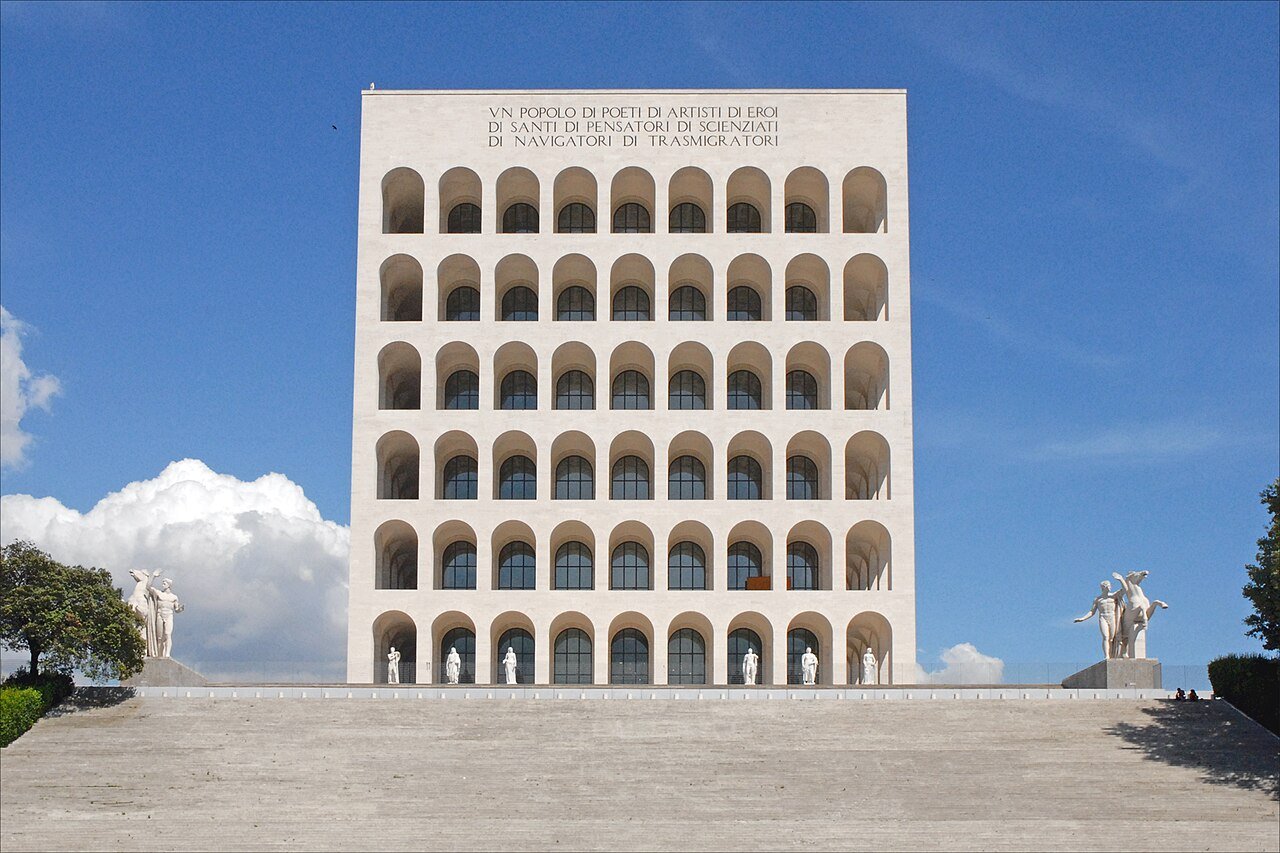
Rome holds two distinct and contradictory chapters of the CHO period: the exuberant eclecticism of the Quartiere Coppedè — the most fantastical Liberty ensemble in Italy — and the severe travertine geometry of EUR, Mussolini’s Rationalist showcase district, where the Colosseo Quadrato stands as the period’s most haunting monument.
At a glance
Rome was not a primary centre of Art Nouveau production — the city’s dominant aesthetic was historicism, and its ancient fabric imposed a conservatism on new construction. But two exceptions produced architecture of extraordinary intensity. The Quartiere Coppedè (1913–1927), designed entirely by Gino Coppedè in the Trieste-Salario neighbourhood, is a private urban experiment that merges Baroque, medieval, Liberty and vaguely Masonic imagery into a neighbourhood of 26 buildings around a single square — the most concentrated and bizarre Liberty environment in the world. The EUR district (Esposizione Universale Roma, planned from 1935 for a 1942 world fair that never took place) is the opposite extreme: stripped Classicism in white travertine, wide axial avenues and a rational urban plan that intended to demonstrate Fascist civilisation to the world. Its buildings remain among the most visually powerful examples of Italian Rationalism.
Key facts
- Country: Italy (Lazio)
- Key periods: Liberty romano (1900s–1920s); EUR / Razionalismo (1935–1943)
- Key figures: Gino Coppedè (1866–1927, Quartiere Coppedè); Marcello Piacentini (1881–1960, EUR master plan); Adalberto Libera (1903–1963, Palazzo dei Congressi)
- Essential sites: Quartiere Coppedè, Palazzo della Civiltà Italiana (EUR), Palazzo dei Congressi EUR (Libera), Foro Italico, Casina delle Civette
- Collections: Casina delle Civette (Villa Torlonia) houses Rome’s Liberty and stained-glass collection
History
Gino Coppedè was born in Florence in 1866 and trained as a decorator before developing an architectural practice that drew on every historical style simultaneously. His Quartiere Coppedè commission (1913) came from the landowner Società Anonima Edilizia Moderna and gave him almost complete freedom: what resulted was a private neighbourhood whose entrance arch, Piazza Mincio fountain, and surrounding apartment blocks mix Gothic crenellations, Baroque putti, Art Nouveau ironwork, Egyptian scarabs and Masonic symbols in a combination that no architectural movement claimed or could classify. Coppedè died in 1927 before the development was fully complete; the neighbourhood was lightly used for many decades but has been fully restored since the 1990s.
The EUR project began in 1935 under the direction of Marcello Piacentini and a committee of Italy’s leading Rationalist architects. The concept was a permanent exhibition quarter that would demonstrate Fascist modernity while incorporating Mussolini’s “eternal” ambitions in travertine and marble. The Palazzo della Civiltà Italiana (1940–1943, La Padula, Romano and Guerrini) — nicknamed the Colosseo Quadrato — is the most famous result: a six-storey rectangular block with 54 identical arched bays, inscribed with a sentence from a Mussolini speech and flanked by statues of labour. Adalberto Libera’s Palazzo dei Congressi (1938–1954, delayed by the war) represents a more subtle Rationalism: a cube of travertine topped by a concrete barrel vault that mediates between Roman precedent and international modernism.
What you see
The Quartiere Coppedè is reached by metro line A to Trieste, then a short walk to Piazza Mincio — the central square with the Fontana delle Rane (Frog Fountain) and the principal apartment buildings. The entrance arch that straddles Via Dora is the most photographed element: a Baroque-Liberty bridge connecting two buildings with a Medusa head at its keystone. The entire quarter is freely accessible at all times and takes about an hour to walk thoroughly.
EUR is served by metro line B (EUR Palasport or EUR Fermi). The Palazzo della Civiltà Italiana now houses the Fendi fashion house and is open for periodic cultural events; its travertine exterior can always be photographed from the street. The Palazzo dei Congressi (Piazza John F. Kennedy) is open for events. The Museo della Civiltà Romana (closed for renovation) and the Museo delle Arti e Tradizioni Popolari complete the district’s institutional offer. The Casina delle Civette at Villa Torlonia (Via Nomentana 70) is a must for Liberty enthusiasts: the eclectic hunting lodge built for Prince Giovanni Torlonia Jr. is now a museum of Liberty stained glass, with intact interiors from the 1910s.
Practical information
- Quartiere Coppedè: freely accessible; best visited morning or evening for lower pedestrian traffic
- EUR district: metro B (EUR Palasport/Fermi); fully walkable from either station
- Casina delle Civette: open Tue–Sun; villatorlonia.it
- Roma Pass: covers metro and museum admission
- Time needed: half-day for Coppedè; half-day for EUR; full day combining both
Getting there
Leonardo da Vinci – Fiumicino Airport (FCO) connects to Roma Termini by the Leonardo Express (32 min, €14) or by regional train FL1 (55 min, €8). Ciampino Airport (CIA) is served by bus to Termini (40 min). Metro line A (Trieste) reaches the Quartiere Coppedè; metro line B (EUR Palasport or Fermi) serves the Rationalist district directly.
Related in CHO
- Palazzo dei Congressi — EUR by Adalberto Libera (existing CHO card ID 2348)
- Torino — Liberty italiano
- Firenze — Razionalismo organico di Michelucci
Sources
Find it on the map
See this place and what’s around it →Record researched and written by Stefano Vigolo for Cultural Heritage Online, 2026.
Events here — now on & upcoming
- Death Anniversary: Marcello Piacentini — May 19, 196019 May 2027See the event →
- Death Anniversary: Adalberto Libera — March 17, 196317 Mar 2027See the event →
- Birth Anniversary: Mario Ridolfi — May 5, 190405 May 2027See the event →
- Death Anniversary: Mario Ridolfi — November 11, 198411 Nov 2026See the event →
📷 Become a Cultural Heritage Online photographer
Share your photos of places: they stay published under your name as the author. The more they're seen, the more you get noticed — and soon a contest will reward the most appreciated photos.
Log in or sign up free to add a photo