

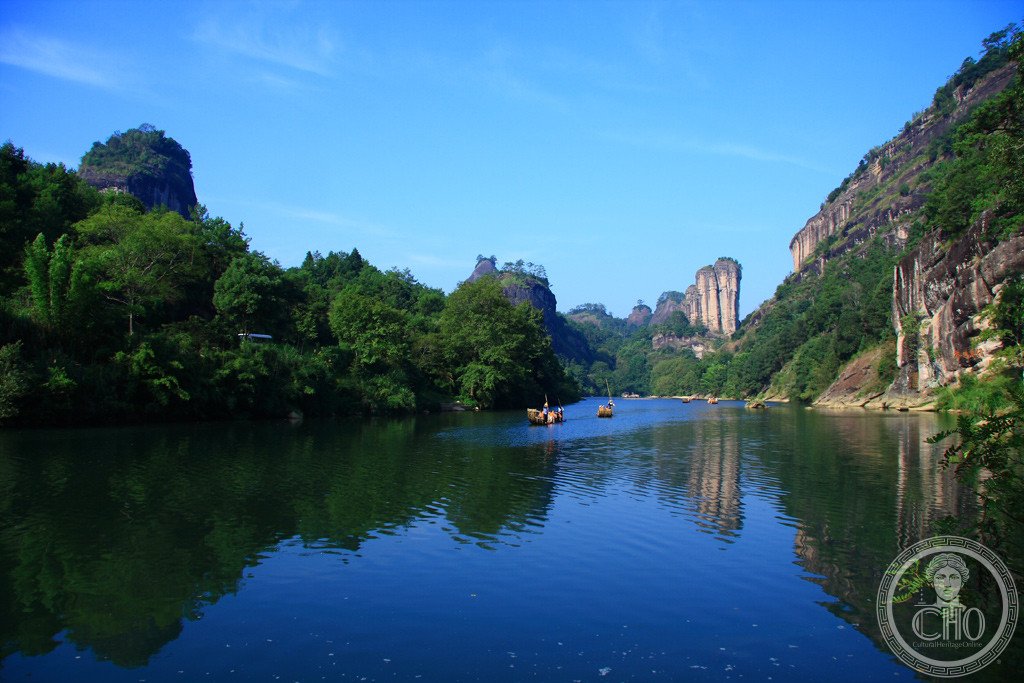
In northern Fujian, on the border with Jiangxi, the Wuyi Mountains rise over a landscape of red rock stacks and granite peaks wrapped in cloud, cut through by the Nine Bend River. A refuge of exceptional biodiversity — including endemic species among the rarest in southern China — and the seat of ancient Buddhist monasteries, Neo-Confucian academies and Bronze Age burial sites, the park has been a UNESCO World Heritage site since 1999 as a mixed cultural and natural site.
At a glance
Wuyi Mountains (Wuyishan) in northern Fujian province is one of China’s most important UNESCO inscriptions, recognised for both its natural and cultural value in 1999. The protected area covers 99,975 hectares of granite and red sandstone peaks, deep river valleys and ancient forests. The Nine-Bend River, famous for its scenic bamboo raft journeys, winds through the mountains between dramatic cliffs. The site is an outstanding biodiversity hotspot for subtropical forest species, and also contains cliff tombs from the Shang-Zhou period (c. 1000 BC), Neo-Confucian academies and Buddhist monasteries that made Wuyi a centre of Chinese philosophical thought.
Key facts
- UNESCO: World Heritage since 1999 (Wuyi Mountains, ref. 911bis)
- Area: 99,975 hectares in northern Fujian, bordering Jiangxi
- Highest peak: Mount Huanggang, 2,158 m
- Nine-Bend River: the scenic bamboo-raft river journey through the gorges
- Biodiversity: exceptional subtropical forest fauna including many species endemic to SE China
- Culture: cliff tombs (c. 1000 BC), Neo-Confucian academies, Buddhist temples
History
Human presence in the Wuyi Mountains dates back at least 3,000 years. The extraordinary “hanging coffins” — boat-shaped wooden coffins placed in cliff crevices — from the Shang-Zhou period remain a mystery of Bronze Age culture in south-eastern China. Buddhist monasteries began to appear from the Tang dynasty (7th–10th centuries); Wuyi became famous across China as a spiritual retreat. In the Southern Song dynasty (12th century) the philosopher Zhu Xi founded the Wuyi Academy at the foot of the mountains, where he developed the Neo-Confucian synthesis that would shape Chinese thought for centuries and spread to Korea and Japan.
The mountain was also the birthplace of Wuyi Rock Tea (Yancha), particularly Dahongpao (“Big Red Robe”), among the most prized oolongs in the world. UNESCO inscribed Wuyi in 1999 for both its natural biodiversity and its cultural depth — one of relatively few sites on the World Heritage list to qualify under all four cultural and two natural criteria.
What you see
The landscape of Wuyi is immediately dramatic: red-brown sandstone pillars and granite peaks rise from forested valleys, with mists and clouds that give the mountains a classic Chinese ink-painting quality. The Nine-Bend River (Jiuqu Xi) offers the iconic experience — a two-hour bamboo raft journey through ten km of gorges, past cliff faces bearing hanging coffins and ancient inscriptions.
On land, trails lead to the Wuyi Palace, Buddhist temples, and viewpoints over the peaks. In autumn the forests turn red and orange; in spring the mountains are veiled in mist. The ancient Wuyi Rock Tea gardens cling to cliff faces.
Practical information
- Base: Wuyishan city, reached by high-speed rail from Fuzhou and Xiamen
- Bamboo raft: Nine-Bend River scenic cruise; book in advance in peak season
- Best time: spring (March–April, misty) or autumn (October, foliage); summer is crowded
- Entry: national park admission required; scenic area tickets extra
Getting there
Wuyishan city has a high-speed rail station on the Hefei–Fuzhou line, reachable from Fuzhou (1 hr), Xiamen (2 hrs) and Shanghai (4 hrs). The scenic area is 15 km from the city centre; minibuses and taxis available. GPS: 27.72° N, 117.68° E.
Nearby
- Tulou Fujian — the UNESCO earthen communal houses of the Hakka and Hokkien people, 3 hrs south
- Fuzhou — Fujian’s provincial capital with Three Lanes and Seven Alleys historic district
- Longquan ceramics — Zhejiang province, just north, famous for celadon porcelain
Sources
- UNESCO World Heritage Centre — “Mount Wuyi” (ref. 911bis)
- Encyclopaedia Britannica — Wuyi Mountains
- China Cultural Heritage Administration — official documentation
Find it on the map
See this place and what’s around it →📷 Become a Cultural Heritage Online photographer
Share your photos of places: they stay published under your name as the author. The more they're seen, the more you get noticed — and soon a contest will reward the most appreciated photos.
Log in or sign up free to add a photo