
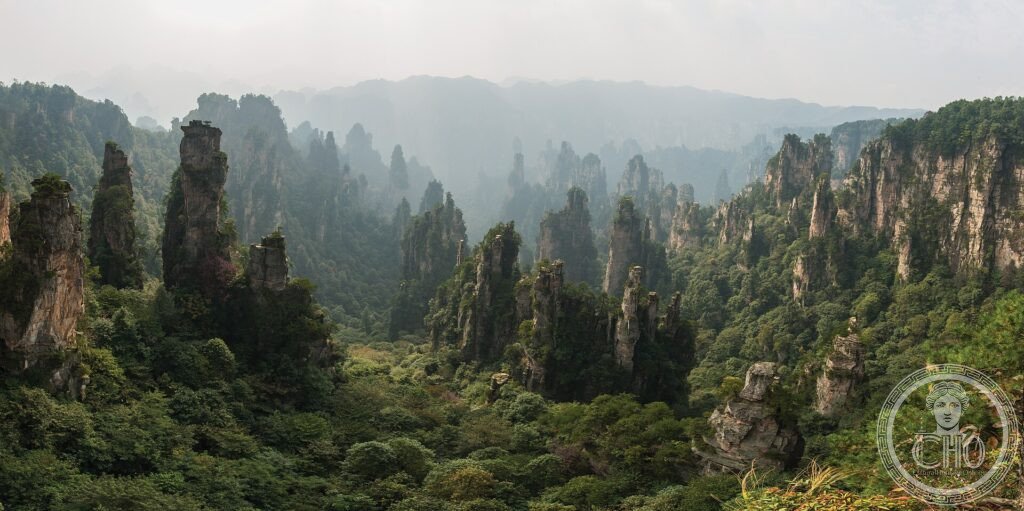
More than three thousand columns of quartzite sandstone rise, slender and immensely tall, out of a jungle of mist-wrapped valleys: this is Wulingyuan, in Hunan, a landscape so unreal that it inspired the floating mountains of the film Avatar. A vertical labyrinth of pinnacles, gorges, caves and waterfalls.
At a glance
Wulingyuan, in the Hunan province of south-central China, is a landscape of more than three thousand tall, slender pillars and peaks of quartzite sandstone, rising sheer from forested ravines often wrapped in mist. Among them run deep gorges, streams, caves and waterfalls, clothed in subtropical forest rich in wildlife. The otherworldly pillars helped inspire the floating mountains of the film “Avatar”. This spectacular natural site was inscribed by UNESCO in 1992.
Key facts
- UNESCO: World Heritage since 1992 (Wulingyuan)
- 3,000+ pillars: tall quartzite-sandstone columns and peaks
- Zhangjiajie: the best-known scenic area within Wulingyuan
- Gorges and caves: deep ravines, karst caves and waterfalls
- Subtropical forest: rich plant and animal life on the pillars
- “Avatar” mountains: the pillars inspired the film’s floating peaks
History
The pillars of Wulingyuan were formed over hundreds of millions of years as rivers cut down through a thick bed of quartzite sandstone, leaving isolated columns that weathering and plant roots sharpened into the forest of spires seen today. Long the home of Tujia and other peoples, the area was remote and little developed.
Recognised for its extraordinary geology and biodiversity, Wulingyuan was protected and inscribed by UNESCO in 1992. The Zhangjiajie scenic area within it became one of China’s most popular natural attractions, its fame spreading worldwide after the pillars were said to have inspired the landscapes of “Avatar”.
What you see
Trails, cable cars and a glass-floored bridge lead among the pillars: viewpoints look out over forests of stone spires emerging from the mist, the tallest soaring over 300 m. Deep gorges such as the Golden Whip Stream wind below, and karst caves like Yellow Dragon Cave open in the rock.
The sea of pillars rising from cloud, especially after rain, is the unforgettable sight of Wulingyuan.
Practical information
- Park: entry ticket; cable cars, lifts and a glass bridge aid access
- Time needed: two or more days for the main scenic areas
- Note: very popular; the pillars are best with morning mist
- Setting: in north-western Hunan
Getting there
Wulingyuan is in north-western Hunan, China, near Zhangjiajie city, which has rail and air links. The scenic areas are reached by road from Zhangjiajie. GPS: 29.34° N, 110.48° E.
Nearby
- Tianmen Mountain — a peak with a cliff cableway and the Heaven’s Gate arch
- Tujia villages — the homeland of the Tujia people
- Fenghuang — an old riverside town to the south
Sources
- UNESCO World Heritage Centre — “Wulingyuan Scenic and Historic Interest Area” (ref. 640)
- Wulingyuan / Zhangjiajie administration — official body
- Encyclopaedia Britannica — Wulingyuan
Find it on the map
See this place and what’s around it →📷 Become a Cultural Heritage Online photographer
Share your photos of places: they stay published under your name as the author. The more they're seen, the more you get noticed — and soon a contest will reward the most appreciated photos.
Log in or sign up free to add a photo