
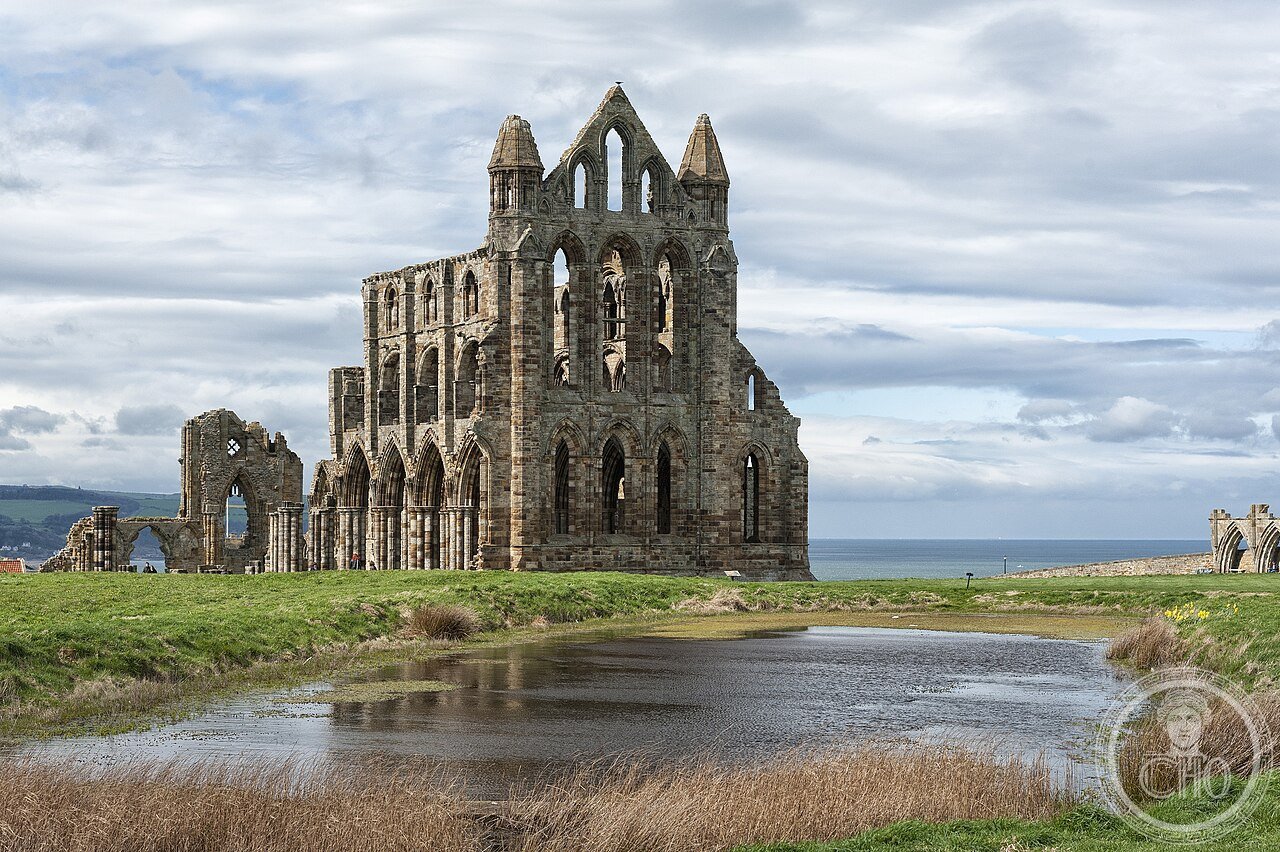
Nel 664, l’abbazia di Whitby ospitò un sinodo che decise se l’Inghilterra avrebbe seguito la tradizione cristiana celtica o quella romana: prevalse Roma, cambiando per sempre il corso della storia religiosa inglese. Nella stessa abbazia, un umile guardiano di animali di nome Caedmon compose in sogno il più antico poema sopravvissuto in lingua inglese antica. Distrutta dai vichinghi nell’870 e poi soppressa nel Cinquecento, le sue rovine gotiche affascinarono nel 1890 lo scrittore Bram Stoker, che vi trovò l’ispirazione per l’approdo della nave Demeter nel suo romanzo Dracula.
About Whitby Abbey
Whitby Abbey was founded in 657 by Oswy, King of Northumbria, with Hilda of Whitby installed as its first abbess, quickly establishing itself as one of the most important early English monasteries. In 664, Hilda hosted and presided over the Synod of Whitby, a pivotal ecclesiastical council convened to resolve whether the Christian communities of Britain would follow the Celtic or the Roman tradition, particularly regarding the calculation of the date of Easter; although Hilda herself favoured the Celtic tradition, the final decision rested with King Oswiu, who opted for the Roman tradition — a choice that fundamentally altered the subsequent course of English religious history. During Hilda’s abbacy, the monastery also became the setting for one of the foundational moments of English literature: according to the 8th-century historian Bede, a herdsman named Caedmon, who cared for the animals at Whitby’s double monastery and had no prior training in composing verse, received the gift of song in a vision one night, producing what is known today as Caedmon’s Hymn — the oldest surviving poem in Old English. The abbey’s early prosperity ended violently when the Great Heathen Army of Danish Vikings invaded Northumbria in 866; Whitby Abbey was raided and sacked in 867 and finally destroyed in 870. The site was later refounded as a Benedictine abbey in the Norman period, and its extensive Gothic ruins, visible today on the East Cliff above Whitby harbour, became famous far beyond their religious history when the Irish writer Bram Stoker visited the town in 1890. While in Whitby, Stoker encountered an 1820 book recounting the story of the 15th-century Wallachian prince Vlad Tepes, known as Dracula, and drew directly on a local shipwreck story for the arrival of the ship Demeter in his 1897 novel “Dracula,” permanently linking the abbey’s atmospheric ruins to one of the most famous works of Gothic horror fiction ever written.
Key facts
- 657: founded by King Oswy of Northumbria, with Hilda as first abbess
- 664: hosts the Synod of Whitby, deciding England would follow Roman Christian tradition
- 7th century: Caedmon composes the oldest surviving Old English poem at the abbey
- 867/870: abbey sacked and destroyed by Viking raids
- Norman period: abbey refounded as a Benedictine house
- 16th century: dissolved during Henry VIII’s Dissolution of the Monasteries
- 1890: Bram Stoker’s visit inspires key scenes in “Dracula” (1897)
History
The Synod of Whitby’s 664 decision to align England with Roman rather than Celtic Christian practice ranks among the most consequential ecclesiastical decisions in early English history, shaping the religious, calendrical, and institutional development of the English Church for centuries afterward — making the abbey the physical setting of a genuinely pivotal turning point in national religious history. Caedmon’s Hymn, composed at Whitby under Hilda’s abbacy, holds a similarly foundational place in English literary history as the oldest surviving poem in the English language, connecting the abbey directly to the very origins of English-language literary composition.
The abbey’s later reinvention as a source of Gothic literary inspiration, through Bram Stoker’s 1890 visit and subsequent use of Whitby’s harbour and clifftop ruins in “Dracula,” gave the site an entirely new cultural afterlife centuries after its religious and monastic functions had ended — a rare case of a medieval ecclesiastical ruin becoming central to the origin story of a major work of modern popular fiction.
What you see
The abbey’s Gothic ruins, dominated by the surviving skeletal remains of the choir and north transept, stand prominently on the East Cliff overlooking Whitby harbour and the North Sea, their dramatic silhouette visible for miles along the coast. The 199 steps leading up from the town to the abbey remain a well-known local landmark, connecting Whitby’s harbourside to the clifftop ruins that inspired Stoker’s fiction.
Practical information
- Opening hours: generally open daily with seasonal variation; check current hours before visiting; admission fee applies
- Address: Church Lane, Whitby, North Yorkshire YO22 4JT, United Kingdom
Getting there
Whitby Abbey is located on the East Cliff above the town of Whitby, North Yorkshire, reachable via the town’s famous 199 steps or by road. GPS: 54.4876° N, -0.6066° E.
Nearby
- Whitby harbour — the historic fishing port below the abbey
- 199 Steps — the famous stairway connecting the town to the abbey
- St Mary’s Church, Whitby — the parish church adjacent to the abbey ruins
Sources
- World History Encyclopedia — “Hilda of Whitby” (worldhistory.org)
- English Heritage — “How Dracula Came to Whitby” (english-heritage.org.uk)
- Wikipedia — “Whitby Abbey” (en.wikipedia.org)
Find it on the map
See this place and what’s around it →📷 Become a Cultural Heritage Online photographer
Share your photos of places: they stay published under your name as the author. The more they're seen, the more you get noticed — and soon a contest will reward the most appreciated photos.
Log in or sign up free to add a photo