
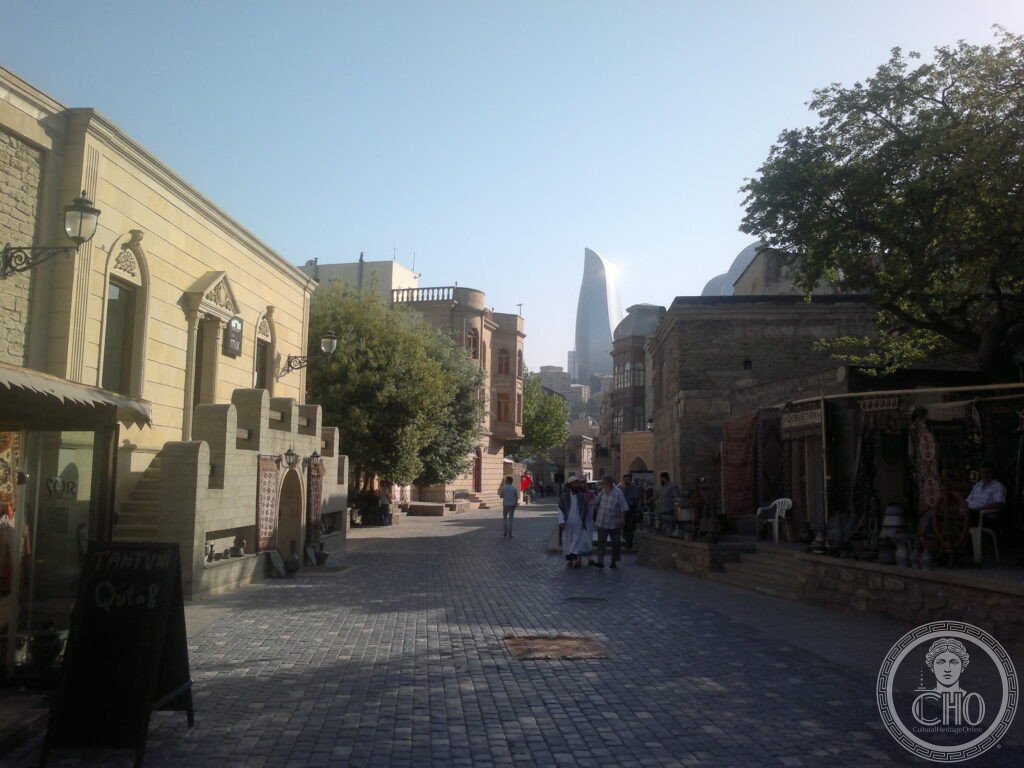
The most unexpected UNESCO World Heritage Site in the Caucasus and the medieval core of a 21st-century oil-boom metropolis. The İçəri Şəhər (Inner City) of Baku, a medieval walled city of labyrinthine limestone lanes on a rocky Caspian shore, preserves the Palace of the Shirvanshahs (the most accomplished example of medieval Caucasian Islamic architecture) and the Maiden Tower (whose original purpose, 1,000 years after construction, remains a genuine archaeological mystery, making it one of the most intriguing monuments in the world).
At a glance
The Walled City of Baku with the Shirvanshah’s Palace and Maiden Tower (UNESCO WHS 2000; the inscribed zone covers the İçəri Şəhər (the “Inner City”; approximately 22 hectares; population approximately 2,000 permanent residents; the walled city is surrounded by the modern Baku city centre and by the Caspian Sea boulevard) on the Absheron Peninsula of Azerbaijan, on the western shore of the Caspian Sea) was a continuously inhabited urban settlement from at least the 7th–8th century AD. Baku (the capital of Azerbaijan; population approximately 2.2 million in the city, 3.5 million in the greater metropolitan area; the largest city on the Caspian Sea) is simultaneously one of the most ancient and one of the most newly wealthy cities in Eurasia. The medieval stone city of the Shirvanshah dynasty and the extraordinary post-2000 oil-boom architecture (the Flame Towers (three skyscrapers shaped as flames with LED facades that display animated flame patterns at night); the Heydar Aliyev Centre (the Zaha Hadid building (2012; the most celebrated piece of contemporary architecture in Azerbaijan; a flowing white concrete and glass building without any sharp angles or visible joints); the Crystal Hall (the modern concert venue built for Eurovision 2012)) represent the same duality of ancient and ultra-modern that characterises Dubai and Abu Dhabi, but with a much longer and more complex historical foundation).
Key facts
- The Maiden Tower: the most mysterious medieval monument in the Caucasus. The Maiden Tower, Qız Qalası, is a cylindrical stone tower 29.5 m high and 16.5 m across, of 8 storeys, built in the 12th century — though the date is contested: a 12th-century inscription runs on the exterior, while the substructure may be older, 7th–8th century or even 4th–5th. What it was for is the real puzzle, and no medieval source says. Four explanations are offered. A lighthouse: the tower stands on a promontory above the Caspian and was the tallest structure in the medieval city, so a fire at the top would have been visible far out to sea. A Zoroastrian fire temple: the Absheron Peninsula was the heartland of Zoroastrianism in the ancient world, the “eternal fires” of natural gas seeping from the ground were sacred, and the tower may have been raised to hold such a fire above the sea. An astronomical observatory: the corbelled gallery at the top aligns with certain astronomical phenomena, a theory put forward by Azerbaijani archaeologists and not universally accepted. A defensive tower: this is the common popular answer, and the design is clearly defensive — walls 5 m thick, a single ground-floor entrance, the corbelled overhang above — but defensive against what is unclear, since the tower stands apart from the city walls and could never have served as a keep in the usual sense. The strongest reading remains a pre-Islamic sacred site, given the Zoroastrian past of the peninsula and how badly the tower’s form fits any strictly practical use.
- The Palace of the Shirvanshahs: the finest medieval Islamic palace complex in the Caucasus. The Palace of the Shirvanshahs, in the İçəri Şəhər, was built mainly in the 15th century under Shirvanshah Ibrahim I, r. 1382–1417, and his successors. The Shirvanshahs ruled Shirvan — the land of what is now northern Azerbaijan and part of southern Russia — from approximately 800 AD to 1538 AD: the longest continuously reigning dynasty in the Caucasus and one of the longest anywhere in the Islamic world. The main residence, the Upper Palace, is a courtyard building of dressed limestone with a carved entrance portal of geometric and vegetal decoration. The finest single building is the Divan Khane, the court of justice: a separate octagonal pavilion in the courtyard, open, with carved stone lattice screens and a dome on a drum, used for judicial proceedings and public audiences. The Mausoleum of the Shirvanshahs holds the burials of the rulers and their families, behind the finest carved portal in the complex, a muqarnas hood moulding cut in limestone. The Kichik Qala Mosque, 15th century, is the only mosque to survive inside the palace walls. There is a Palace Bath, a traditional hammam with a hypocaust — the Roman and Islamic system of underfloor heating, hot air circulating beneath the raised floor. And beside the palace stands the Karvansaray, the merchants’ inn, the only one left in the İçəri Şəhər.
- Oil and the Absheron Peninsula: the oldest oil production in the world and the city that funded it all. The Absheron Peninsula has natural oil seeps, where petroleum works its way up through cracks in the rock to the surface. The same phenomenon produced the eternal fires of Yanar Dağ, Burning Mountain, 25 km north of Baku: a hillside where methane seeps continuously from the ground and has burned for thousands of years, and one of the sacred sites of Zoroastrianism — the “eternal fire” the Zoroastrians worshipped for millennia was a gas seep of this kind. The oil itself was used in antiquity for lamps, for waterproofing and as medicine, and the first industrial wells, hand-dug and some still visible around the city, date to approximately the 8th–9th century AD: the oldest industrial oil extraction in the world, approximately 1,000 years before the Pennsylvania rush. The modern era began in 1876, when the Nobel Brothers Petroleum Company — Alfred Nobel’s brothers Robert and Ludvig — founded the first mechanised extraction company here, and by 1900 Baku was producing approximately 50% of the world’s oil. That money paid for the Nobel Prize: Alfred Nobel had invented dynamite in 1867, stabilising nitroglycerin in diatomaceous earth, but the family fortune came chiefly from the Baku oil fields and not from dynamite.
- Heritage: UNESCO World Heritage Site, Walled City of Baku with the Shirvanshah’s Palace and Maiden Tower, inscribed 2000.
- GPS: 40.3657° N, 49.8357° E.
History
Ancient Caucasian Albania and early Zoroastrian sacred sites (the eternal fires and the Ateshgah Fire Temple). Arab conquest (642 AD; Baku was captured by the Arab army of Salman ibn Rabi’a; the Absheron Peninsula became part of the Arab Caliphate). The Shirvanshah dynasty (c. 800–1538; the longest-ruling dynasty in the Caucasus; the construction of the walled city (İçəri Şəhər) and the Palace). Mongol conquest (1239; the Ilkhanate; Baku under Mongol suzerainty). The Kara Koyunlu and Aq Qoyunlu Turkmen states (14th–15th century; the Shirvanshahs maintained autonomy under Turkmen suzerainty). Safavid Persian conquest (1538; Shah Tahmasp I captured Baku and destroyed the Shirvanshah dynasty; the palace was looted and subsequently used as a military fortress and powder magazine by the Persians and later the Russians). Russian conquest (1806; during the Persian-Russian wars; the Baku Khanate was annexed by Russia; the construction of the Russian-period outer city). The oil boom (1871–1920; the industrialisation of the oil fields; Baku became the most important oil city in the world by 1900). Soviet period (1920–1991; the Soviet takeover of the Azerbaijan Democratic Republic; the state oil company Socar; Baku as the oil capital of the Soviet Union). Azerbaijani independence (1991). Post-independence oil boom (2003–present; the construction of the modern Baku skyline; UNESCO WHS 2000).
What you see
Enter the İçəri Şəhər by the main Şəhər Darvazası gate on the west side. The medieval street grid is narrow and labyrinthine, and the streets twist in ways that make navigation without a map difficult — which is deliberate, since the layout of a medieval Islamic city is built around privacy. The Maiden Tower can be climbed to the top by an internal spiral staircase, and from the corbelled gallery you see the Caspian, the oil platforms offshore, the rooftops of the old city below, Baku Bay and the modern skyline. The Palace of the Shirvanshahs deserves 1h 30 min: the Divan Khane, the Mausoleum portal, the Palace Bath, and the Palace Museum in the main residence. The Caravanserai-hotels: two surviving karvansarays inside the walls have become hotels and restaurants, and dinner in a 15th-century merchants’ court is the most atmospheric meal in Baku. Outside the walls, take the Metro to Nariman Narimanov for the Heydar Aliyev Centre by Zaha Hadid: the exterior for the building, the museum inside for the context of Azerbaijani history.
Practical information
- Getting there: Heydar Aliyev International Airport (GYD; 25 km north-east of the city centre; Metro Line 1 (Kəhrib/İçəri Şəhər direction) → İçəri Şəhər station (directly adjacent to the walled city); taxi approximately AZN 20–30 (EUR 11–17)). Direct flights from most major European hubs (Turkish Airlines via Istanbul; Fly Dubai via Dubai; Azerbaijan Airlines direct to London, Paris, Frankfurt, Istanbul, Moscow, Dubai; Pegasus; Flydubai). The Baku Metro (clean; fast; approximately EUR 0.30 per journey; the İçəri Şəhər station is the most architecturally significant on the network — a Soviet-era marble-and-mosaic station designed as a museum of ancient Azerbaijani history and handicrafts).
- The Caspian seafront promenade (Bulvar): the finest urban promenade in the Caucasus. The Baku Boulevard, the Bulvar, runs 3.5 km of pedestrian promenade along the Caspian waterfront, from Neftçilər Avenue, the Oil Workers’ Avenue, to National Flag Square, where the flagpole stands 162 m and was the third-tallest in the world when it went up in 2010. From it you look out on the sea, the oil rigs offshore and the green water: the Caspian is not a sea but a lake, the largest in the world, with no outlet, and its salinity is approximately one-third that of the ocean. Along the way stands the State Museum of Azerbaijan Carpets, the most important of its kind anywhere, with 10,000 carpets, in a building Franz Janz designed in 2014 in the shape of a rolled carpet. The Flame Towers are best seen from the Promenade: the LED flame show begins at 8pm and runs until midnight.
- Gobustan National Park and the mud volcanoes: UNESCO WHS 20,000-year-old rock art and 300 active mud volcanoes within 1h of Baku. Gobustan, UNESCO WHS 2007, lies 65 km south of Baku and holds the largest collection of prehistoric rock carvings in the Caucasus: approximately 6,000 petroglyphs of hunting, boats, rituals and animals, dated approximately 5,000–40,000 BCE. The most important is a large boat with oarsmen, approximately 10,000 BCE, one of the oldest known representations of a sea-going vessel anywhere. A Roman inscription of the 1st century AD records that the XIIth Fulminata Legion was stationed here under Emperor Domitian. The other marvel is the mud volcanoes. Approximately 300 are active in the Gobustan and Absheron area, the largest concentration on Earth: of approximately 700 in the world, 300 are in Azerbaijan. They are cold — the mud sits at the temperature of the surrounding air — and have nothing to do with volcanic heat, rising instead on methane and water pressure from deep underground. The mud erupts slowly, and now and then the gas ignites by itself and burns briefly across the surface. The most spectacular is Lökbatan, which last erupted in flame in 2001.
Getting there
Baku Airport (25 km; Metro to İçəri Şəhər station or taxi EUR 11–17). Direct flights from most of Europe via Istanbul or Dubai. GPS: 40.3657, 49.8357.
Nearby
- Ateshgah (Fire Temple of Baku). 25 km north-east of Baku (40 min by car; Bus 184 from 20 Yanvar Metro). The Zoroastrian, Hindu, and Sikh fire temple at the eternal gas flame. The Ateshgah — Atəşgah, “home of fire” in Azerbaijani — is a pentagonal courtyard temple raised over a natural gas seep in the 17th–18th centuries, built mainly by the Indian merchants of the Baku-based Hindu trading community, the South Asian traders of the city. They brought their own religion with them and built around the eternal fire, which they identified with the Hindu fire god Agni, and the temple carries inscriptions in Persian, Arabic, Sanskrit and Punjabi, the last in Gurmukhi script left by Sikh pilgrims. The flame on the central altar went out in 1883, when the gas pressure underground dropped, and a pipeline was laid to restore it: what burns there now is fed by that pipe, not by the seep. It is the most unusual religious building in the Caucasus, serving three different religions at once.
- Sheki. 380 km north-west of Baku (4h 30 min by train or road; the most important historic city in the Azerbaijan interior). The finest 18th-century Khanate palace in the Caucasus and the silk-road city of the mountains. Sheki (Şəki; UNESCO WHS 2019; the Palace of the Sheki Khans (1762; the most extraordinary small palace in the South Caucasus; a two-storey wooden palace with 5,800 coloured glass panes (şəbəkə: the Azerbaijani interlocking wooden grid framework that holds the coloured glass; the frames are assembled without nails or glue — only wooden joinery; the light effect inside the palace when the sun comes through the multicoloured glass is extraordinary); the palace walls covered with miniature frescoes; the UNESCO inscription covers the palace, the old city caravanserai (a 2-storey brick karvansaray), and the surrounding historic neighbourhood)).
- Lahıc. 160 km north-west of Baku (2h 30 min by road). The most authentic medieval craft village in Azerbaijan. Lahıc, or Lahij, is a mountain village at approximately 1,200 m in the southern foothills of the Greater Caucasus, reached from the main road by 18 km of serpentine mountain driving, where the Azerbaijani copper craft — mis işi, “copper work” — has been practised without interruption for at least 700 years. Approximately 200 households live here, almost all of them making hand-hammered copper: bowls, kettles, trays, jugs, candlesticks and decorative plates, each chased and engraved with the geometric and floral patterns of the Lahıc style. The copper bazaar runs along the central street, lined with small workshops where the artisans work in full view, the sound of hammering carries through the whole village together with the smell of hot copper and smoke, and it is the most authentic traditional craft experience in Azerbaijan.
Sources
- Wikipedia, İçəri Şəhər. Maiden Tower, Baku. Palace of the Shirvanshahs, accessed June 2026.
- UNESCO, Walled City of Baku with the Shirvanshah’s Palace and Maiden Tower, WHS reference 958, inscribed 2000.
- Audrey Altstadt, The Azerbaijani Turks: Power and Identity Under Russian Rule, Hoover Institution Press, 1992.
Find it on the map
See this place and what’s around it →📷 Become a Cultural Heritage Online photographer
Share your photos of places: they stay published under your name as the author. The more they're seen, the more you get noticed — and soon a contest will reward the most appreciated photos.
Log in or sign up free to add a photo