
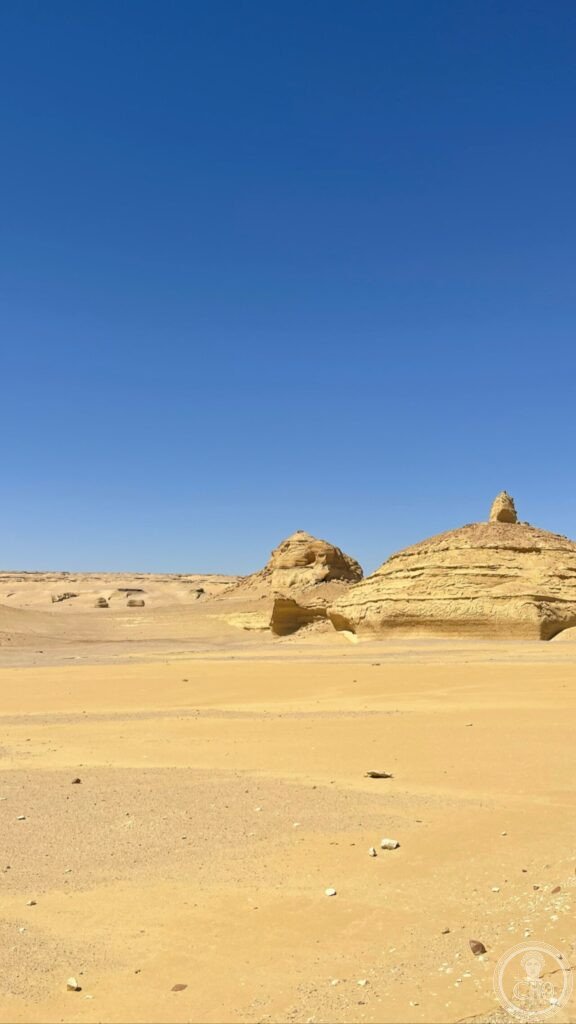
In the Western Desert south-west of Cairo, a stretch of Eocene seabed holds the skeletons of whales that still had legs. Wadi Al-Hitan preserves the fossil record of the transition from land to sea in one place, left largely where it was found, on open desert sand.
At a glance
Wadi Al-Hitan lies in a remote section of the Western Desert where wind has stripped away younger rock to expose sandstone and limestone laid down when this was the floor of the ancient Tethys Sea, some 37 to 40 million years ago. The eroded ridges and pale sand now hold the bones of early whales, bleached white against the desert floor, with the shallow lake of Birket Qarun visible far off on the horizon.
The centrepiece is the archaeocete Basilosaurus isis, a serpentine predatory whale up to 15 to 18 metres long, whose skeleton at Wadi Al-Hitan retains small hind limbs, complete with a femur, tibia, fibula and three-toed feet. Those limbs, too small to have supported any weight on land, are among the clearest physical evidence that whales descend from land-dwelling mammals.
Key facts
- Significance: the site is regarded as the world’s foremost location for understanding whale evolution from terrestrial mammals to fully marine creatures.
- Key species: Basilosaurus isis and Dorudon atrox, both archaeocetes, with fossils of young Dorudon suggesting the area may have served as a calving ground.
- The 1989 discovery: Philip Gingerich of the University of Michigan, excavating from 1983 onwards, uncovered a Basilosaurus skeleton with vestigial hind limbs still articulated, confirming a transitional form Darwin had predicted in On the Origin of Species.
- Evolutionary link: the closest living relative of whales is the hippopotamus, part of the even-toed ungulate group from which whales descended; the shift from the early Pakicetus to the fully marine Basilosaurus is thought to have taken around 15 million years.
- Coordinates: 29.2667° N, 30.0167° E.
History
The fossil beds were first scientifically recorded in 1902 by the British geologist Hugh John Llewellyn Beadnell, working for the Egyptian Survey Department, who published his description in 1904; the Basilosaurus remains were initially mistaken for those of sea reptiles. In the following decades, institutions including the Natural History Museum in London and the American Museum of Natural History collected specimens, many of which left Egypt.
Systematic excavation resumed under Philip Gingerich of the University of Michigan from 1983, continuing into the 2000s with interruptions tied to diplomatic relations. From the 1990s the Egyptian authorities and Gingerich’s team adopted a policy of leaving significant new finds in place, turning the desert floor into what is effectively an open-air museum. The site was nominated for UNESCO World Heritage status and inscribed in 2005, a notably rapid process reflecting broad scientific consensus on its importance.
Wadi Al-Hitan sits within the wider Fayoum Oasis, inhabited since Neolithic times and once the site of Lake Moeris, a freshwater body used for irrigation under Pharaoh Amenemhat I around 1970 BCE. Its modern remnant, Birket Qarun, is now saline and supports no fish, though it draws flamingos.
What you see
The Wadi Al-Hitan Fossil and Climate Change Museum, opened in 2016 and designed by the Egyptian architect Raef Fahmi, marks the entrance to the site and was built with a deliberately light environmental footprint; it won the Aga Khan Award for Architecture the same year. Inside, around 200 fossils are displayed, including complete Basilosaurus and Dorudon skeletons mounted in their natural positions, alongside an account of Eocene climate, when the sea stood far higher and the region was considerably warmer than it is now.
From the museum, a marked trail of some eight kilometres leads out across unpaved desert, passing roughly forty skeletons exposed in situ, including the largest known Basilosaurus at the site. Wind-carved sandstone outcrops known locally for their mushroom-like shapes rise along the route, formed as softer rock at the base eroded faster than the harder caps above. A limited number of camping permits allow visitors to spend a night in the desert here.
Practical information
- Access: a park ranger guide accompanies visitors along the fossil trail, since the route between exposed skeletons needs explanation.
- Admission and hours: current entrance fees and opening times are best checked directly with the site’s official visitor channels before travelling.
- Terrain: the desert trail is unpaved; sturdy footwear and sun protection are advisable given the exposed setting.
- Where to stay: most visitors base themselves overnight in Fayoum town or at Tunis Village rather than attempting the trip from Cairo in a single day.
Getting there
Wadi Al-Hitan lies south-west of Cairo, reached via the Desert Road into the Fayoum region; the final stretch of the approach is unpaved track, so a four-wheel-drive vehicle is essential, and many visitors arrange a driver or join an organised tour from Cairo rather than self-driving.
Nearby
- Fayoum City and Birket Qarun — the oasis town and its saline lake, a remnant of the ancient Lake Moeris.
- Lahun Pyramid — the Middle Kingdom pyramid complex of Senusret II, of the 12th Dynasty, notable for its elaborate, deliberately confusing burial chamber passages; finds from nearby royal tombs are held in the Cairo Museum.
- Fayoum portraits sites — the Greco-Roman period produced painted mummy portraits associated with this region, now held in museum collections.
- Tunis Village — around 40 km from Wadi Al-Hitan, an arts colony of potters and small guesthouses founded by the Swiss ceramicist Evelyne Porret in the 1970s.
Sources
- UNESCO
- University of Michigan
- Aga Khan Award for Architecture
- Natural History Museum, London
- American Museum of Natural History
- Charles Darwin, On the Origin of Species
Find it on the map
See this place and what’s around it →📷 Become a Cultural Heritage Online photographer
Share your photos of places: they stay published under your name as the author. The more they're seen, the more you get noticed — and soon a contest will reward the most appreciated photos.
Log in or sign up free to add a photo