
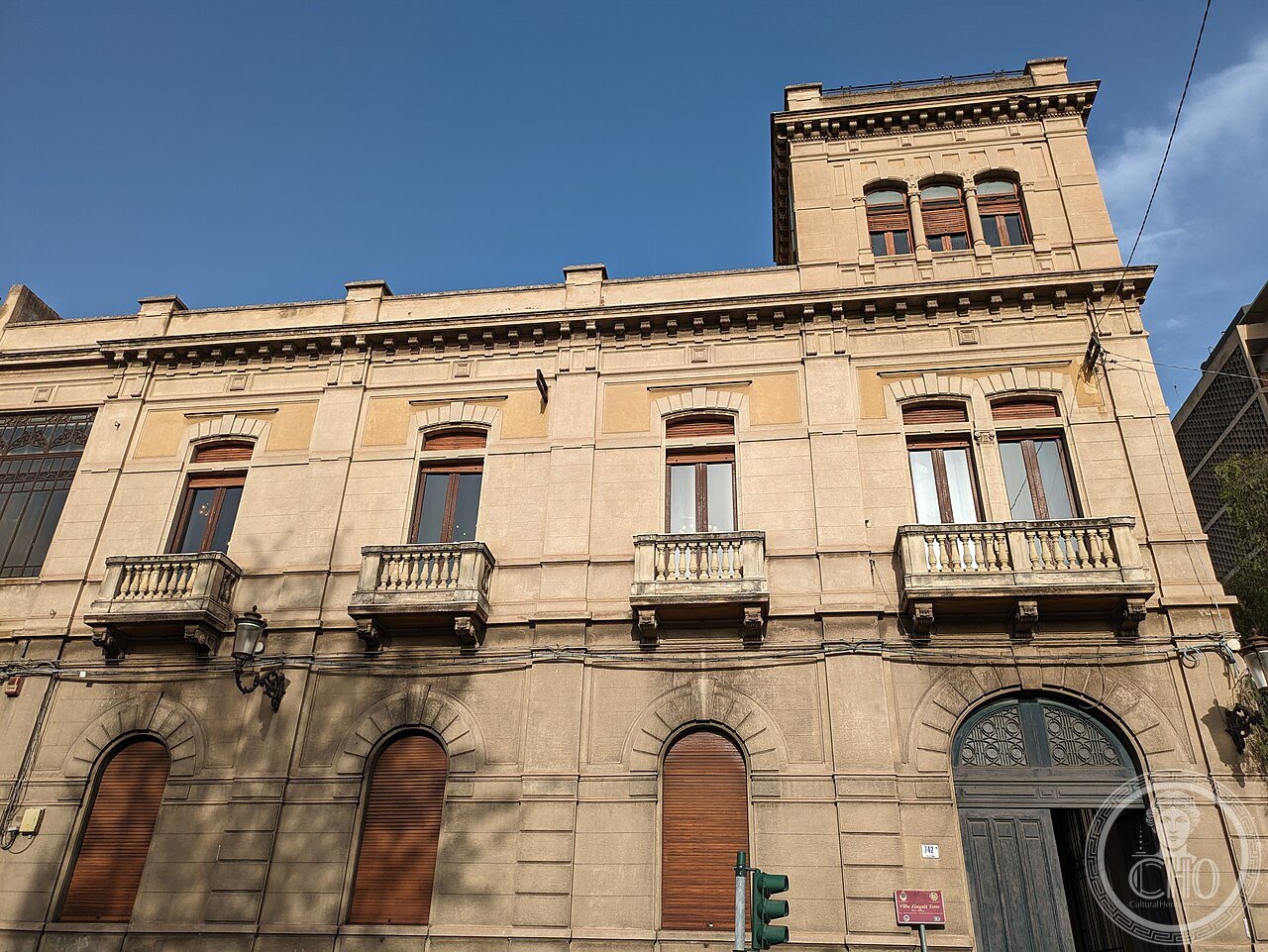
A lawyer’s winter garden near the top of Via Etnea, where Paolo Lanzerotti gave Catanese Liberty one of its last flourishes.
At a glance
Toward the northern end of Via Etnea, where the avenue climbs out of the city centre, Villa Zingali Tetto stands as one of the last and most complete works of Liberty architecture in Catania. The lawyer Paolo Zingali Tetto commissioned it, and the architect Paolo Lanzerotti (1875–1944) designed both the house and its garden, working in the second half of the 1920s. After restoration the villa became the Museo della Rappresentazione of the University of Catania, which keeps the Francesco Fichera Fund of architectural drawings together with a major collection of Piranesi etchings.
Key facts
- Architect: Paolo Lanzerotti (1875–1944)
- Built: commissioned 1926, completed in the late 1920s
- Commissioned by: the lawyer Paolo Zingali Tetto
- Style: Liberty (Italian Art Nouveau)
- Address: Via Etnea 742, Catania
- Now: Museo della Rappresentazione, University of Catania
History
By the late 1920s the Liberty wave that had reshaped Catania in the first decade of the century was already giving way to rationalism. Lanzerotti, who had spent thirty years designing villas and shopfronts across the city, built this house for a private client at the moment the style was passing. It reads as a summary of everything Catanese Liberty had learned: the eclectic plan, the decorative programme that runs from the gates to the ceilings, the garden treated as part of the architecture.
The villa passed to the University of Catania, which restored it and opened it as the Museo della Rappresentazione, the museum of architectural drawing. The choice was fitting: the rooms that Lanzerotti decorated now hold Fichera’s architectural drawings and a collection of eighteenth-century Piranesi etchings, so the Liberty villa preserves the record of the city’s design history.
What you see
The set piece is the winter garden, whose stained glass by Salvatore Gregoretti throws floral patterns of green, blue and red across the floor on a sunny afternoon. Gaetano D’Emanuele executed the floors and ceilings, and the Salone delle Feste keeps its period frescoes and trompe-l’oeil mosaics.
Original wooden boiserie survives in the dining room, and the lawyer’s study retains its fireplace and desk. Outside, the garden holds an ornamental basin and an artificial grotto, the kind of staged nature that Liberty designers liked to set against their geometric interiors.
Practical information
- Run as a university museum; opening hours follow the academic calendar, so check before visiting.
- Allow about 45 minutes for the rooms and the drawings collection.
- The garden and winter garden are the highlights; visit on a bright day for the glass.
Getting there
The villa sits at Via Etnea 742, in the Borgo district north of the centre. Buses run the length of Via Etnea from Piazza Stesicoro; on foot it is a steady uphill walk of about half an hour from Catania Centrale station.
Nearby
- Giardino Bellini, the city’s historic public garden, further down Via Etnea
- Palazzo delle Poste, Fichera’s post office beside the garden
Sources
- Museo della Rappresentazione, University of Catania – museorappresentazione.unict.it
- “Liberty a Catania”, Wikipedia (it)
Find it on the map
See this place and what’s around it →Record researched and written by Carla Szathvary for Cultural Heritage Online, 2026.
📷 Become a Cultural Heritage Online photographer
Share your photos of places: they stay published under your name as the author. The more they're seen, the more you get noticed — and soon a contest will reward the most appreciated photos.
Log in or sign up free to add a photoIs this page about you?
This page is read by travellers and heritage enthusiasts who find it on Google. Tell us how you are connected to this place and we will take it from there.