
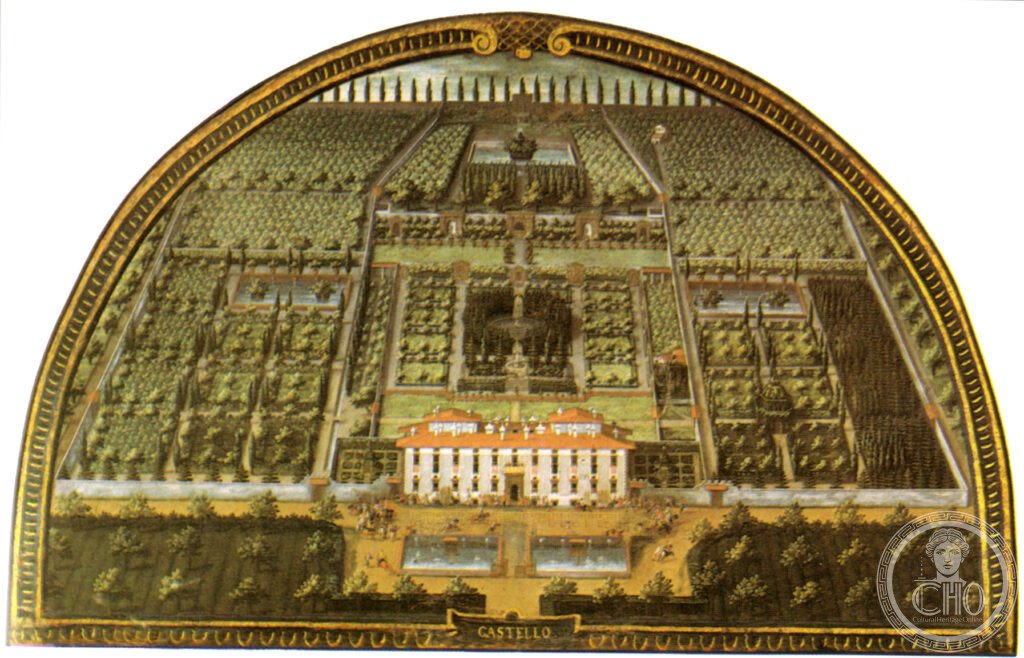
Two Medici country properties on the hills above Florence preserve the most complete surviving ensemble of a sixteenth-century Medici garden, from Tribolo’s symbolic planting scheme at Castello to the terraced garden and Giambologna’s bronze Venus at La Petraia.
At a glance
Villa La Petraia and Villa di Castello stand a short walk apart in Sesto Fiorentino, on the northern edge of Florence. Both belonged to the Medici family and together they form part of the serial UNESCO World Heritage Site known as the Medici Villas and Gardens of Tuscany, inscribed in 2013 under reference 175bis and made up of fourteen properties across the region.
La Petraia grew out of a medieval tower, converted into a villa for Cardinal Ferdinando de’ Medici between 1576 and 1590 by Bartolomeo Ammanati and Bernardo Buontalenti. Castello is older in Medici hands, a summer residence from 1477, and its garden was redesigned from 1538 by Nicolò Tribolo for Cosimo I de’ Medici as a deliberate statement of Medici power expressed through landscape and planting.
Key facts
- Location: Sesto Fiorentino, Città Metropolitana di Firenze, Tuscany
- Villa La Petraia: medieval tower converted 1576–1590 by Ammanati and Buontalenti for Cardinal Ferdinando de’ Medici
- Villa di Castello garden: designed from 1538 by Nicolò Tribolo for Cosimo I de’ Medici
- Giambologna’s Venus fountain: completed around 1559, moved from Castello to La Petraia in 1788
- Heritage status: part of the Medici Villas and Gardens of Tuscany, a serial UNESCO World Heritage Site inscribed in 2013 (reference 175bis), comprising fourteen properties
History
The building that became La Petraia began as a medieval tower associated with the Brunelleschi family. Cosimo I de’ Medici bought the property in 1533, and later in the century his son Cardinal Ferdinando de’ Medici, who would become Grand Duke Ferdinando I, commissioned Ammanati and Buontalenti to fold the tower and existing farm buildings into a villa. The tower survives, taller than the rest of the structure and visible from the road below, incorporated as a belvedere at the northeast corner.
Castello had been Medici property since 1477 and served Lorenzo il Magnifico as a summer residence. Botticelli’s Primavera and Birth of Venus were displayed there before being moved to the Uffizi, the first recorded home of both paintings after they were finished. From 1538 Cosimo I had Tribolo rework the garden around an iconographic programme centred on a fountain of Hercules and Antaeus, read as an allegory of Medici rule over nature and over Tuscany itself.
The Medici line ended in 1737 with the death of Gian Gastone de’ Medici and the Grand Duchy passed to the House of Lorraine, whose dukes kept both villas as country retreats. Vittorio Emanuele II, the first King of Italy, used La Petraia as a private residence between 1861 and 1870. The two villas were later inscribed together with twelve other Medici properties on the UNESCO World Heritage List in 2013.
What you see
At La Petraia the covered courtyard, roofed over in the nineteenth century with a cast-iron and glass skylight on the orders of Vittorio Emanuele II, carries a fresco cycle on Medici history painted by Cosimo Daddi. The garden rises in three terraces: a formal upper garden with parterres and Giambologna’s Venus fountain, a middle terrace given over to a kitchen garden, and a lower area laid out as an English-style park in the nineteenth century.
At Castello the garden is built around Ammanati’s bronze group of Hercules and Antaeus, with a cast of the Venus standing in the basin below where the original once stood. The Grotto of the Animals, one of the most elaborate Mannerist grottoes in Tuscany, is a vaulted chamber lined with shells and mineral specimens, its niches filled with bronze figures of birds, fish and land animals arranged by type.
Giambologna’s Venus itself, popularly called the Venere delle Gocce for the drops of water once released from her wrung hair, was designed by Tribolo for the Castello fountain and finished by Giambologna after Tribolo’s death. It stood at Castello for over two centuries before Ferdinando III di Lorena moved it to La Petraia in 1788, where it remains today.
Practical information
- Access: La Petraia’s interior and garden, and Castello’s garden, are open to the public; both close one day a week. Current opening times and admission arrangements should be checked with the Florentine museums’ official channels before visiting.
- Distance between the two: Villa La Petraia is a short uphill walk from Villa di Castello.
- Combined visiting: the two sites are often visited together in a half-day, and can be paired with the Medici villas at Poggio a Caiano and Careggi for a longer itinerary.
Getting there
From central Florence, ATAF bus line 28 towards Castello runs from the Piazza della Stazione area near the main train station and stops at the gate of Villa di Castello, from where La Petraia is reached on foot uphill. Villa Medicea di Poggio a Caiano, a further extension of the Medici villa itinerary, lies to the west on the road to Pistoia and is served by a COPIT bus from Piazza Santa Maria Novella.
Nearby
- Villa di Castello — a short walk from La Petraia, with Tribolo’s sixteenth-century garden and the Grotto of the Animals
- Villa Medicea di Poggio a Caiano — west of Florence on the road to Pistoia, notable for Giuliano da Sangallo’s classical temple-front facade and frescoes by Andrea del Sarto, Pontormo, Granacci and Franciabigio
- Villa Medicea di Careggi — the Medici country seat where Lorenzo il Magnifico died in 1492
Sources
- UNESCO
Gallery

Find it on the map
See this place and what’s around it →📷 Become a Cultural Heritage Online photographer
Share your photos of places: they stay published under your name as the author. The more they're seen, the more you get noticed — and soon a contest will reward the most appreciated photos.
Log in or sign up free to add a photo