

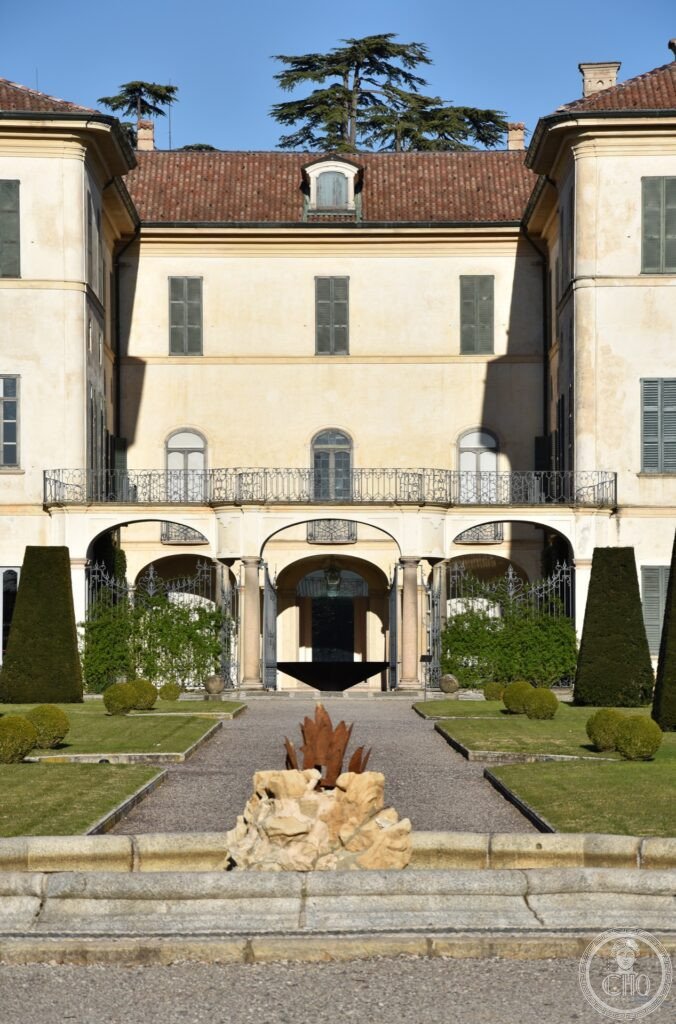
A neoclassical villa above Varese housing one of Europe’s most significant collections of American art from the 1950s to 1990s, assembled by industrialist and collector Giuseppe Panza di Biumo and now managed by the FAI with support from the Guggenheim Foundation.
At a glance
Villa Panza stands on a hill above Varese commanding views of the city and, on clear days, the Alps. The villa was built in the early nineteenth century and extensively remodelled in 1850 by Luigi Rognoni for the Litta family; it acquired its present character under Marquis Giuseppe Panza di Biumo, who purchased it in 1956 and transformed its interiors into gallery spaces for the American art he had begun collecting in New York since 1954.
By the time the FAI acquired the villa in 1996, Panza had assembled more than 2,500 works — Dan Flavin, Robert Irwin, James Turrell, David Simpson, Doug Wheeler, and many others — many of which were site-specific installations conceived for the villa’s rooms. The Guggenheim Foundation manages part of the collection on long-term loan. Panza himself lived in the villa until his death in 2010; his wife Giovanna continues to be involved in its curation.
Key facts
- Built: Early XIX cent.; major remodelling 1850 (L. Rognoni)
- Collector: Marquis Giuseppe Panza di Biumo (1923–2010)
- Collection: 2,500+ works, American art 1950s–1990s
- FAI acquisition: 1996
- Guggenheim partnership: Long-term loan of site-specific works
- Notable artists: Dan Flavin, Robert Irwin, James Turrell, Doug Wheeler
- GPS: 45.8240, 8.8319 — Google Maps
History
The hill of Biumo Superiore, overlooking Varese from the northwest, had been a site of aristocratic villeggiatura since the seventeenth century. The property was remodelled between 1850 and 1860 to its present neoclassical form, with a long entrance avenue, formal parterre gardens, and service buildings arranged around a rear courtyard. After several changes of ownership, it was acquired by the industrialist Giuseppe Panza di Biumo in 1956.
Panza made his first purchases of American art in New York in 1956, years before the European market recognized Abstract Expressionism as more than an American curiosity. He bought directly from artists — Mark Rothko, Franz Kline, Robert Rauschenberg — often at prices that reflected complete indifference on the part of Italian collectors. By the mid-1970s he had shifted his focus to Minimalism and environmental art, commissioning James Turrell and Robert Irwin to create works specifically for the villa’s stables, attic spaces, and outbuildings.
The collection’s significance attracted international attention in the 1980s. The Guggenheim acquired a major portion of the works in 1990; a parallel agreement with the FAI transferred the building and remaining collection in 1996. The arrangement is unusual: the Guggenheim owns the works, the FAI owns the building, and together they manage Europe’s most coherent permanent installation of American environmental art from the postwar period.
What you see
The villa presents itself modestly: a two-storey neoclassical façade with pilasters and a shallow pediment, set at the end of an entrance court. The park behind it — 30,000 square metres of terraced garden falling toward the valley — is one of the finest English-style parks in Lombardy, with ancient cedars, a maze of box hedges, and a belvedere terrace facing the Sacri Monti range.
Inside, the ground-floor piano nobile has been maintained as nineteenth-century domestic rooms with original furniture and tapestries, alongside the Panza family’s smaller-format American acquisitions. But the experience that sets Villa Panza apart is in the outbuildings: the former stables, carriage house, and attic rooms contain site-specific light installations by Dan Flavin (dozens of fluorescent tube works arranged throughout the stable corridors), Robert Irwin (scrim installations that dematerialise walls), and James Turrell (light-into-space chambers that require the eye to adapt over several minutes). These works cannot be reproduced by photography or moved; the villa is their only location.
Gallery
Practical information
- Opening: Tuesday–Sunday 10:00–18:00; closed Monday.
- Admission: Full €15; FAI members free; students and seniors reduced.
- Duration: 2–3 hours recommended (park + villa + installations).
- Light installations: Allow 10–15 minutes in each space for dark-adaptation.
- Booking: Advisable for weekends; some installation rooms have timed entry.
Getting there
Villa Panza is at Piazza Litta 1, Biumo Superiore. From Varese: bus no. 1 to Biumo Superiore (15 min); from Varese station by taxi (10 min). By car from Milan: A8 motorway to Varese exit, then follow signs for Biumo Superiore; parking on Via Marconi adjacent to the villa. Train from Milan Cadorna to Varese (Ferrovie Nord, 55 min) or Milan Centrale to Varese (Trenord, 1h).
Nearby
- Sacro Monte di Varese — UNESCO World Heritage, pilgrimage chapels on the adjacent hill, 3 km
- Villa Toeplitz (Varese) — Moorish-Gothic villa with park, 2 km
- Museo Civico di Varese, Palazzo Estense — neoclassical palazzo, 15 min walk
Sources
- FAI – Fondo Ambiente Italiano: fondoambiente.it/luoghi/villa-panza
- Solomon R. Guggenheim Foundation: Panza Collection documentation
- Wikipedia IT: Villa Panza
- Panza di Biumo, Giuseppe: Memories of a Collector, Milan, Electa, 2006
Find it on the map
See this place and what’s around it →📷 Become a Cultural Heritage Online photographer
Share your photos of places: they stay published under your name as the author. The more they're seen, the more you get noticed — and soon a contest will reward the most appreciated photos.
Log in or sign up free to add a photoIs this page about you?
This page is read by travellers and heritage enthusiasts who find it on Google. Tell us how you are connected to this place and we will take it from there.