Villa Medicea di Poggio a Caiano — Giuliano da Sangallo 1485 CE

Villa Medicea Poggio a Caiano Giuliano da Sangallo 1485 portico trabeato Toscana UNESCO 2013
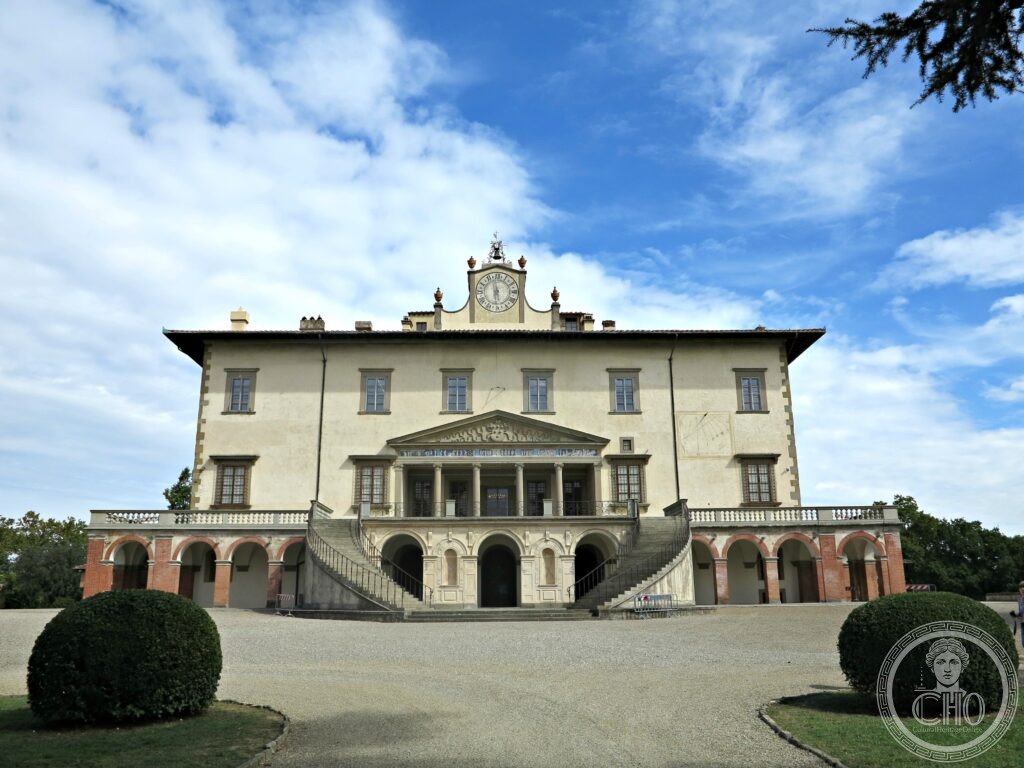
Villa Medicea di Poggio a Caiano, Prato, Toscana, Italia. Il prospetto principale della villa con il portico trabeato ionico (1490–1492 CE) e il fregio in terracotta invetriata di Andrea Sansovino e Benedetto da Maiano (1490 CE, gli scene mitologiche del ciclo Ovidiano); la villa è elevata su una piattaforma artificiale di 7,4 m per dominare la pianura. Giuliano da Sangallo (1445–1516 CE) per Lorenzo il Magnifico. UNESCO WHS 2013 (rif. 1560). Foto via Wikimedia Commons.
Poggio a Caiano, Prato, Toscana, Italia · Giuliano da Sangallo 1485 CE; Lorenzo il Magnifico; Pontormo Salone di Leone X 1521 CE; Baroncelli Cappella Pontormo; villa su podio 7.4 m; fregio terracotta Sansovino; UNESCO WHS 2013 (rif. 1560 Ville Medicee)

Villa Medicea di Poggio a Caiano

La Villa Medicea di Poggio a Caiano (UNESCO 2013, rif. 1560) è la più ambiziosa e la più innovativa delle ville medicee — la prima villa rinascimentale italiana a essere progettata come sintesi programmatica di architettura, paesaggio e decorazione letteraria, dove Lorenzo il Magnifico tradusse le sue idee neoplatoniche in pietra con l’aiuto del suo architetto di fiducia Giuliano da Sangallo.

At a glance

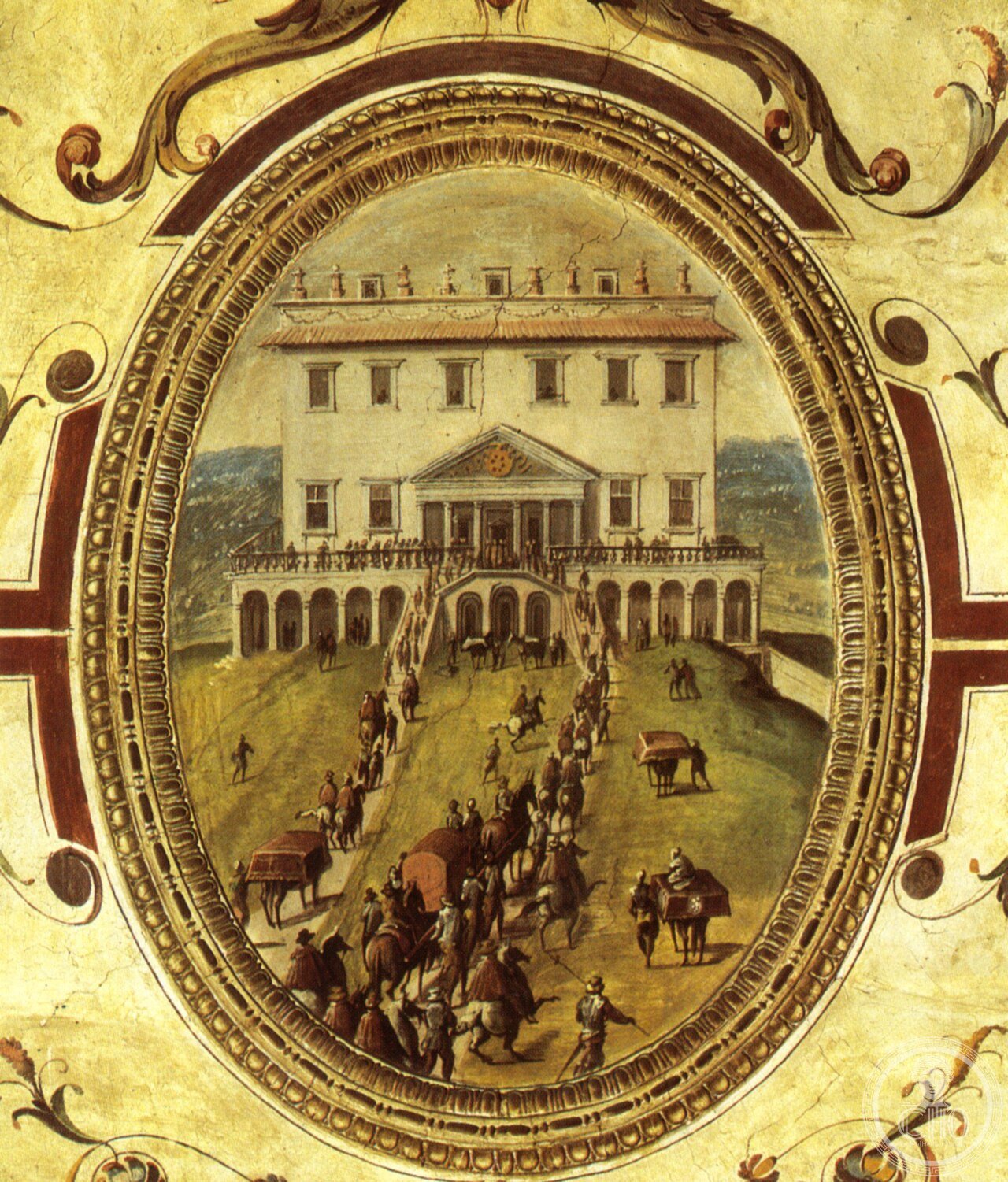
Villa Medicea Poggio a Caiano Toscana (the most precisely Poggio a Caiano zone Poggio a Caiano Prato Toscana Italy 43.8200 N 11.0450 E UNESCO WHS 2013 reference 1560 Medici Villas and Gardens: the Poggio a Caiano component (one of 14 components of the serial UNESCO WHS “Medici Villas and Gardens” (inscribed 2013): the 14 villas: Careggi (1434 CE) + Il Trebbio (1427 CE) + Cafaggiolo (1451 CE) + Il Palmieri (1460s CE) + Il Poggio a Caiano (1485 CE: THE MOST IMPORTANT) + Il Galluzzo / Castello di Acciaiuoli (15th CE) + Il Castello (1477 CE) + La Petraia (1575 CE) + Cerreto Guidi (1567 CE) + La Magia (16th CE) + L’Ambrogiana (1587 CE) + Artimino (1594 CE) + La Topaia (16th CE) + L’Lilliano (17th CE); the OUV (the UNESCO Outstanding Universal Value for the Medici Villas: the OUV geography: the Medici villas demonstrate the Medici’s development of the Italian landscape from the Middle Ages to the 17th century CE: the concept of the “Villa Suburbana” (the suburban villa: the Medici villa as a country retreat within 20–40 km of Florence, accessible by horse in 3–4 hours): this concept (the deliberate integration of architecture + garden + working agricultural estate + landscape view) was INVENTED by the Medici and exported across Europe (the French chateau: the Loire Valley chateaux of the 1520s CE are directly influenced by the Medici villa model; the English country house: through Charles I’s contact with the Medici tradition))); the villa (the Poggio a Caiano architecture: the architect: Giuliano da Sangallo (1445–1516 CE): the most technically innovative Florentine architect of the Renaissance; the commission: the contract for the villa was signed between Lorenzo de’ Medici (1449–1492 CE) (Lorenzo il Magnifico) and Giuliano da Sangallo in 1485 CE; the construction: 1485–1513 CE (Lorenzo died in 1492 CE and never saw the completed building); the platform (the raised platform or podium: 7.4 m above the surrounding garden: the largest elevated platform of any Renaissance villa; the purpose: to give the villa the appearance of a Roman temple on a hill; the actual Roman precedent: the Temple of Fortuna at Praeneste (Palestrina), which Giuliano da Sangallo had studied in 1474 CE and reproduced in a drawing (Uffizi Arch. 4, cod. Barb. Lat. 4424): the villa’s platform directly quotes the Praeneste terracing).

Key facts

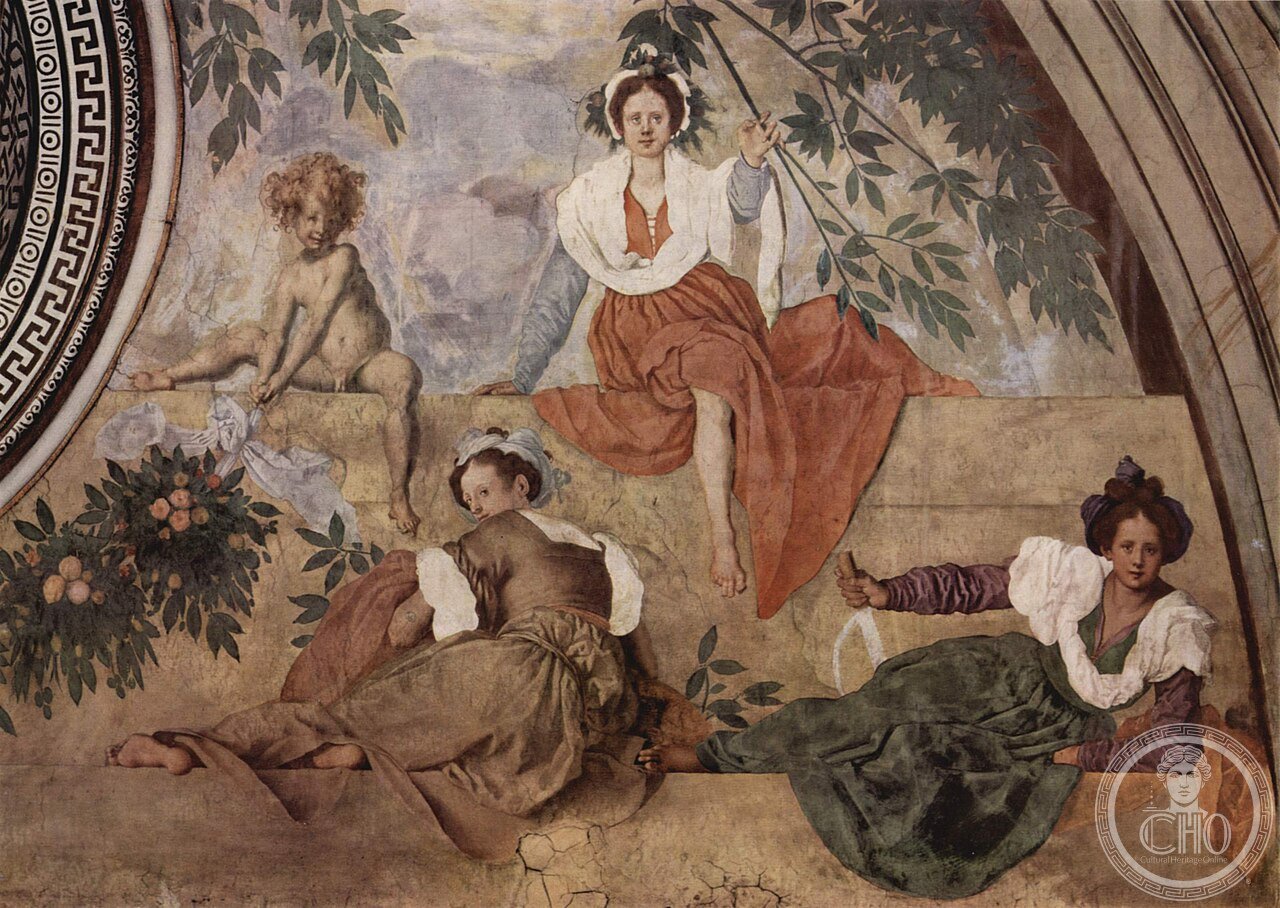
  • Il Salone di Leone X (Pontormo, 1521 CE) e il fregio laurenziano in terracotta (1490 CE): i due livelli di programma iconografico che traducono le idee neoplatoniche di Lorenzo il Magnifico in un linguaggio visivo: the Salone di Leone X (the main hall of the piano nobile of Villa Poggio a Caiano: the commission: Pope Leo X (Giovanni de’ Medici, 1475–1521 CE: the son of Lorenzo il Magnifico and the first Medici pope): Leo X commissioned the decoration of the Salone in 1515 CE for the planned visit of the Holy Roman Emperor Charles V (the visit never happened; Charles V instead came to Florence in 1536 CE after Leo X’s death in 1521 CE)); the paintings (the cycle of paintings in the Salone: (1) the north lunette: the “Vertumnus and Pomona” by Jacopo Pontormo (1494–1557 CE): painted 1519–1521 CE (the most important fresco Pontormo ever completed: 24 m² of fresco in the lunette space above the north door; the Ovidian myth (Vertumnus and Pomona from Ovid’s Metamorphoses XIV, 623–771 CE): the disguised Vertumnus (the god of the seasons) courting the nymph Pomona (the goddess of fruit orchards): the Medici reading (the myth was read as an allegory of Lorenzo il Magnifico’s courtly poems to Simonetta Vespucci)); (2) the frieze (the terracotta glaze frieze under the loggia: the 8 allegorical scenes from Ovid’s Fasti + Metamorphoses, designed by Giuliano da Sangallo and executed by Andrea Sansovino (c.1467–1529 CE) and Benedetto da Maiano (1442–1497 CE) in 1490–1492 CE: the frieze was the first application of invetriata terracotta (the glazed terracotta) to a villa exterior in the Italian Renaissance)
  • GPS (Villa Medicea, Via Lorenzo il Magnifico 5, Poggio a Caiano): 43.8200° N, 11.0450° E

History

Da Lorenzo il Magnifico 1485 CE al UNESCO 2013 (the most precisely Poggio a Caiano zone history: the acquisition (Lorenzo de’ Medici acquired the existing country property at Poggio a Caiano in 1474 CE for 4,000 florins: the Ambra stream flows through the property (Lorenzo’s pastoral poem “L’Ambra” (1480 CE) was written here)); the Sangallo commission (1485 CE: Giuliano da Sangallo was commissioned to completely rebuild the medieval farmhouse: the first documented Italian Renaissance villa project that treated the landscape integration as a design requirement, not an afterthought); the Lorenzo period (1485–1492 CE: Lorenzo used the villa as his primary country retreat in the last decade of his life: the “Accademia Platonica” meetings at Poggio a Caiano: Ficino (1433–1499 CE), Poliziano (1454–1494 CE), and Pico della Mirandola (1463–1494 CE) were regular visitors); the Medici exile (1494 CE: the Medici were expelled from Florence by Savonarola’s forces (October 9, 1494 CE): the villa was sacked and the farm animals were released); the return (1513 CE: the Medici returned to Florence after the election of Leo X; the villa was completed and decorated); the later history (1576 CE: Bianca Cappello (the mistress and later wife of Francesco I de’ Medici (1541–1587 CE)) died at the villa along with Francesco I on October 19–20, 1587 CE: poisoned (the poisoning theory: the most popular historical theory is that they were poisoned by Cardinal Ferdinando de’ Medici, Francesco’s brother, who inherited the Grand Duchy)); the UNESCO inscription (2013 CE: reference 1560).

What you see

Podio 7.4 m, portico ionico, fregio terracotta invetriata, Salone di Leone X (Pontormo “Vertumno e Pomona” 1521 CE), scuderie, teatro, giardino formale (the most precisely Poggio a Caiano zone visit (2h + 30 min garden): the access (Poggio a Caiano is 18 km from Florence; the bus: the CAP bus from Florence Santa Maria Novella bus station to Poggio a Caiano (35 min; €2.50; line 30); the ticket for the villa (free admission since 2015 CE for EU citizens under 25 and all visitors on the first Sunday of each month; otherwise €6); the visit route: ground floor → the Cappella (the private family chapel: the 16th-century CE altarpiece “Natività” by Filippino Lippi (1492 CE: the last work Lippi completed before his death)); piano nobile → the Salone di Leone X (the main hall: (1) the Pontormo lunette: “Vertumnus and Pomona” (1521 CE): the pastel palette (peach pink + aquamarine + lemon yellow): the “mannerist airiness” of the figures: 24 m² of the finest early Mannerist fresco outside Florence; (2) the Andrea del Sarto lunette (south side): “Caesar receives Tribute from Egypt” (1521 CE): the Medici self-identification with Roman imperial power); the garden (the formal garden (the Italian garden: 1807 CE redesign under Napoleon’s Kingdom of Etruria: the Napoleonic garden replaces the original 15th-century CE garden; the 18th-century CE baroque terraces and fountains are mostly intact); the English garden (the Romantic park added by the Lorena grand dukes in 1807 CE: the artificial lake + the grotto).

Practical information

  • Come raggiungere Poggio a Caiano da Firenze in bus, e come combinare la visita con Prato (la Cappella dei Magi di Filippo Lippi e il Museo del Tessuto) in una giornata: il trasporto (Firenze Santa Maria Novella → Poggio a Caiano: CAP bus linea 30 (35 min; €2.50; partenza da Via Luigi Alamanni (adiacente alla stazione SMN); ogni 30–60 min; il bus non ha fermate all’aeroporto)); Prato → Poggio a Caiano: CAP bus linea 7 (20 min; €1.50; partenza dalla stazione di Prato Centrale); il programma 1 giorno: 9:30 arrivo Poggio a Caiano → 10:00 Villa Medicea (2h; il Pontormo nel Salone di Leone X: arrivare alle 10:00 esatte per la luce di mattina che entra dalla finestra Nord e illumina la lunetta di Vertumno e Pomona; il risultato: la luce naturale rivela i colori pastello del Pontormo in modo che la fotografia non può riprodurre) → 12:30 pranzo al ristorante “Il Covaccino” (Via Garibaldi 12; €18/persona; la farinata di ceci + il cinghiale in umido (il cinghiale toscano in salsa di acciughe e capperi: la ricetta della Valdinievole vicina) → 14:00 bus verso Prato (20 min) → 14:30 Duomo di Prato e Cappella dell’Assunta (Filippo Lippi 1452–1466 CE: il ciclo in affresco con la danza di Salome; €5; la storia di Lippi a Prato: il frate pittore che rapisce la monaca Lucrezia Buti e la sposa grazie all’autorizzazione di Pio II) → 16:30 Museo del Tessuto (€10; la storia dell’industria tessile pratese: dal lanificio medievale alla “fast fashion” contemporanea: la distanza tra i due è di 6 secoli e 10 km)

Getting there

CAP bus linea 30 da Firenze SMN (35 min, €2.50). GPS: 43.8200/11.0450. Ingresso €6 (gratis primo domenica del mese e under 25 EU). 8:30–17:30 (chiuso lunedì).

Nearby

  • Prato — Duomo (Filippo Lippi 1452–1466 CE) e Museo del Tessuto (la catena del fast-fashion) — 7 km (CAP bus 20 min; €1.50; il Duomo di Prato: la “Sacra Cintola” (la reliquia della cintura della Madonna portata dalla Terrasanta da Michele Dagomari nel 1141 CE): la reliquia più venerata della Toscana (dopo la Sindone in Piemonte))
  • Villa della Petraia (1575 CE, Tribolo e Buontalenti, giardini terrazzati) — 12 km (bus CAP verso Sesto Fiorentino; 25 min; la villa de’ Medici (parte dello stesso WHS 1560): il giardino terrazzato di Niccolò Tribolo (1500–1558 CE): il pianta “a giardiniere chiuso” (il giardino che gira attorno alla villa): il primo giardino all’italiana a struttura centripeta + la fontana di Fiorenza (Giambologna 1572 CE: lo stesso scultore de “Il Ratto delle Sabine” in piazza della Signoria))

Sources

  • Wikipedia, Villa di Poggio a Caiano; Giuliano da Sangallo; Pontormo; Lorenzo de’ Medici, accessed June 2026
  • UNESCO, Medici Villas and Gardens in Tuscany, WHS reference 1560, inscribed 2013
  • Acidini Luchinat, Cristina (ed.). Le ville e i giardini medicei. Milan: Giunti, 2001

Hero image: Villa Medicea di Poggio a Caiano, Toscana, Italy, Wikimedia Commons. Editorial text © Cultural Heritage Online, 2026.

📷 Diventa un fotografo di Cultural Heritage Online

Condividi le tue foto dei luoghi: restano pubblicate con la tua firma come autore. Più vengono viste, più ti fai conoscere — e presto un concorso premierà le foto più apprezzate.

Accedi o registrati gratis per aggiungere una foto

Do you manage this place?

This page is read by travellers and heritage enthusiasts who find it on Google. Keep it accurate — and make it work for you. Free for non-profit heritage institutions.

📋 Copy & share on social
Scroll to Top