
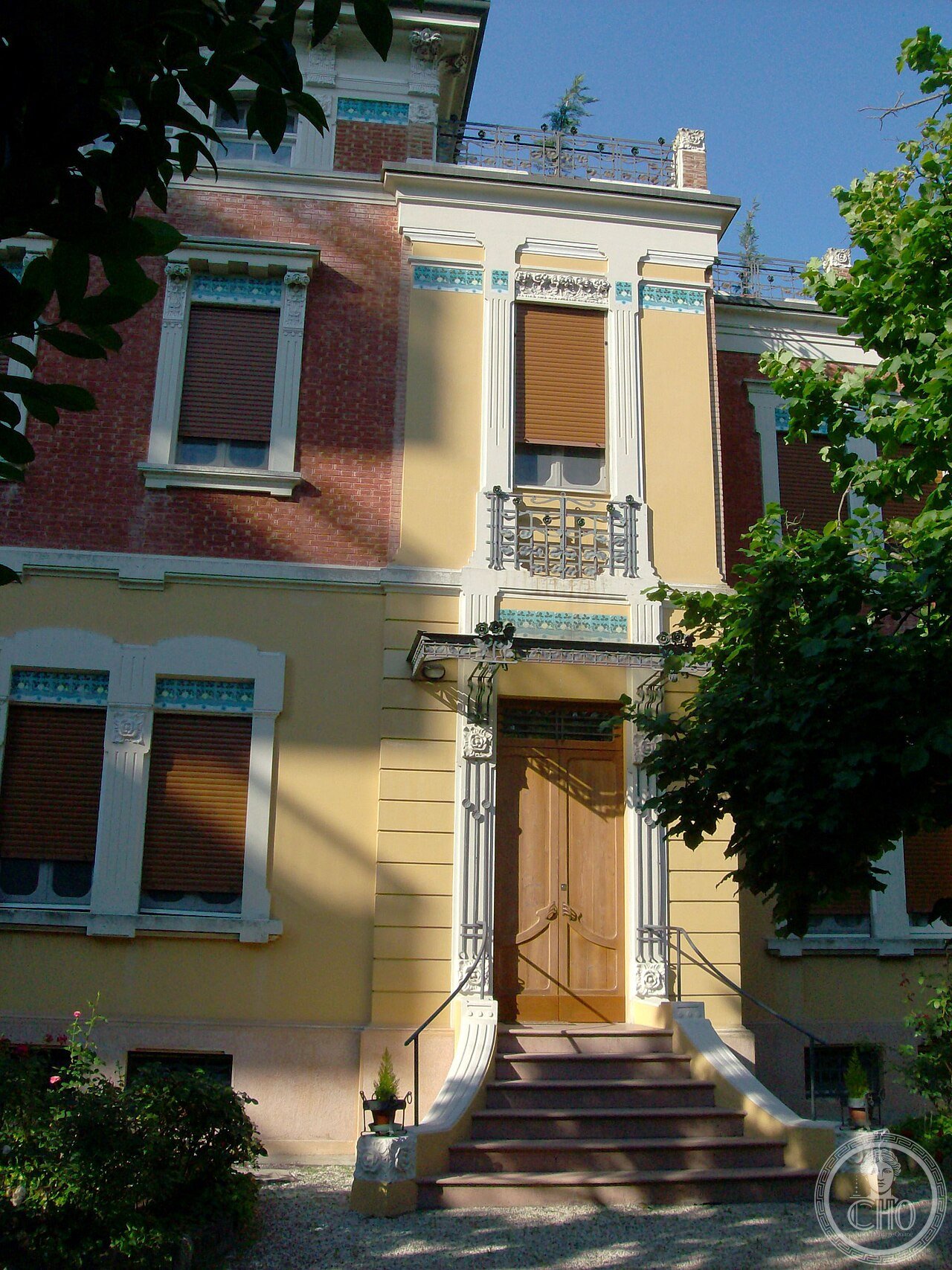

Named after the patron’s wife, Villa Amalia is the second of Ciro Contini’s Liberty villas on Viale Cavour — a four-storey residence where the engineer’s decorative vocabulary stretches across an entire bourgeois social programme, from entertaining floors to servants’ quarters.
At a glance
Completed in 1905, Villa Amalia stands at Viale Cavour 194, metres from Villa Melchiorri (1904) and visible as the second chapter of Ciro Contini’s Liberty experiment on Ferrara’s emerging southern boulevard. The client was Paolo Santini, an entrepreneur in the metallurgical industry; the villa took its name from his wife, Amalia Torri, a wealthy landowner from the town of Bondeno. Where Melchiorri was all about the florist’s trade, Amalia follows a grander residential ambition, spread across four hierarchical levels.
Key facts
- Architect: Ciro Contini
- Client: Paolo Santini (metallurgical entrepreneur)
- Named after: Amalia Torri, the patron’s wife
- Completed: 1905
- Address: Viale Cavour, 194, 44121 Ferrara
- Style: Liberty (Italian Art Nouveau)
- Floors: Semi-basement, raised ground floor, first floor, second floor
- GPS: 44.8429, 11.6107
History
Paolo Santini built Villa Amalia as a statement of industrial-era success: the semi-basement held service functions, the raised ground floor was reserved for entertaining — the social display floor — while the first floor housed the family’s private rooms and the second floor accommodated domestic staff. This stratification of domestic life by floor was a standard bourgeois convention of the period, but on Viale Cavour it arrived clothed in Contini’s Liberty ornament.
The villa sits within the Addizione Contini, the planned expansion of Ferrara that replaced the former Castel Tedaldo and Fortezza di Ferrara on the city’s southern edge. Naming the urban development after the engineer was not standard practice; it reflects how thoroughly Contini’s work defined the neighbourhood’s character in the decade before World War One.
What you see
The four-storey elevation follows the social hierarchy within: the raised ground floor is marked by the tallest windows and the most elaborate mouldings, signalling the entertaining rooms behind them. Above, the floors diminish gradually in ceiling height and ornamental density as the building moves from public representation to private life and then to service.
Contini’s Liberty handling here is more restrained than at Villa Melchiorri, just down the street: the floral motifs are present but lighter, the ironwork more geometric, the overall composition more vertical. The building reads as a refinement of the earlier experiment, the architect adjusting his vocabulary for a patron whose background was industry rather than horticulture.
Practical information
- Access: Exterior visible from Viale Cavour at any time; interior is private and in current residential use
- Time needed: 10 minutes for exterior viewing
- Combine with: Villa Melchiorri (150 m north) and Villino Masieri-Finotti (450 m south-east) for the full Contini Liberty walk
Getting there
From Ferrara Centrale station, walk south along Viale Cavour for approximately 1.2 km to reach the Contini Liberty cluster. Villa Amalia is at n. 194, between Villa Melchiorri (n. 184, 150 m north) and the rest of the boulevard. The three villas can be visited in sequence on a single 30-minute walk from the station to Villino Masieri-Finotti.
Nearby
- Villa Melchiorri (Ciro Contini, 1904) — 150 m north, Viale Cavour 184
- Villino Masieri-Finotti (Ciro Contini, 1907–08) — 450 m south-east, Viale Cavour 112
- Palazzo dei Diamanti — 10-minute walk north, Ferrara Renaissance landmark
- Ferrara historic centre (UNESCO World Heritage Site) — 15-minute walk north
Sources
- Wikipedia (Italian): Villa Amalia (Ferrara)
- Wikimedia Commons: File:Ferrara Villa Amalia.JPG, photo by Rapallo, CC BY-SA 4.0
- Nominatim / OpenStreetMap: GPS 44.8429, 11.6107
Find it on the map
See this place and what’s around it →Record researched and written by Carla Szathvary for Cultural Heritage Online, 2026.
📷 Become a Cultural Heritage Online photographer
Share your photos of places: they stay published under your name as the author. The more they're seen, the more you get noticed — and soon a contest will reward the most appreciated photos.
Log in or sign up free to add a photoIs this page about you?
This page is read by travellers and heritage enthusiasts who find it on Google. Tell us how you are connected to this place and we will take it from there.