
Vicenza
Most cities are shaped by many hands over centuries. Vicenza was largely reshaped by one: Andrea Palladio (1508–1580), whose name became a style the whole world borrowed.
At a glance
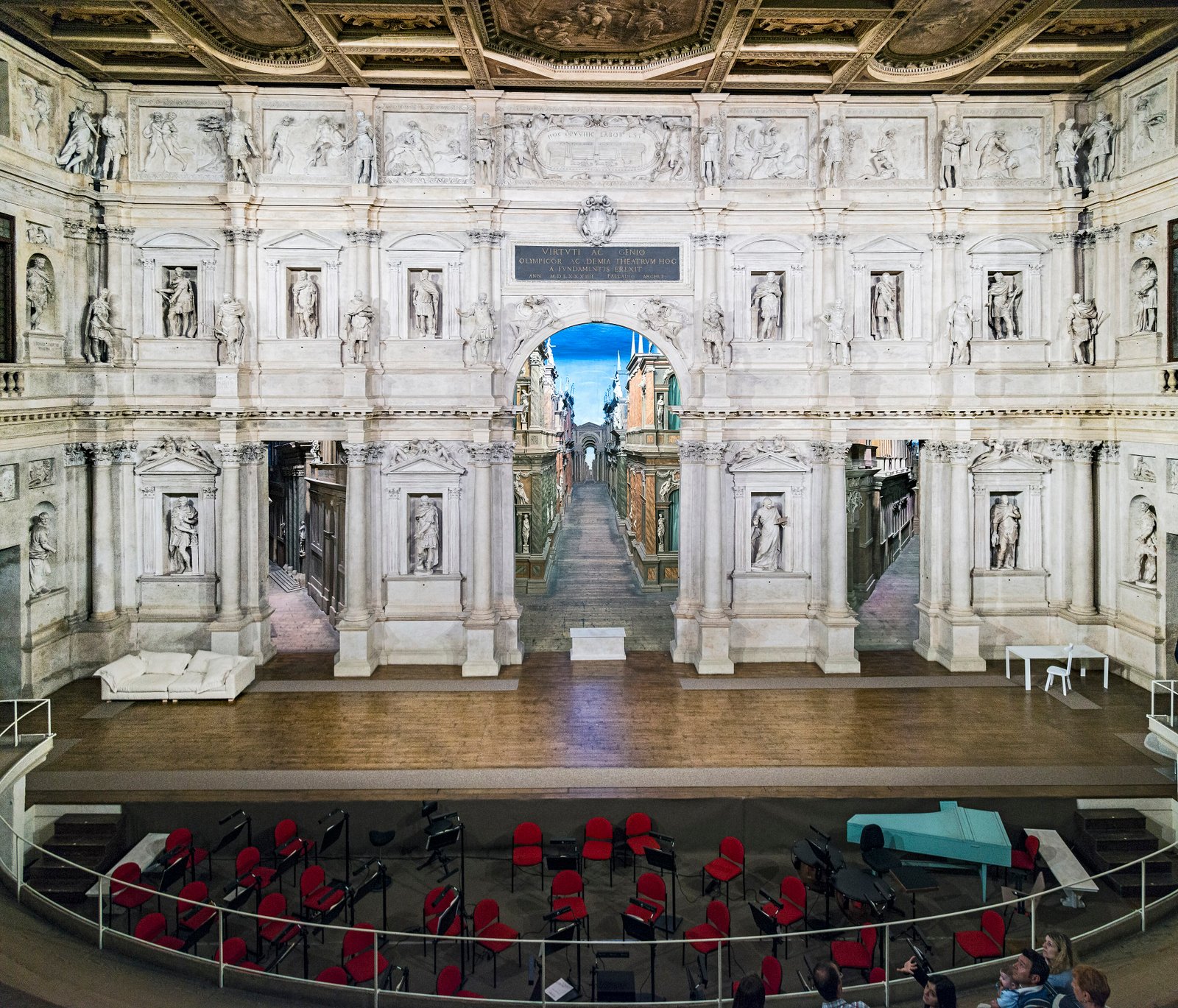
Vicenza stands on the Veneto plain between Verona and Padua, under the foothills of the Little Dolomites. In the 16th century a single architect filled it with palaces, public buildings and the white stone loggias that define its centre, and the surrounding hills with villas. That body of work gave the world “Palladian” architecture, copied from London to Virginia. UNESCO listed the city in 1994. You come for the streets and squares Palladio drew, and for the Teatro Olimpico, the oldest surviving indoor theatre on earth.
Key facts
- Region: Veneto · Province: Vicenza
- Ruled by: the Republic of Venice from 1404
- UNESCO: City of Vicenza and the Palladian Villas of the Veneto (inscribed 1994, extended 1996, ref. 712)
- Signature figure: Andrea Palladio (1508–1580), who left palaces and villas across the city and its territory
- Last work: the Teatro Olimpico, begun in 1580, the year Palladio died
History
Italic tribes settled the site, and Rome made it a centre in 157 BC. The town came under the rule of the Republic of Venice in 1404 and stayed within its orbit for the rest of the Renaissance.
The 16th century was the age of Andrea Palladio. Trained as a stonemason, he studied Roman ruins and ancient texts, then rebuilt much of Vicenza in their image — symmetry, columns, clear proportion. His treatise, The Four Books of Architecture (1570), carried that grammar far beyond the Veneto, shaping country houses in England and the early United States two centuries later. Few architects have ever stamped one provincial city so completely.
Heavy bombing in the Second World War damaged the historic core. Careful reconstruction followed, and the centre reads today much as Palladio left it.
What you see
- Teatro Olimpico — begun in 1580, the year Palladio died, and his last work. Behind its stage stand permanent wooden streets in forced perspective, built by Vincenzo Scamozzi to look far longer than they are. It is the oldest surviving indoor theatre in the world.
- Basilica Palladiana — the medieval Palazzo della Ragione on Piazza dei Signori, wrapped from 1549 in the white marble loggias Palladio designed to brace and clad it; the work that first made his reputation.
- Palazzo Chiericati — a Palladian palace begun for the Chiericati family, now home to the city’s civic art gallery.
- Villa La Rotonda — the Villa Almerico Capra, begun around 1567 on a low hill just outside town; a square block crowned by a dome with four identical temple fronts, among the most imitated buildings ever raised.
- Corso Palladio — the long main street threading the centre, lined with palaces, the spine that ties the Palladian set pieces together.
Practical information
- Time needed: a full day for the centre; add half a day for Villa La Rotonda and the nearby hills.
- Getting around: the historic core is compact and walkable, built around Corso Palladio.
- When to go: spring and autumn are mildest; the Veneto plain turns hot and humid in high summer.
Getting there
Trains from Venice take about 50 minutes, from Verona around 30, from Padua under 20. The nearest airports are Venice (VCE) and Verona (VRN), each roughly an hour away. From the station the centre is a short walk.
Nearby
- The Palladian villas of the Veneto are scattered through the countryside around the city, several open to visitors.
- Verona lies about half an hour west; Padua a similar distance east.
Sources
- Wikipedia, Vicenza.
- UNESCO World Heritage List, City of Vicenza and the Palladian Villas of the Veneto, ref. 712 (inscribed 1994, extended 1996).
Find it on the map
See this place and what’s around it →Historical events at this place (2)
📷 Diventa un fotografo di Cultural Heritage Online
Condividi le tue foto dei luoghi: restano pubblicate con la tua firma come autore. Più vengono viste, più ti fai conoscere — e presto un concorso premierà le foto più apprezzate.
Accedi o registrati gratis per aggiungere una foto