
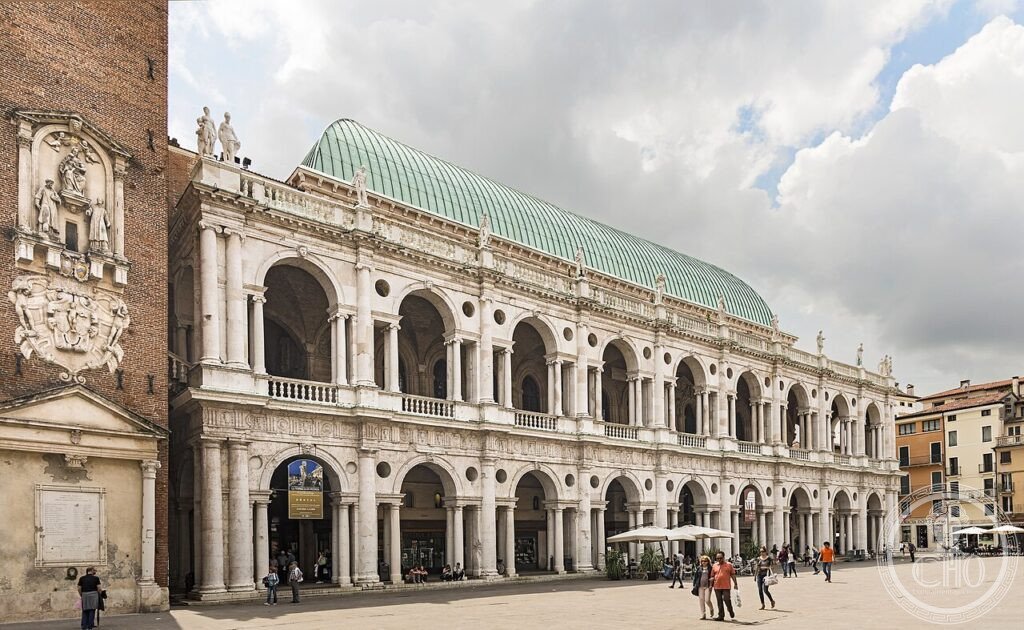
The building that made Palladio’s international reputation — a Gothic town hall wrapped in a double colonnade of white limestone loggie (1549–1614), each opening in a Serlian arch of the proportions that would be called “Palladian” and exported to England, North America, and the rest of the world — standing in the central square of a city where Palladio built 23 palaces, 2 theatres, and a single bridge, and which became the most complete surviving example of a city transformed by a single architectural mind.
At a glance
Vicenza is a mid-sized city (population approximately 110,000) in the Veneto plain, 60 kilometres west of Venice. It is the city where Andrea Palladio (1508–1580) worked from the 1530s until his death — producing an extraordinary body of work concentrated in the historic centre, including the Basilica Palladiana (his first and most prestigious commission), the Teatro Olimpico (his last, completed by Vincenzo Scamozzi after Palladio’s death), and 23 palaces on the main street (the Corso Palladio). The UNESCO inscription (1994, enlarged 1996, ref. 712) covers the city of Vicenza and the Palladian villas of the Veneto — an inscription that recognises Palladio’s influence not just on Vicenza but on the entire subsequent history of Western architecture.
Key facts
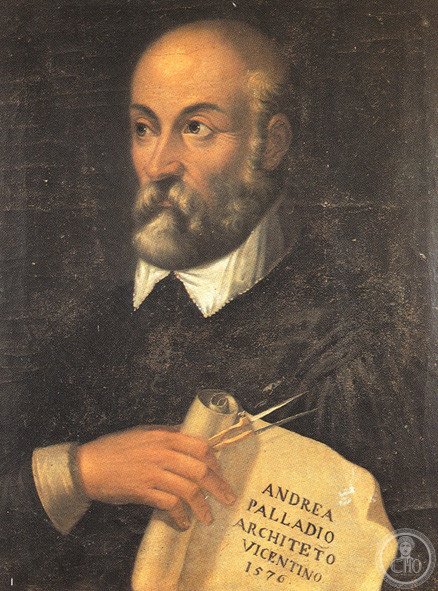
- Andrea Palladio: 1508 (Padua) – 1580 (Vicenza); born Andrea di Pietro della Gondola; trained as a stonemason; given the humanist name “Palladio” by his patron Gian Giorgio Trissino (1538); the most influential architect in Western history after Vitruvius
- Basilica Palladiana: 1549–1614; the medieval Palazzo della Ragione (c. 1222) enclosed in a new double colonnade; ground floor: Doric order; upper floor: Ionic order; each bay opened by a “Serlian” (Palladian) arch — a motif derived from Bramante, standardised by Serlio, and here canonised by Palladio as the definitive solution to the problem of equal bays in unequal openings
- Teatro Olimpico: 1580–1585; Palladio’s last work, completed by Scamozzi after his death; the permanent perspective stage set (built 1585 for the inaugural Oedipus Rex) is the oldest surviving stage set in Europe and has been unchanged since 1585
- I Quattro Libri dell’Architettura: published 1570; four volumes on classical architecture and Palladio’s own work; the most widely read architectural treatise in history; carried to England by Inigo Jones (1613), to North America by Thomas Jefferson, to Russia by Catherine the Great’s architects
- Palladian influence: Inigo Jones (Banqueting House, London, 1619); Lord Burlington (Chiswick House, London, 1726); Thomas Jefferson (Monticello, 1772–1809); Washington DC Capitol (general layout derived from Palladian principles)
- UNESCO: 1994 (Vicenza), 1996 (extended to include villas in the Veneto), ref. 712
- GPS: 45.5454, 11.5455 — Google Maps
History
Andrea Palladio was born in Padua in 1508 as Andrea di Pietro della Gondola, the son of a miller. He moved to Vicenza at the age of thirteen to work as a stonecutter and remained there until his death. His first architectural patron was Gian Giorgio Trissino, a Vicentine nobleman and humanist who gave him the name “Palladio” (after the figure of Pallas Athena, goddess of wisdom, who appears in Trissino’s epic poem L’Italia liberata dai Goti) and took him on study trips to Rome (1541, 1545, 1547, 1554) where Palladio drew and measured the surviving ancient Roman buildings. These Roman studies — published in 1554 as Antiquità di Roma and later incorporated into the Quattro Libri — formed the empirical basis for Palladio’s subsequent work: an architecture of mathematical proportion, antique symmetry, and applied ornament derived directly from the monuments.
The Basilica commission (1549) was Palladio’s decisive breakthrough: the problem was to enclose the existing Gothic palazzo in a new colonnade, regularising its irregular openings and matching its varying heights, without demolishing the original structure. Palladio’s solution — the so-called “Palladian arch” or “Serliana,” a central wide arched opening flanked by two narrower rectangular openings, all within a bay of the colonnade — was flexible enough to accommodate any width of bay and any height of order, while maintaining the regularity and symmetry that antique architecture required. The result was a formula that could be applied to any building of any size, which is why it spread so rapidly across Europe and North America in the following two centuries.
What you see
The Piazza dei Signori in Vicenza is a long, irregular medieval square — the old forum of Roman Vicentia — with the Basilica Palladiana on the south side and the Torre di Piazza (medieval bell tower, 82 m, XI century) on the north. The Basilica fills the full length of the south side of the piazza: a two-storey colonnade in white limestone, the ground floor Doric (lower, heavier), the upper floor Ionic (lighter, more delicate), each bay marked by the canonical Serlian arch opening. Walking along the loggia under the colonnade, you are under an arcade that is 82 metres long on the piazza side alone; the columns are large enough to be in proportion with the medieval palazzo behind them and the medieval tower across the square, but not so large as to overwhelm the pedestrian.
The Basilica roof (the copper-covered boat-hull shape above the colonnade) is an eighteenth-century addition (1740); the interior (the great hall of the Palazzo della Ragione behind the colonnade) is now used for temporary exhibitions. From the roof terrace of the Basilica, accessible by the internal staircase and during exhibitions, the view over the Piazza dei Signori, the Torre di Piazza, and the surrounding roofscape is the best overview of Palladio’s Vicenza.
Gallery
Practical information
- Basilica Palladiana: The colonnade (loggia) at street level is always open (free). The interior and roof terrace are open when temporary exhibitions are running (check at vicentocard.it); admission varies by exhibition (~€8-12). Even without an exhibition, the loggia itself is worth visiting.
- Teatro Olimpico: Via Malaespina; open Tuesday–Sunday 9:00–17:00. Admission ~€11 (or included in the Vicentocard). The permanent perspective stage set by Scamozzi (1585) has not been altered since the inaugural performance — a unique theatrical and architectural experience.
- Villa Almerico-Capra “La Rotonda”: 2 km south-east of the historic centre; built 1566–1610; the most copied building in history (Chiswick House, Mereworth Castle, Monticello, etc.); open Wednesday–Thursday interior tour; exterior and garden daily March–November.
- Vicentocard: Combined ticket (~€15-20) covering the Teatro Olimpico, Palazzo Chiericati (museum), Villa Almerico-Capra, and most Palladio monuments; recommended if visiting for a full day.
Getting there
Vicenza, Veneto. By train: on the main Milan–Venice line (Freccia or Regionale); 45 minutes from Verona, 1h from Venice, 1h30 from Milan. The historic centre is 15 minutes on foot from Vicenza FS station (via Viale Roma and Corso Palladio). By car: A4 (Milan–Venice) exit Vicenza Est or Vicenza Ovest; park at Parcheggio Verdi or Parcheggio Sveva (near the historic centre, paid). From Venice: 60 km, 1h by car, 1h by train. From Verona: 50 km, 50 min by car, 45 min by train. From Milan: 220 km, 2h10 by Freccia.
Nearby
- Villa Barbaro (Maser) — 30 km north; Palladio + Paolo Veronese; the only Palladian villa with its original painted interior intact (Veronese, 1560–1562): trompe-l’oeil doorways opening onto painted landscapes, members of the Barbaro family portrayed in the frescoes as if watching from painted balconies; UNESCO 1996 (included in the Palladian Villas extension)
- Verona — 50 km west; UNESCO 2000 (ref. 797); the Arena (I century CE, still used for opera); the medieval towers of the Scaligeri; Juliet’s balcony (Via Cappello 23; the connection to Shakespeare is fictional, but the 14th-century house is real); Castelvecchio by Scarpa (restoration 1964)
- Padova e la Cappella degli Scrovegni — 30 km east; Giotto’s complete fresco cycle (1304–1306, 39 scenes from the Life of the Virgin and Life of Christ); the most important painting cycle in Western art; UNESCO 2021 (ref. 1623, “Padua’s fourteenth-century fresco cycles”)
Sources
- UNESCO: whc.unesco.org/en/list/712
- Wikipedia EN: Basilica Palladiana
- Ackerman, James S.: Palladio, Penguin/Harmondsworth, 1966
- Puppi, Lionello: Andrea Palladio: The Complete Works, Electa/Rizzoli, 1989
Find it on the map
See this place and what’s around it →📷 Become a Cultural Heritage Online photographer
Share your photos of places: they stay published under your name as the author. The more they're seen, the more you get noticed — and soon a contest will reward the most appreciated photos.
Log in or sign up free to add a photoIs this page about you?
This page is read by travellers and heritage enthusiasts who find it on Google. Tell us how you are connected to this place and we will take it from there.