
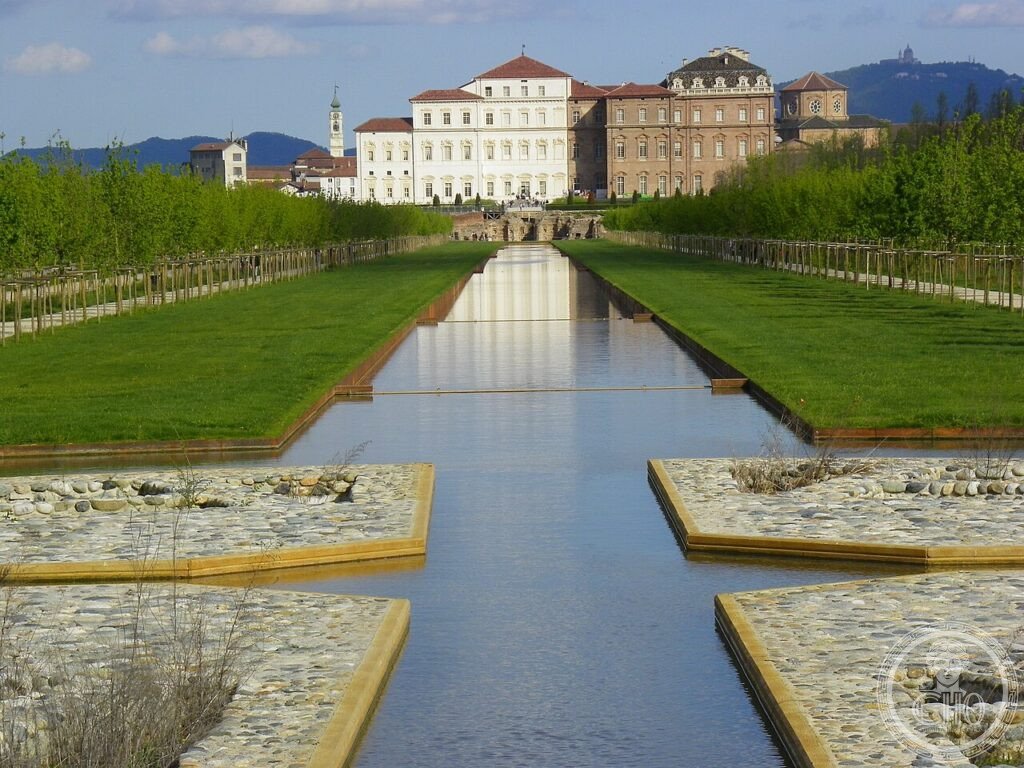
The Royal Residence of Venaria Reale — the largest royal palace complex in Europe by total area of gardens (80 hectares) and the centrepiece of the UNESCO inscription covering twenty Savoy royal residences in Piedmont — was built starting in 1659 as a hunting palace and pleasure garden for Duke Charles Emmanuel II of Savoy, then expanded by the architect Filippo Juvarra (1714-1728) into a Baroque palace that contemporary observers described as surpassing Versailles in the scale and ambition of its garden terraces.
At a glance
The Residences of the Royal House of Savoy (UNESCO 1997, ref. 823) constitute a serial property covering 20 royal residences, hunting lodges, and garden palaces distributed across the Piedmont region and the city of Turin, all built or used by the House of Savoy (the dynasty that ruled Piedmont from the 11th century and became Kings of Italy in 1861) between the 15th and 19th centuries. The most important individual buildings in the inscription are: the Palazzo Reale di Torino (the main city palace, 17th century, seat of the Savoy court); the Palazzo di Caccia di Stupinigi (Juvarra, 1729-1730, the most perfect Baroque hunting palace in Italy); the Villa della Regina (Cardinal Maurizio of Savoy, 1615, on the Turin hillside); the Castello di Rivoli (partly rebuilt by Juvarra, 1718; now the Museo d’Arte Contemporanea); and the Reggia di Venaria Reale (Amedeo di Castellamonte, 1659; Juvarra, 1714-1728 — this CHO card focuses on Venaria Reale as the largest and most fully restored of the group).
Key facts
- Construction: Duke Charles Emmanuel II of Savoy (r. 1638-1675) commissioned Amedeo di Castellamonte to design a hunting palace and town at Venaria Reale in 1659 (the name means “Royal Hunt” from the Latin venatio + realis); Castellamonte completed the initial palace in 1679; it was enlarged by Carlo di Castellamonte and Michelangelo Garove in the 1690s-1710s; the architect Filippo Juvarra (1678-1736, the dominant Italian Baroque architect of the early 18th century, also responsible for the Basilica di Superga 1717-1731 and the Palazzo Reale additions in Turin) was commissioned in 1714 to build the new Grande Galleria and Cappella di Sant’Uberto (1716-1729) and to redesign the garden facade; Juvarra’s interventions (the 80-metre Grande Galleria, the Tempio di Diana with its twin domed pavilions, the new west wing) transformed Venaria Reale into the largest Baroque royal complex in Italy
- The Grande Galleria (Juvarra, 1716-1729): An 80-metre-long gallery (the longest in any Italian royal palace) with paired pilasters of coloured marble, barrel-vaulted ceiling with painted decoration, and floor-to-ceiling windows on the garden side; it was modelled on the Grande Galerie of Versailles (1678-1684, Charles Le Brun) but in the Italian idiom: the marble and gilding are more prominent, the light sources more carefully calculated for the Piedmont latitude
- The gardens (80 hectares): Redesigned by Juvarra and André Le Nôtre’s collaborators; the main axial garden (Parterre di Diana, with the demolished Temple of Diana as its focal point) is 1 km long; the restored gardens (partially reopened after the 2007-2017 restoration) include the Peschiera semicircular fishpond, the deer park, and the kitchen garden
- Restoration: Venaria Reale was used as a military barracks from 1869 to 1978, causing extensive damage; it was restored 2006-2007 in a project involving 400 conservators, at a cost of approximately €200 million — one of the largest palace restorations in Italian history. The restored complex opened to the public in 2007
- UNESCO: 1997, ref. 823 (as part of Residences of the Royal House of Savoy)
- GPS: 45.1277, 7.6339 — Google Maps
History
The House of Savoy was one of the oldest dynasties in Europe: ruling over a territory centred on Piedmont from the 11th century, they accumulated territories through marriage, diplomacy, and occasional warfare until becoming Dukes of Savoy in 1416, Kings of Sicily in 1713 (exchanged for Sardinia in 1720), Kings of Sardinia 1720-1861, and finally Kings of Italy from 1861 to 1946. The Savoy court at Turin became in the 17th-18th centuries one of the most architecturally ambitious in Europe: the “Crown of Delights” (Corona di Delizie) — the ring of royal residences, hunting palaces, and garden villas that surrounds Turin at a radius of 10-30 km — was constructed over 200 years as a calculated expression of dynastic power and cultural ambition, competing with the courts of France, Spain, and Austria. The program was initiated by Christine of France (sister of Louis XIII of France, regent for her son Charles Emmanuel II 1637-1648) who brought French artistic standards to the Savoy court; it was continued by successive rulers culminating in the great Juvarra commissions of the 1710s-1730s.
What you see
The Reggia di Venaria Reale (entrance from Piazza della Repubblica, Venaria Reale) is organized in a circuit that takes 2-3 hours for the main apartments and gallery: the Grande Galleria (Juvarra’s 80-metre masterpiece, usually containing contemporary art installations from the Residencies collection); the Sale dei Paggi (the pages’ halls with period furniture); the Cappella di Sant’Uberto (1716, Juvarra; the private chapel with dome and vaulted nave, one of Juvarra’s finest interiors); the Scuderie Juvarriane (the great stable block, 1699-1700, now a major exhibition space). The restored gardens (Orangerie, Peschiera, Boschetto dei Daini) require an additional hour.
The most impressive single space is the Grande Galleria — the longest gallery in any Italian palace, flooding with northern light from the double row of windows, its walls alternating between the dark green of the Bardiglio di Valdieri marble pilasters and the gold of the capitals and cornice. On clear days, the view from the garden terrace looks toward the Alps (the Monviso is visible from the Parterre di Diana axis on clear winter days, 120 km distant).
Gallery
Practical information
- Reggia di Venaria Reale: Piazza della Repubblica 4, Venaria Reale (TO); open Tuesday-Friday 9:00-17:00, Saturday-Sunday 9:00-19:00 (last entry 1 hour before closing). Admission ~€20 (palace + gardens; reduced ~€15; under 6 free). Combined tickets with Stupinigi palace available (~€28). Book online at lavenaria.it.
- Season: Year-round; the garden exhibition programmes run spring-autumn; the palace interior is fully accessible year-round. The late afternoon light (winter in particular) on the Grande Galleria is extraordinary.
- Duration: Palace circuit: 1.5-2 hours. Gardens: 1-1.5 hours. Total with stable exhibitions: 3-4 hours.
Getting there
Piazza della Repubblica 4, Venaria Reale (TO), Piemonte. GPS 45.1277, 7.6339. By public transport: from Turin Porta Nuova or Porta Susa, GTT bus line 11B or metro line 1 to Fermi then bus line 72 (total ~50 min from Torino Porta Nuova); or Ferrovia Torino-Ciriè train to Venaria Reale station (1 km from palace). By car: from Turin city centre, Corso Francia north-west (12 km, 20 min); paid parking at Piazza della Repubblica.
Nearby
- Torino (Turin) — 12 km south-east; the Palazzo Reale (main Savoy royal palace, Piazza Castello, with the Armeria Reale; open Tuesday-Sunday 9:00-19:00); the Museo Egizio (the second most important Egyptian museum in the world after Cairo, Via Accademia delle Scienze 6; 40,000 items); the Mole Antonelliana (Antonelli, 1863-1889, the distinctive Turin skyline landmark; Museo Nazionale del Cinema inside; panoramic lift to the cupola); the Museo Nazionale del Risorgimento
- Palazzo di Caccia di Stupinigi — 15 km south-west of Turin; Juvarra, 1729-1730; the finest Baroque hunting palace in Italy, with a central domed hall in an X-plan; now the Museo di Arte e Ammobiliamento
- Basilica di Superga — 15 km east of Turin on the Turin hills; Juvarra, 1717-1731; the Savoy dynastic mausoleum, on a 672-m hilltop with panoramic views of Turin and the Po plain; crypt contains tombs of 33 members of the House of Savoy
Sources
- UNESCO: whc.unesco.org/en/list/823
- Wikipedia EN: Venaria Reale (palace)
- Gritella, Gianfranco: Juvarra. L’architettura, Franco Cosimo Panini, 1992
- La Venaria Reale: lavenaria.it
Find it on the map
See this place and what’s around it →📷 Become a Cultural Heritage Online photographer
Share your photos of places: they stay published under your name as the author. The more they're seen, the more you get noticed — and soon a contest will reward the most appreciated photos.
Log in or sign up free to add a photoIs this page about you?
This page is read by travellers and heritage enthusiasts who find it on Google. Tell us how you are connected to this place and we will take it from there.