

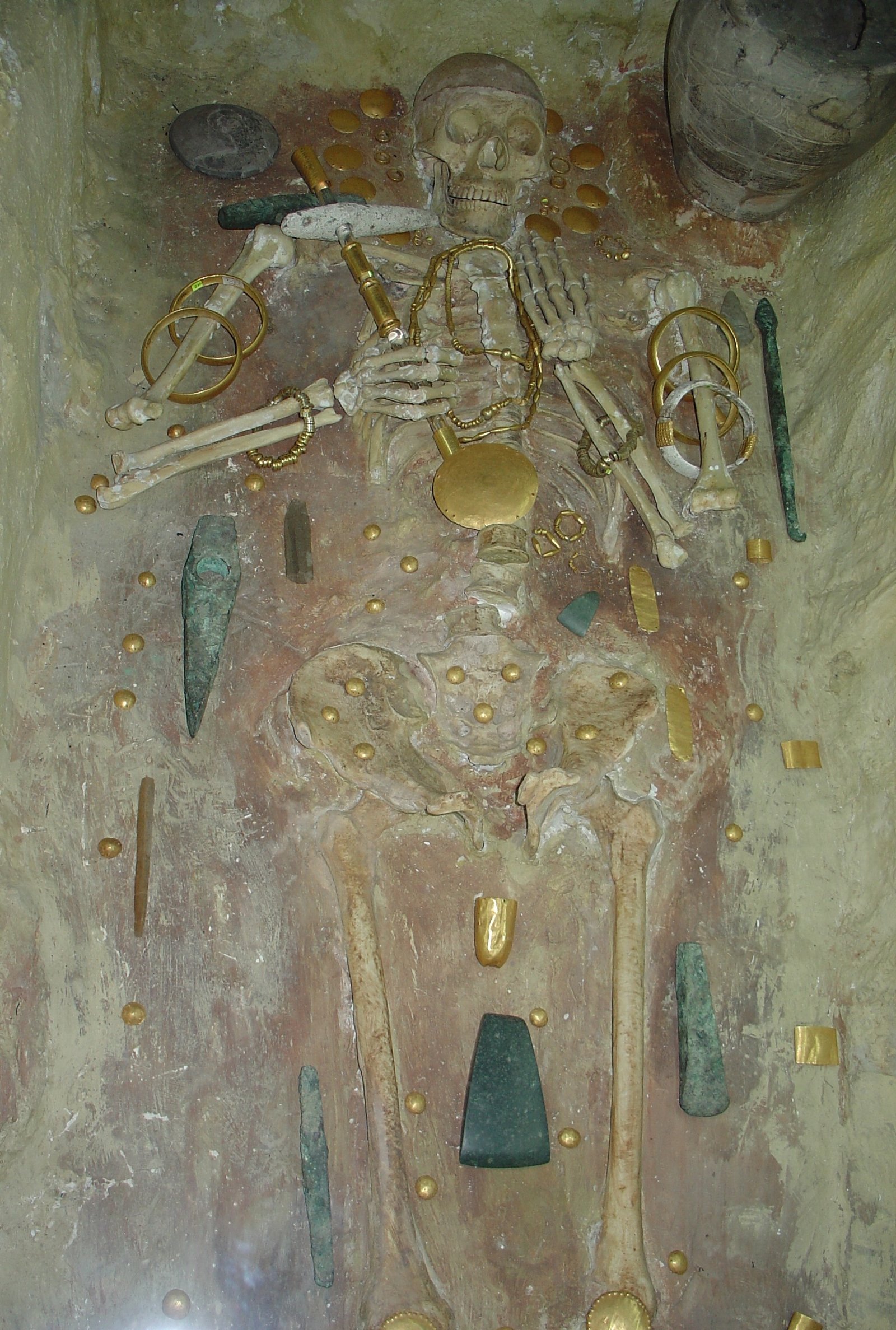
A Copper Age cemetery on the Bulgarian Black Sea coast, dated to c. 4600 BC, where a single grave held over 990 gold objects — the world’s oldest known gold treasure, predating Egyptian pharaonic gold by 1,500 years.
At a glance
The Varna Necropolis is a Chalcolithic burial site in the western industrial zone of Varna, on Bulgaria’s Black Sea coast. Discovered accidentally in 1972 during construction work, the cemetery contains 294 graves belonging to the Varna culture, a sophisticated society that flourished between approximately 4600 and 4200 BC. The necropolis is considered one of the most significant prehistoric sites in the world for a single reason: it contains the earliest large assemblage of worked gold objects yet found anywhere on earth. The 3,000-plus gold artefacts recovered — many of them from a single burial, Grave 43 — demonstrate a level of metallurgical skill, social differentiation, and symbolic elaboration that rewrote earlier assumptions about Chalcolithic Europe.
Key facts
- Period: c. 4600–4200 BC (Chalcolithic / Copper Age, Varna culture)
- Discovery: October 1972, by excavator operator Raycho Marinov during construction work; systematic excavation directed by Mihail Lazarov and Ivan Ivanov from 1972
- Scale: 294 graves excavated; over 3,000 gold objects totalling more than 6 kg; Grave 43 alone contained 990 gold objects weighing over 1.5 kg
- Status: Active archaeological site; primary collection at Varna Regional Museum of History
- Access: The original burial site is in an industrial zone with limited visitor infrastructure; the gold collection is on permanent display in Varna
History
On a morning in October 1972, a 22-year-old excavator operator named Raycho Marinov was clearing land for an electrical cable factory on the western edge of Varna when his machine broke through into a layer of soil containing unfamiliar objects. Marinov stopped work, collected what he had disturbed, and brought it to the Varna Museum of History. Among the objects were fragments of fired clay, copper tools, and gold. The site was immediately recognised as significant; systematic excavation under archaeologist Ivan Ivanov began within days and continued through the following two decades. What they found progressively dismantled the prevailing view of prehistoric Europe as a world of relative material simplicity.
The Varna culture — named for the site — was a lake- and sea-adjacent society that practised both agriculture and fishing, engaged in long-distance trade networks stretching from the Aegean to the Carpathians, and had developed, by approximately 4600 BC, the capacity to mine, smelt, and cast copper and gold with considerable technical precision. The granulation and surface decoration found on the Varna gold objects demonstrate craft specialisation and aesthetic intention of a kind previously associated only with much later Bronze Age civilisations.
Grave 43, excavated in 1974, contained the remains of an adult male buried in extended position with an extraordinary concentration of prestige objects: gold earrings, a solid gold sceptre, gold plaques sewn to a garment, a gold-sheathed penis cover, copper tools, and flint blades. The total gold content — 990 objects, 1.516 kg — was, and remains, the largest single concentration of gold from any burial site of comparable date in the world. Numerous other graves contained gold, copper, spondylus shell ornaments, and ceramic vessels, suggesting a stratified society in which wealth, and the symbolic power it represented, was already unevenly distributed.
What you see
The necropolis itself, in Varna’s industrial western quarter, is not set up as a visitor site — the graves were excavated, their contents removed to the museum, and the land largely returned to other uses. What survives above ground is modest. The encounter with Varna is therefore a museum encounter, and the Varna Regional Museum of History delivers it with appropriate weight: a dedicated hall in near-darkness, the gold displayed under controlled lighting in cases that allow close inspection. The objects are small — earrings the diameter of a fingertip, plaques thinner than a credit card — but the collective effect of 3,000 gold pieces arranged in approximately their burial positions is unlike almost anything else in European prehistoric display.
Grave 43 is reconstructed at roughly one-third of actual scale, with the gold objects positioned as they were found on and around the skeleton. The sceptre — a solid gold cylinder with a flared head — is the piece most immediately legible as a marker of authority: something made to be held, seen, and understood as power. The granulation on the earrings, examined under the display case magnification available in the museum, shows that the goldsmiths of the Varna culture were working at a level of precision not surpassed in European metalwork for another three millennia.
Practical information
- Opening hours: Varna Regional Museum of History: Tuesday–Sunday 10:00–17:00; closed Mondays
- Best season: Year-round for the museum; May–September if combining with Varna’s Black Sea coast
- Duration: 1.5–2 hours for the museum’s full prehistoric and Varna Necropolis collections
- Notes: Photography permitted in most areas; audio guides available. The museum also holds significant Hellenistic and Roman collections from the Black Sea coast.
Getting there
Varna Airport (VAR) has seasonal direct connections to major European cities and year-round services via Sofia. The museum is centrally located in Varna city, accessible by tram, bus, or a 15-minute walk from the main train station. Varna is Bulgaria’s third-largest city and the primary Black Sea resort hub, with extensive accommodation at all price points.
Nearby
- Varna Archaeological Museum — adjacent collection of Greek and Roman material from the Black Sea colonies
- Aladzha Monastery — 25 km north; medieval cave monastery complex carved into white limestone
- Cape Kaliakra — 65 km northeast; dramatic limestone headland with Bronze Age and medieval fortification remains
Sources
- Wikipedia: Varna Necropolis
- Varna Regional Museum of History: archaeologymuseumvarna.com
- Chapman, J. (1991). “The creation of social arenas in the Neolithic and Copper Age of SE Europe.” Sacred and Profane. Oxford University Committee for Archaeology.
Find it on the map
See this place and what’s around it →📷 Become a Cultural Heritage Online photographer
Share your photos of places: they stay published under your name as the author. The more they're seen, the more you get noticed — and soon a contest will reward the most appreciated photos.
Log in or sign up free to add a photoIs this page about you?
This page is read by travellers and heritage enthusiasts who find it on Google. Tell us how you are connected to this place and we will take it from there.