

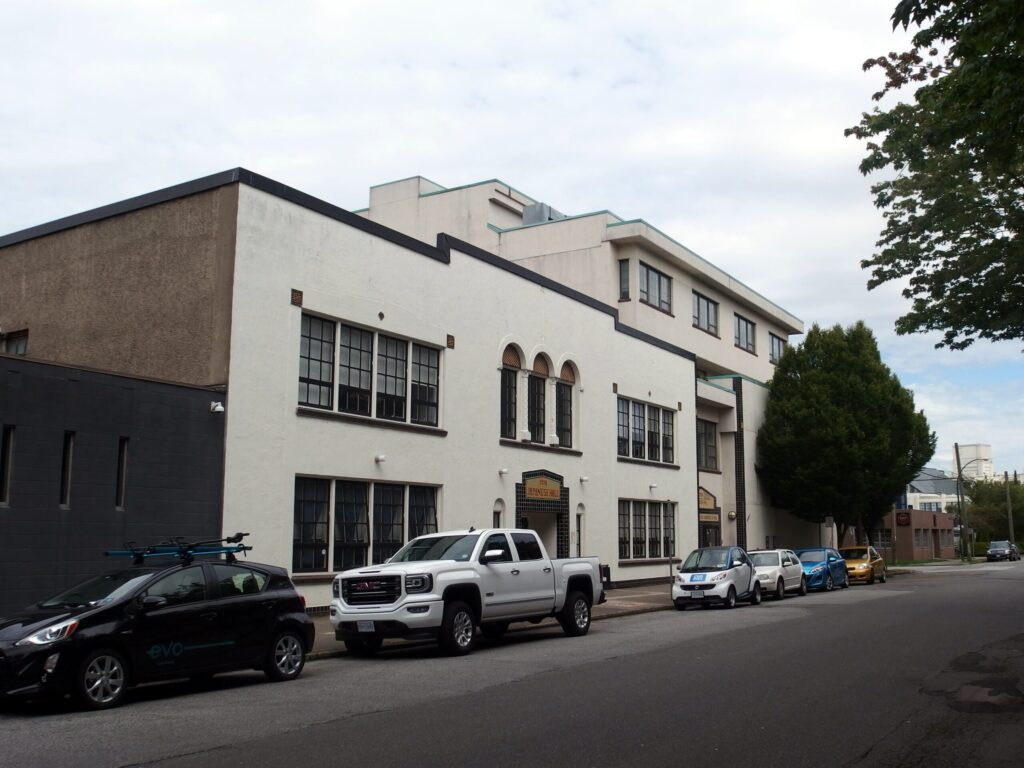
Canada’s oldest Japanese language school, anchoring Japantown since the early twentieth century.
At a glance
The Vancouver Japanese Language School stands in the heart of Japantown, a neighborhood shaped by waves of Japanese immigration to British Columbia. For over a century, the school has served as a vital cultural institution, transmitting language and heritage across generations.
History
Established in 1906 as the Vancouver Kyoritsu Nihon Kokumin Gakko (Vancouver Japanese Citizens’ School), the institution holds the distinction of being the oldest Japanese language school in Canada. Its founding reflects the maturation of Vancouver’s Japanese community in the early twentieth century, when families sought to preserve language and cultural identity alongside their children’s education in English-speaking Canada.
What you see
The school occupies a modest building situated within Japantown’s historic streetscape. Its architectural presence reflects the neighborhood’s character as a cultural enclave centered on Powell Street.
Cultural significance
The school represents a continuous thread of Japanese-Canadian community life and educational continuity. As Canada’s oldest institution of its kind, it documents the deep roots of Japanese settlement on the Pacific Coast and the role of language schools in preserving cultural identity during periods of significant social change.
Key facts
- Country: Canada
- City: Vancouver, British Columbia
- Founded: 1906
- Original name: Vancouver Kyoritsu Nihon Kokumin Gakko (Vancouver Japanese Citizens’ School)
- Location: Japantown
- Coordinates: 49.2841, -123.0938
Practical information & getting there
The school is located in Vancouver’s historic Japantown neighborhood, centered on Powell Street between Main and Commercial. For current visiting information and enrollment details, contact the school directly or check its website.
The present building dates from 1928, when the school moved into a new Art Deco hall on Alexander Street; during the Second World War the property was seized, and the community prevented its sale, reclaimed ownership in 1952 and reopened the school in 1953 — one of the only properties returned to Japanese Canadians after the war.
Sources & resources
Find it on the map
See this place and what’s around it →📷 Become a Cultural Heritage Online photographer
Share your photos of places: they stay published under your name as the author. The more they're seen, the more you get noticed — and soon a contest will reward the most appreciated photos.
Log in or sign up free to add a photoIs this page about you?
This page is read by travellers and heritage enthusiasts who find it on Google. Tell us how you are connected to this place and we will take it from there.
This entry stays online and free either way — and a free account lets you add to it yourself.