
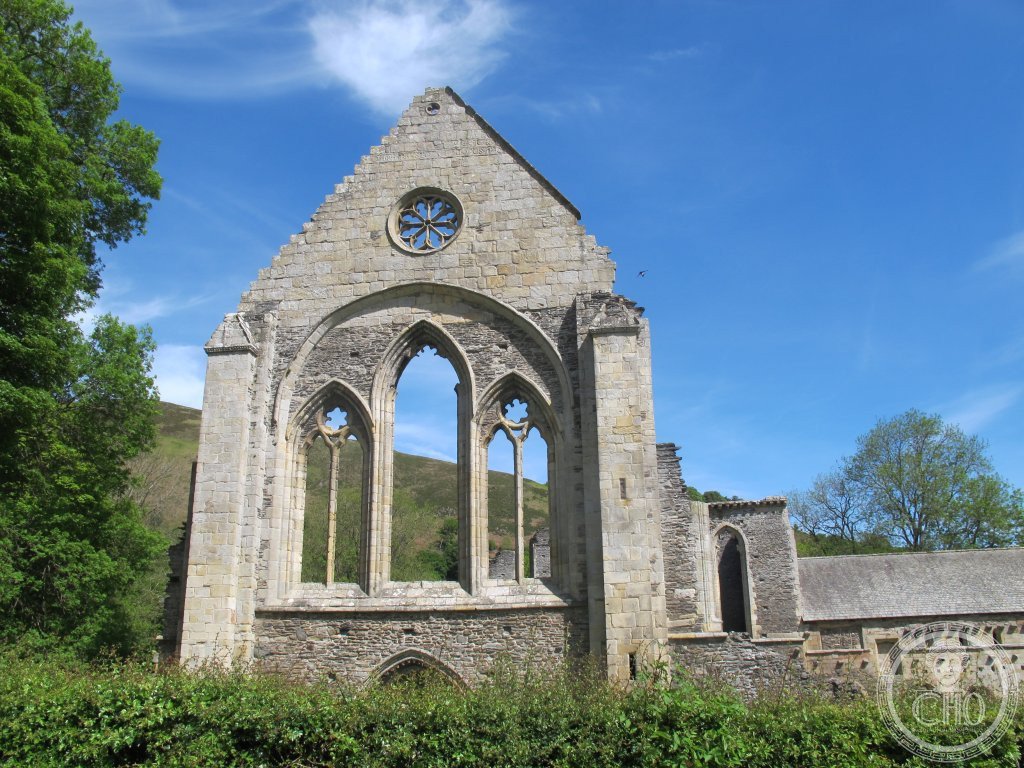
Founded in 1201 by Madog ap Gruffudd Maelor, lord of Powys Fadog, Valle Crucis was the last of the fourteen Cistercian foundations built in Wales. Its name, “Valley of the Cross”, comes from the nearby Pillar of Eliseg, a cross monument raised in the ninth century by King Cyngen of Powys in honour of his ancestors. In the second half of the fifteenth century the abbey became famous for its patronage of the Welsh bards and for its collection of literary manuscripts.
About Valle Crucis Abbey
Valle Crucis Abbey was founded in 1201 by Madog ap Gruffudd Maelor, ruler of Powys Fadog, situated some two kilometres north of the town of Llangollen, and stands as the last of fourteen Cistercian abbeys established anywhere in Wales. When the community was first founded, twelve monks took occupation of a temporary wooden church and domestic buildings, immediately beginning construction of more permanent structures built of roughly faced rubble stone; the founding monks came from Strata Marcella Abbey, another Cistercian house supported by the princes of Powys. The abbey’s distinctive name, meaning “Valley of the Cross,” derives from the nearby Eliseg’s Pillar, a stone cross monument dating to the 9th century, originally erected by Concenn, King of Powys, to honour his royal ancestors. The abbey’s early history was marked by a devastating fire in 1236, and an inscription set high above the west window records that this part of the building was completed under Abbot Adam, who held office from 1330 to 1344. During the second half of the 15th century, Valle Crucis achieved particular renown as a centre of scholarship, celebrated especially for its patronage of Welsh bards and for its significant collection of Welsh literary manuscripts, positioning the abbey as an important cultural as well as religious institution within late medieval Wales. By the time of the wider dissolution of the monasteries under King Henry VIII in 1537, Valle Crucis was already in decline, and the abbey was formally suppressed along with the rest of England and Wales’s monastic houses that same year.
Key facts
- 1201: founded by Madog ap Gruffudd Maelor, ruler of Powys Fadog
- Rank: the last of fourteen Cistercian abbeys founded in Wales
- Name origin: from the nearby 9th-century Eliseg’s Pillar
- 1236: the abbey damaged by fire
- 1330-1344: west window section completed under Abbot Adam
- Late 15th century: renowned for patronage of Welsh bards and literary manuscripts
- 1537: dissolved under Henry VIII
History
As the last of Wales’s fourteen Cistercian foundations, Valle Crucis marks something of a closing chapter in the country’s medieval Cistercian expansion, its 1201 establishment coming toward the end of a broader wave of Cistercian monastic settlement that had reshaped the religious landscape of Wales over the preceding half-century. The abbey’s naming after the nearby Eliseg’s Pillar directly ties the 13th-century Cistercian foundation to a much older layer of early medieval Welsh royal commemoration, linking the monastery physically and symbolically to the dynastic memory of the kings of Powys who had ruled the same valley centuries earlier.
Valle Crucis’s late medieval flowering as a centre of bardic patronage and manuscript preservation situates the abbey within the wider tradition of Welsh Cistercian houses serving as custodians of native literary and historical culture, a role that made the 1537 dissolution a loss not only for institutional religious life but for the preservation of Welsh-language literary heritage more broadly.
What you see
The abbey’s substantial surviving ruins include the west front of the church, its elaborate window still standing above the site of the original entrance, alongside sections of the chapter house and other monastic buildings. The site preserves large parts of its original 13th- and 14th-century structure despite centuries of decay following the 1537 dissolution, making it one of the better-preserved Cistercian ruins in Wales.
Practical information
- Opening hours: generally open daily with seasonal variation; check current hours before visiting; admission fee applies
- Address: A542, Llantysilio, Llangollen, Denbighshire LL20 8DW, Wales, United Kingdom
Getting there
Valle Crucis Abbey is located about two kilometres north of Llangollen, in Denbighshire, North Wales, reachable by road. GPS: 52.9887° N, -3.1865° E.
Nearby
- Eliseg’s Pillar — the 9th-century cross monument that gave the abbey its name, nearby
- Llangollen — the nearest town
- Pontcysyllte Aqueduct — the UNESCO-listed canal aqueduct, within the same region
Sources
- Wikipedia — “Valle Crucis Abbey” (en.wikipedia.org)
- Cadw — “Valle Crucis Abbey” (cadw.gov.wales)
- Historic UK — “Valle Crucis Abbey” (historic-uk.com)
Find it on the map
See this place and what’s around it →📷 Become a Cultural Heritage Online photographer
Share your photos of places: they stay published under your name as the author. The more they're seen, the more you get noticed — and soon a contest will reward the most appreciated photos.
Log in or sign up free to add a photo