

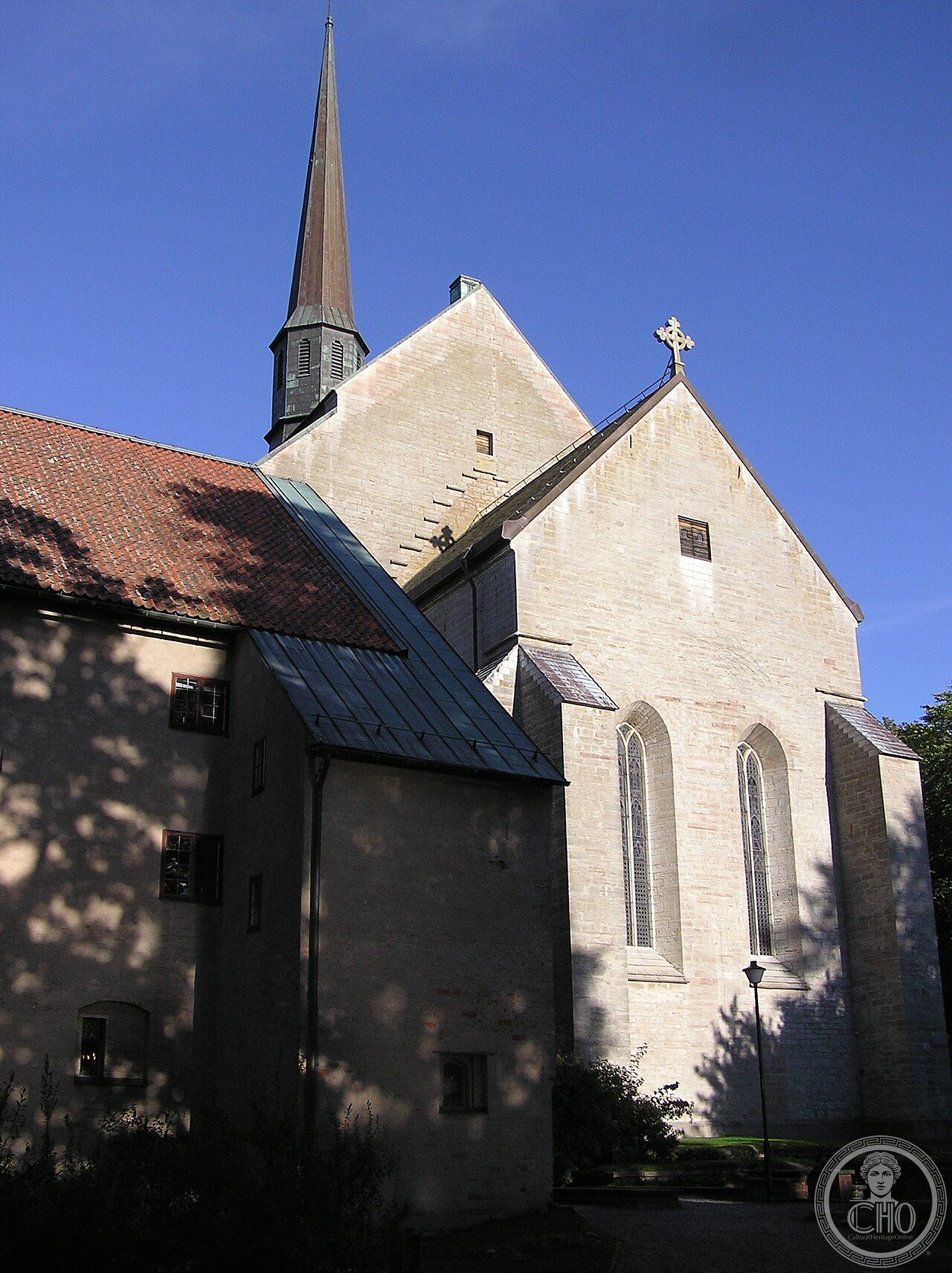
Founded in 1346 by Saint Bridget of Sweden with the support of King Magnus IV and Queen Blanche, Vadstena was conceived as a double monastery: twenty-five monks, led by a confessor general, and sixty nuns, led by a prioress, lived together under the authority of a single abbess, elected by both the monks and the nuns. It became the mother house of the whole Bridgettine order, with foundations in England, Estonia, Finland and Poland.
About Vadstena Abbey
Vadstena Abbey was founded in 1346 by Saint Bridget of Sweden, who developed the idea for a new religious community after the death of her husband; the foundation was richly endowed by King Magnus IV of Sweden and Queen Blanche of Namur, who donated ten farms, including that of Vadstena itself in Östergötland. The Bridgettine Order, formally the Order of the Most Holy Saviour, was founded by Bridget in 1344 and approved by Pope Urban V in 1370. Vadstena was structured as a double monastery: a community of 25 monks organised under a General Confessor, and 60 nuns under a prioress, with the whole community governed by an abbess elected jointly by monks and nuns — an unusual governance model that placed ultimate authority in a woman’s hands. The original wooden abbey church burned down in 1388 and was rebuilt in Gothic style, consecrated on 16 February 1430. Vadstena served as the international motherhouse of the Bridgettine Order from 1346 to 1595, sending founding communities to Syon Abbey in England (1415), Reval in Estonia, Nådendal in Finland, and Danzig in Poland. Following Sweden’s Reformation in 1527, Vadstena uniquely retained permission to accept new novices for some decades, with its abbess and prioress required to swear the Tridentine Oath of 1564, but Duke Charles — later King Charles IX — ordered the abbey’s dissolution in 1594, and the last nuns departed in 1596.
Key facts
- Foundation: 1346, by Saint Bridget of Sweden, endowed by King Magnus IV and Queen Blanche
- Structure: double monastery, 25 monks and 60 nuns, governed by a single elected abbess
- Abbey church: original wooden church burned 1388; rebuilt in Gothic style, consecrated 16 February 1430
- Motherhouse: of the Bridgettine Order, 1346-1595, with daughter houses in England, Estonia, Finland, Poland
- Dissolution: ordered 1594 by Duke Charles (later Charles IX); last nuns departed 1596
- Today: Evangelical-Lutheran parish church, 2,500-3,000 pilgrims daily in summer; a Bridgettine convent, Pax Mariae, re-established nearby in 1963
History
The governance structure Bridget designed for Vadstena — a double community of monks and nuns unified under a single abbess with authority over both — represented a genuinely unusual model of female religious leadership for 14th-century Europe, one that persisted at the abbey’s core for two and a half centuries until its dissolution. Vadstena’s rapid expansion into an international network of daughter houses across England, the Baltic, and Poland within decades of its founding demonstrates how quickly a single Swedish royal-sponsored foundation could become a genuinely pan-European monastic order, carrying Bridget’s distinctive governance model far beyond Scandinavia.
Vadstena’s unusual survival of several decades into the Swedish Reformation before its eventual 1594 dissolution — continuing to accept novices even as the rest of Sweden’s monastic institutions were being suppressed — reflects the special status the abbey held in Swedish religious and royal life as the resting place of Saint Bridget’s relics and the country’s principal centre of native sainthood, a status strong enough to delay, though not ultimately prevent, its closure.
What you see
The abbey church, rebuilt in Gothic style after the 1388 fire and consecrated in 1430, remains in active use today as a Lutheran parish church within the Diocese of Linköping, drawing thousands of visitors and pilgrims especially during the summer months. Surviving convent buildings around the church, including the former royal palace donated by the Bjälbo dynasty and the separate monks’ and nuns’ cloisters, still trace the outline of the double monastery’s original layout, though much has been repurposed over the centuries since the 1594 dissolution.
Practical information
- Opening hours: the abbey church is generally open daily, especially during summer; check current hours before visiting; free admission
- Address: Vadstena Klosterkyrka, Lasarettsgatan, 592 21 Vadstena, Sweden
Getting there
Vadstena is reachable by car from Linköping (approximately 45 minutes) in Östergötland county, on the shore of Lake Vättern. GPS: 58.4508° N, 14.8915° E.
Nearby
- Vadstena Castle — a 16th-century royal Renaissance castle in the same town
- Lake Vättern — Sweden’s second-largest lake, on whose shore Vadstena sits
- Pax Mariae — the modern Bridgettine convent re-established nearby in 1963
Sources
- Wikipedia — “Vadstena Abbey” and “Bridgettines” (en.wikipedia.org)
- Catholic Encyclopedia (1913) — “Abbey of Vadstena” (newadvent.org)
- UpplevVadstena.se — “Vadstena Abbey” (upplevvadstena.se)
Find it on the map
See this place and what’s around it →📷 Become a Cultural Heritage Online photographer
Share your photos of places: they stay published under your name as the author. The more they're seen, the more you get noticed — and soon a contest will reward the most appreciated photos.
Log in or sign up free to add a photo