
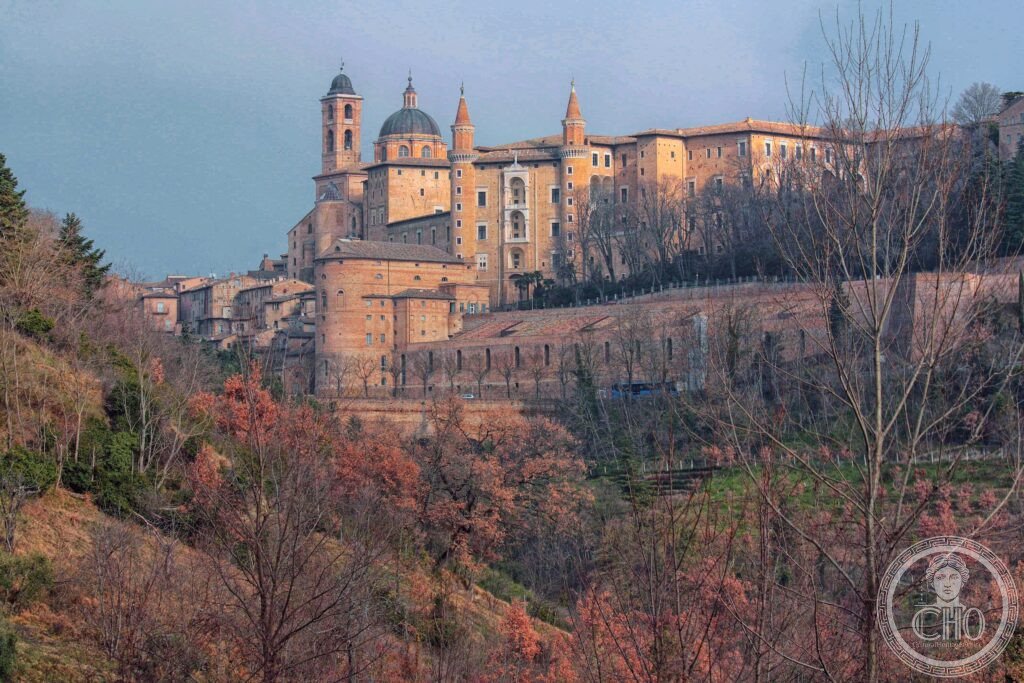
Urbino’s hilltop skyline, dominated by the twin towers of the Palazzo Ducale, preserves the built ambition of Federico da Montefeltro’s Renaissance court almost intact. Inside, the intarsia studiolo remains one of the finest surviving examples of trompe-l’œil wood inlay from the fifteenth century.
At a glance
Urbino is a hill town in the Marche region built around the Palazzo Ducale, the residence of Federico da Montefeltro, a condottiero who spent his military earnings on architecture, scholarship and book-collecting. The palace, begun under Maso di Bartolomeo and largely constructed under Luciano Laurana between 1465 and 1472, was completed by Francesco di Giorgio Martini. Its twin cylindrical towers, the Torricini, are among the most recognisable features of the old town’s profile.
The town is also the birthplace of Raffaello Sanzio, whose father Giovanni Santi worked as a painter at Federico’s court. The historic centre of Urbino was inscribed on the UNESCO World Heritage List in 1998.
Key facts
- Palazzo Ducale: begun 1454 under Maso di Bartolomeo, principal construction 1465–1472 under Luciano Laurana, completed 1480–1482 by Francesco di Giorgio Martini.
- Torricini: the twin cylindrical towers on the east façade, built by Laurana, standing 32 metres tall with a courtyard between them known as the cortiletto del Pasquino.
- City walls: the fifteenth-century fortifications by Francesco di Giorgio Martini, laid out on an irregular hexagonal plan following the town’s terrain.
- Studiolo: Federico’s private study on the piano nobile, decorated with 28 intarsia panels of illusionistic open cabinets, designed with input attributed to Botticelli and Baccio Pontelli and executed by the workshops of Giuliano and Benedetto da Maiano.
- UNESCO status: the historic centre of Urbino was inscribed in 1998 under reference 828.
History
Federico da Montefeltro ruled Urbino as count from 1444 and as duke from 1474 until his death in 1482. He built his reputation and his fortune as a condottiero, commanding armies for nearly four decades in the service of the papacy, Milan, Naples and Florence, and was made a Knight of the Garter by Edward IV of England in 1474. Piero della Francesca’s portrait of him, now in the Uffizi, shows only his right profile, a convention adopted after Federico lost his right eye and damaged the bridge of his nose in a jousting accident at Pesaro in 1450.
Federico used his military income to build one of the great humanist courts of the Renaissance, assembling a library of illuminated manuscripts that was later sold to the Vatican by his Della Rovere heirs in 1657 and now forms the Fondo Urbinate of the Biblioteca Apostolica Vaticana. Raffaello Sanzio was born in Urbino in 1483 and grew up watching his father paint at the ducal court, before the court’s decline under Federico’s son Guidobaldo led him to move to Perugino’s workshop.
The historic centre of Urbino, built largely around Federico’s patronage, was inscribed on the UNESCO World Heritage List in 1998.
What you see
The visit to the Palazzo Ducale, now home to the Galleria Nazionale delle Marche, begins in the Cortile d’Onore, Laurana’s courtyard built with Ionic columns and Corinthian pilasters on a herringbone brick floor in Adriatic sandstone. The state rooms of the piano nobile include the Sala del Trono, with its red damask walls and gilded coffered ceiling, and lead to the studiolo, Federico’s small private study whose lower walls are entirely covered in intarsia panels depicting open cabinets filled with mathematical and musical instruments and rolled documents rendered in trompe-l’œil wood inlay.
The Sala delle Udienze holds Piero della Francesca’s Flagellazione di Cristo, whose three foreground figures remain a subject of scholarly debate. A short walk away, the Casa Natale di Raffaello on Via Raffaello preserves the room traditionally identified as the artist’s birthplace, along with a small ground-floor fresco of the Madonna attributed to his father, Giovanni Santi.
Practical information
- Palazzo Ducale and Galleria Nazionale delle Marche: Piazza Duca Federico; check the museum’s official channels for current admission and opening times.
- Casa Natale di Raffaello: Via Raffaello 57; check official sources for visiting hours.
- Cathedral: the Duomo was rebuilt by Giuseppe Valadier after the 1789 earthquake, though its fifteenth-century bell tower survives.
Getting there
Urbino can be reached from nearby towns in the Marche and neighbouring regions; travellers typically approach via road connections from larger centres such as Bologna, Rimini and Ancona, and should check current timetables for the best route.
Nearby
- Duomo di Urbino — within the old town, rebuilt after the 1789 earthquake with its original quattrocento bell tower intact.
- City walls — encircling the historic centre, built under Francesco di Giorgio Martini in the late fifteenth century.
- Casa Natale di Raffaello — a short walk from the Palazzo Ducale, on Via Raffaello.
Sources
- Baldesar Castiglione, Il Cortigiano (1528)
- UNESCO (World Heritage List, reference 828)
Gallery
Find it on the map
See this place and what’s around it →📷 Become a Cultural Heritage Online photographer
Share your photos of places: they stay published under your name as the author. The more they're seen, the more you get noticed — and soon a contest will reward the most appreciated photos.
Log in or sign up free to add a photoIs this page about you?
This page is read by travellers and heritage enthusiasts who find it on Google. Tell us how you are connected to this place and we will take it from there.