

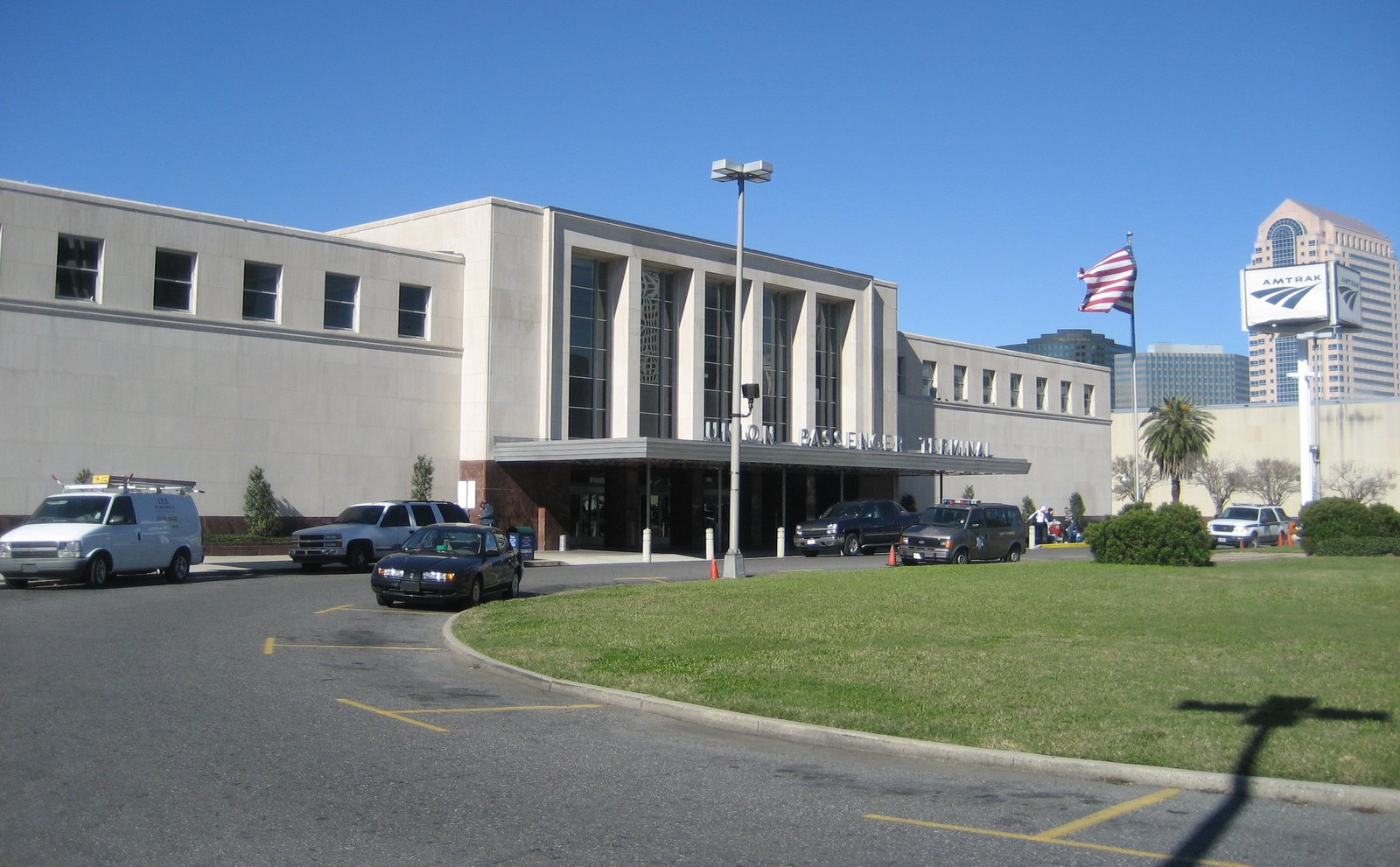

Opened on 8 January 1954 on Loyola Avenue, the Union Passenger Terminal consolidated New Orleans’ five competing rail stations into a single Mid-Century Modernist hub — the last major American passenger terminal of the classic railway era, still serving Amtrak today.
At a glance
New Orleans Union Passenger Terminal opened in 1954 at 1001 Loyola Avenue, consolidating five previously separate railroad termini that had served the city from different points in the downtown grid. Its Postwar Modernist design — stone facade, marble, terrazzo, and metal-and-glass detailing in the vocabulary of mid-century civic architecture — was the language of a nation investing in post-war infrastructure and civic confidence. The terminal was one of the last large passenger rail stations built in the United States before the private railroad passenger business entered terminal decline. The station was designed by Wogan and Bernard, Jules K. de la Vergne, and August Perez & Associates. It continues to serve as New Orleans’ Amtrak station and Greyhound bus terminal, its interior largely intact from the 1954 opening.
Key facts
- Opened: 8 January 1954
- Architects: Wogan and Bernard; Jules K. de la Vergne; August Perez & Associates
- Style: Mid-Century Modernist / Postwar Modern
- Address: 1001 Loyola Avenue, New Orleans, LA 70113
- Current operators: Amtrak (passenger rail); Greyhound (intercity bus)
- Rail services: Crescent (New York–New Orleans), City of New Orleans (Chicago–New Orleans), Sunset Limited (New Orleans–Los Angeles)
- Signature feature: Mid-Century Modernist stone facade with horizontal aluminium banding and projecting canopy
History
By the late 1940s, New Orleans’ railroad infrastructure had become an obstacle to efficient operations: six separate termini — each owned by a different railroad — served the city from dispersed downtown locations, with no single point of transfer. The construction of a unified Union Passenger Terminal was the result of extended negotiations between the city and the railroad companies, eventually supported by Federal funds and a joint operating agreement that brought the Illinois Central, Southern Railway, Louisville & Nashville, Texas & Pacific, and Louisiana & Arkansas railroads under one roof.
The terminal opened on 8 January 1954 in the mid-century modernist vocabulary that characterised postwar American civic architecture — stone facades, generous interior volumes, and the confidence of a country investing in public infrastructure. The building’s restrained geometry and quality materials were a deliberate statement about rail travel’s legitimacy, even as the private automobile and commercial aviation were beginning to erode the passenger rail market.
The terminal’s timing proved bittersweet: it opened just as the post-war decline of American passenger railroads was accelerating, and its operators had surrendered most intercity traffic to airlines and automobiles within a decade. The formation of Amtrak in 1971 stabilised a reduced rail service, and the terminal has continued to function as New Orleans’ main rail gateway. Its three remaining Amtrak routes — the Crescent, the City of New Orleans, and the Sunset Limited — make it one of the busiest Amtrak stations in the South.
What you see
The terminal’s Loyola Avenue facade reflects mid-century civic modernism: a stone-clad horizontal volume with a cantilevered entrance canopy, metal-framed windows in a regular grid, and decorative spandrel panels between bays. The palette — pale stone, bronze metalwork, terrazzo inside — is restrained and civic in register, more aligned with the postwar International Style than the streamlined aesthetic of the previous decade. The architects Wogan and Bernard, Jules K. de la Vergne, and August Perez & Associates produced a building that reads as dignified and efficient rather than theatrical.
Inside, the main waiting hall retains its 1954 character: terrazzo floors, coffered ceiling, and the warm-toned materials that distinguish the building’s interior from the more austere institutional spaces of the same period. The departure concourse with its original signage and aluminium fixtures is one of the better-preserved mid-century rail interiors in the South. The terminal is best experienced at platform level when an Amtrak train is being prepared — the spatial scale and the operational continuity linking the 1954 building to the present recall the moment when passenger rail still seemed to have a future in American cities.
Practical information
- Access: Open daily for Amtrak and Greyhound passengers; interior accessible with ticket
- Best time: Platform access when trains are arriving or departing; morning light on the facade
- Time needed: 20–30 minutes architecture visit; full terminal experience with train departure
- GPS: 29.9462° N, 90.0786° W
- Nearest transit: Bus routes on Loyola Avenue; Superdome/Union Passenger Terminal stop
Getting there
The Union Passenger Terminal stands at 1001 Loyola Avenue, adjacent to the Caesars Superdome and a 10-minute walk from Canal Street and the Saenger Theatre. Louis Armstrong International Airport is accessible by taxi or rideshare in approximately 35 minutes. Amtrak’s Crescent and City of New Orleans depart from and arrive at this terminal; Greyhound interstate buses also operate from the same building.
Nearby
- Caesars Superdome (1975) — immediately adjacent; the scale contrast between the 1954 Streamline terminal and the 1970s stadium illustrates two decades of civic ambition
- Saenger Theatre (1927) — Emile Weil’s atmospheric Moorish cinema on Canal Street, 10 minutes’ walk north-east
- Charity Hospital (1939) — PWA Moderne medical tower on Tulane Avenue, 1 mile north
Sources
- Droege, John A. Passenger Terminals and Trains. McGraw-Hill, 1916 (historical context, rail terminal typology)
- New Orleans Public Library, Louisiana Collection — city planning and transportation records, nutrias.org
- Amtrak historical records, New Orleans terminal — amtrak.com
- Campanella, Richard. Bienville’s Dilemma. Center for Louisiana Studies, 2008
- Wikidata, New Orleans Union Passenger Terminal Q14691825 — wikidata.org
Find it on the map
See this place and what’s around it →📷 Become a Cultural Heritage Online photographer
Share your photos of places: they stay published under your name as the author. The more they're seen, the more you get noticed — and soon a contest will reward the most appreciated photos.
Log in or sign up free to add a photoIs this page about you?
This page is read by travellers and heritage enthusiasts who find it on Google. Tell us how you are connected to this place and we will take it from there.