

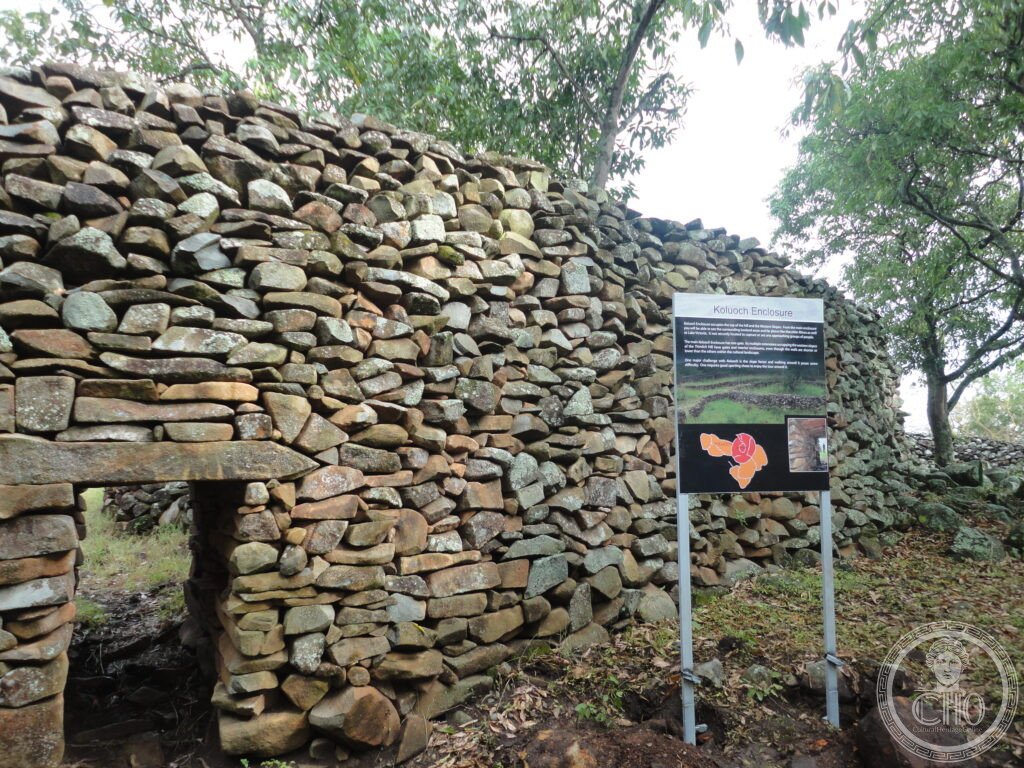
In the Lake Victoria basin, a cluster of dry-stone enclosures built without mortar survives as the best-preserved example of a construction tradition that once stretched across western Kenya, Uganda and Tanzania, raised by Luo settlers to protect homesteads, cattle and families from raiders.
At a glance
Thimlich Ohinga is a homestead enclosure, or ohinga, built from local granite and quartzite stones fitted together without mortar. The walls are between one and four metres thick and up to four metres high, laid in courses using stones selected and placed rather than cut or dressed. The main enclosure is roughly 150 metres in diameter and contains four nested inner enclosures, with a continuous circuit of dry-stone wall and a deliberately narrowed gateway. Three smaller satellite enclosures, called gunda, stand around the main structure and once housed sub-family units.
The entrance passage is the narrowest point of the whole structure, built so that only one person could pass through at a time and forced to turn sideways to do so, making it difficult for armed attackers to enter quickly. Inside, the enclosure held houses for an extended family group along with a cattle pen in the inner section. Thimlich Ohinga is the largest and best-preserved single site to survive from a tradition that once included 521 identified locations across western Kenya, of which 138 still retain standing dry-stone structures.
Key facts
- Location: Migori County, western Kenya, in the Lake Victoria basin.
- Date: constructed between the 15th and 19th centuries CE.
- Builders: the Luo, a Nilotic people, as part of a wider pastoral tradition also linked to the Acholi, Langi and Padhola of Uganda and the Nuer and Dinka of South Sudan.
- Comparison: related in technique to Great Zimbabwe’s Shona-Bantu dry-stone tradition, using undressed granite without mortar, but the two traditions developed independently among different cultural groups.
- UNESCO status: inscribed as a World Heritage Site in 2018, though the inscription covers only the Thimlich site itself rather than the wider set of 521 known ohinga locations, most of which remain outside the protected boundary and continue to deteriorate.
History
The Luo people, a Nilotic group, migrated from the Nile Valley, in what is now roughly South Sudan, southward into the Lake Victoria basin from the 15th century CE onwards. They brought with them the tradition of building ohinga enclosures, and the construction of such a wall marked the true establishment of a new settlement: a community was not considered permanently settled until its ohinga was complete.
The tradition continued until the early 20th century, when British colonial administration brought a level of pacification to the region that removed the practical need for defensive stone enclosures.
What you see
The site is managed by the National Museums of Kenya and has a small visitor centre with a site manager. Guided tours are offered and are worth taking, since the site manager can explain construction techniques and the oral traditions attached to different sections of wall. A typical visit follows the outer wall of the main enclosure, taking in the entrance passage and its deliberate narrowing, before moving into the interior to see the positions of original house bases and the concentric inner enclosures once used by different family segments.
The three satellite enclosures can be reached on foot around the perimeter; some retain partially standing walls. On clear days there are views across the Lake Victoria basin towards the lake itself, several kilometres to the west.
Practical information
- Access: reached via Migori town, from where local transport such as boda-boda motorcycle taxis or a hired car covers the final stretch to the site.
- Facilities: there are no facilities at the site itself beyond the small visitor centre; bring water and sun protection.
- Best time to visit: the dry seasons, roughly June to August and December to February, since the dirt road to the site can become impassable in the rains.
- Entry: a fee applies; check the National Museums of Kenya’s official channels for current details.
Getting there
The nearest large city is Kisumu, from where regular matatu minibuses run south to Migori town. From Migori, a boda-boda motorcycle taxi or a hired private car completes the journey to the site. Accommodation is available in Migori at budget guesthouses or in Kisumu, which offers more comfortable options.
Nearby
- Lake Victoria — around 15 km west, the world’s second-largest freshwater lake by area and Africa’s largest, with fishing communities, a Nile perch fishery, and Rusinga Island, home to independence leader Tom Mboya and the site of a major Miocene hominoid fossil discovery.
- Ruma National Park — around 30 km northwest, a small and rarely visited park that is the only habitat in Kenya for the endangered roan antelope, alongside Jackson’s hartebeest, oribi, leopard and topi.
Sources
- Wikipedia, Thimlich Ohinga
- Wikipedia, Luo people (Kenya and Tanzania)
- UNESCO, Thimlich Ohinga Archaeological Site, WHS reference 1450
Find it on the map
See this place and what’s around it →📷 Become a Cultural Heritage Online photographer
Share your photos of places: they stay published under your name as the author. The more they're seen, the more you get noticed — and soon a contest will reward the most appreciated photos.
Log in or sign up free to add a photo