
Timo and Tuomo Suomalainen, the two architect brothers who won the 1961 competition, had grown up on Suursaari, a granite island in the Gulf of Finland that became Soviet territory after the Second World War, forcing their family to flee. That personal bond with the granite rock of a lost childhood returns, decades later, in their most radical choice: to cut the entire church directly into the living granite of a Helsinki hill.
About Temppeliaukio Church
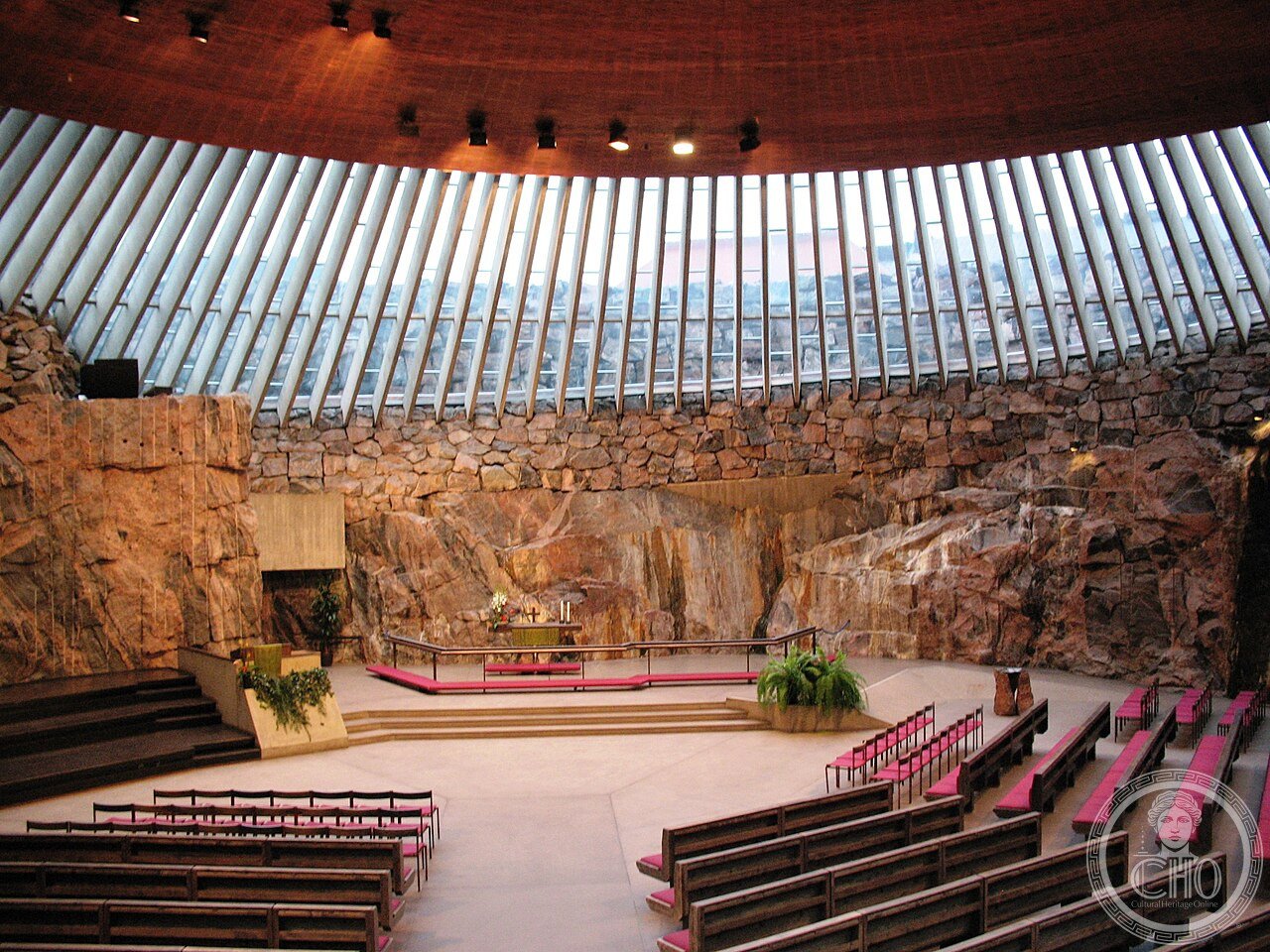
Plans for a church on the Temppeliaukio (Temple Square) site date back to the 1930s, when a plot of land was chosen and an initial design competition held; a winning design by J.S. Sirén from a second competition round was interrupted in its early stages by the outbreak of the Second World War in 1939. After the war, a further competition was held, won in 1961 by the architect brothers Timo and Tuomo Suomalainen, who brought a distinctive personal perspective to the commission: they had grown up on Suursaari, a granite island in the Gulf of Finland that became Soviet territory after the war, forcing their family into refugee status. Construction of the church finally began in February 1968, with the building excavated directly out of the solid bedrock of the site, and the completed “rock church” was consecrated in September 1969. Its most distinctive feature — leaving the excavated granite walls entirely exposed rather than cladding them — was initially considered by the Suomalainen brothers too radical to include in their original competition entry; they only embraced it after the conductor Paavo Berglund shared his knowledge of acoustics from leading concert halls and the acoustical engineer Mauri Parjo provided technical requirements for the wall surfaces, at which point the architects realised that leaving the rock exposed would itself satisfy every acoustic requirement. Natural light floods the interior through a ring of skylights encircling the church’s central copper dome. The church’s organ, built by Veikko Virtanen, contains 43 stops and 3,001 pipes. Today, Temppeliaukio is used frequently as a concert venue thanks to its exceptional natural acoustics, and ranks among Helsinki’s most popular attractions, drawing an estimated half a million visitors annually.
Key facts
- 1930s: site selected, first design competitions held, interrupted by WWII in 1939
- 1961: brothers Timo and Tuomo Suomalainen win the post-war design competition
- February 1968 – September 1969: construction; church excavated directly into bedrock and consecrated
- Exposed rock walls: chosen after acoustical guidance from conductor Paavo Berglund and engineer Mauri Parjo
- Design: a copper dome ringed by skylights, admitting natural light into the rock interior
- Organ: built by Veikko Virtanen, 43 stops and 3,001 pipes
- Today: a popular concert venue; approximately 500,000 visitors annually
History
The Suomalainen brothers’ own biographical connection to Suursaari, a granite island lost to Soviet annexation after the Second World War, adds a genuinely personal dimension to their eventual decision to excavate an entire church directly from bedrock rather than build conventionally atop it — a choice that can be read as translating a specific childhood landscape of loss into a permanent architectural statement, whether or not the architects themselves framed it in those terms. Their initial hesitation to propose leaving the rock walls fully exposed, considering the idea too radical for a formal competition submission, and their subsequent full embrace of it only once acoustical experts confirmed its practical benefits, illustrates how a design decision that today defines the building’s entire identity emerged from a combination of aesthetic caution and later technical validation rather than pure artistic conviction alone.
Temppeliaukio’s continuous popularity as both an active Lutheran parish church and one of Helsinki’s most visited tourist attractions, alongside its frequent use as a concert venue exploiting the very acoustic properties that convinced its architects to expose the rock, reflects an unusually successful convergence of religious, architectural, and musical functions within a single 20th-century sacred building.
What you see
The church’s exterior presents little more than a low rock outcrop crowned by its copper dome and surrounding ring of skylights, giving scant hint of the excavated space below. Inside, the raw, undressed granite walls rise around the congregation, admitting natural light from above and creating the exceptional natural acoustics that make the church a favoured concert setting. Veikko Virtanen’s 3,001-pipe organ complements the space’s musical function.
Practical information
- Opening hours: generally open daily with seasonal variation and closures for services/concerts; check current hours before visiting; admission fee applies
- Address: Lutherinkatu 3, 00100 Helsinki, Finland
Getting there
Temppeliaukio Church is reachable on foot or by tram within central Helsinki, in the Etu-Töölö district. GPS: 60.1730° N, 24.9252° E.
Nearby
- Sibelius Monument — a nearby monument to the Finnish composer, in Sibelius Park
- Helsinki city centre — the surrounding downtown district
- Töölö Bay — a nearby waterfront area
Sources
- Wikipedia — “Temppeliaukio Church” (en.wikipedia.org)
- ArchDaily — “A Modernist Church Set in Stone: The Story Behind the Temppeliaukio Kirkko” (archdaily.com)
- Atlas Obscura — “Temppeliaukio Church in Helsinki” (atlasobscura.com)
Find it on the map
See this place and what’s around it →📷 Become a Cultural Heritage Online photographer
Share your photos of places: they stay published under your name as the author. The more they're seen, the more you get noticed — and soon a contest will reward the most appreciated photos.
Log in or sign up free to add a photo