
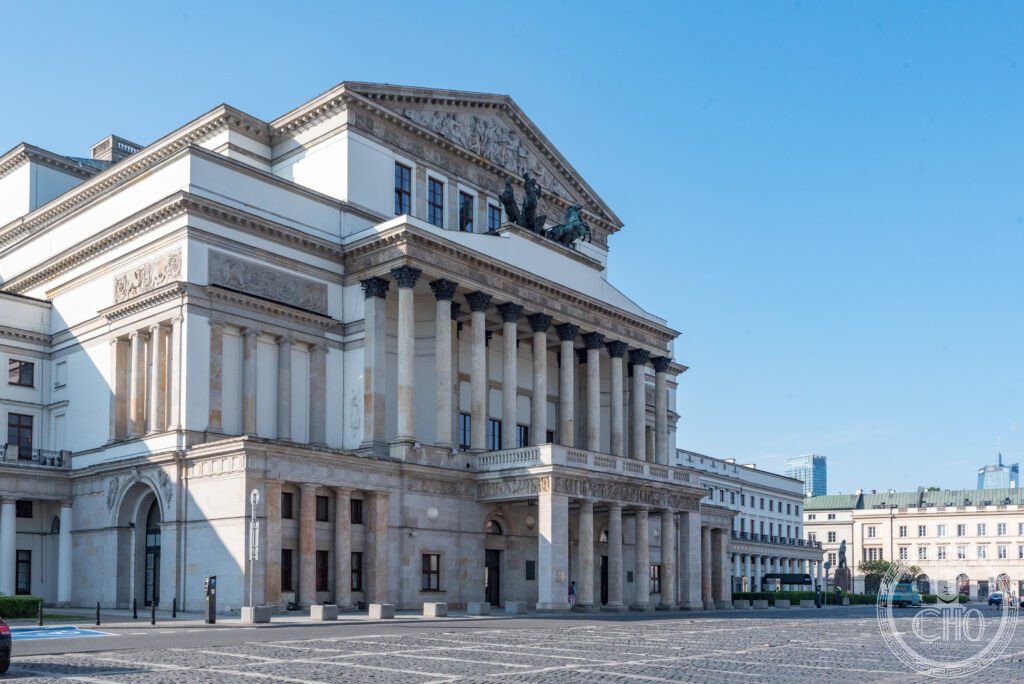
Antonio Corazzi’s 1833 Neoclassical giant on Theatre Square is one of the largest opera houses in the world by stage area — burned in 1939, rebuilt in 1965, and still anchoring Polish national culture with three resident companies.
At a glance
The Teatr Wielki (Grand Theatre) occupies the entire north side of Theatre Square (Plac Teatralny) in central Warsaw, its 140-metre facade of Ionic columns, pedimented pavilions, and bas-relief friezes constituting one of the most imposing neoclassical elevations in Eastern Europe. Designed by Italian architect Antonio Corazzi for the Kingdom of Poland and inaugurated on 24 February 1833, the theatre was destroyed by German fire on 17 September 1939 during the siege of Warsaw. Rebuilt between 1951 and 1965 to enlarged plans, it now houses the Polish National Opera and the National Ballet and, by stage area, stands among the five largest opera houses on earth.
Key facts
- Architect: Antonio Corazzi (1792–1877), Italian neoclassical architect who settled in Warsaw; designed multiple civic buildings for the Kingdom of Poland
- Original inauguration: 24 February 1833 with Karol Kurpiński’s opera Cecylia Piaseczyńska
- Destroyed: September 1939, burned during the German siege of Warsaw
- Rebuilt: 1951–1965 under architects Bohdan Pniewski and colleagues; stage area enlarged to ~3,200 m²
- Stage area: approximately 3,200 m² — among the largest in the world
- Companies resident: Polish National Opera; Polish National Ballet; chamber ensemble
- Capacity: Grand Auditorium 1,841 seats; Chamber Opera 200 seats
- GPS: 52.243° N, 21.011° E
History
The Kingdom of Poland, established in 1815 as a constitutional monarchy within the Russian Empire, invested heavily in public institutions that asserted Polish cultural continuity. The theatre project, initiated under Stanisław Staszic and executed under Corazzi’s supervision, took over a decade to complete. Corazzi, who had settled in Warsaw in 1819 and designed the Finance Ministry and the Stock Exchange, applied the same archaeological Neoclassicism — stripped-back Roman references, clean proportions, strong massing — that characterised his other civic projects. The 1833 inauguration was a national event: Polish opera, performed in the Polish language, on a stage large enough to signal cultural parity with the opera houses of Vienna, Berlin, and St. Petersburg.
The theatre operated through the upheavals of 1830 and 1863 (the two failed Polish uprisings), surviving both the reprisals that followed and the intensified Russification of Warsaw. By the early 20th century it was one of Central Europe’s leading opera stages, hosting premieres of Polish works and major European productions alike. The German siege of Warsaw in September 1939 burned the building, and the subsequent occupation gutted what remained. After the war, the Polish government incorporated the rebuilding into the broader project of reconstructing Warsaw. The new building, completed in 1965, preserved Corazzi’s original facade proportions while massively enlarging the backstage and technical infrastructure.
The Polish National Opera has since premiered major Polish works and hosted international productions. The theatre’s annual Traviata performed outside in the summer on Theatre Square has become one of Warsaw’s most popular cultural events, accessible free to the public.
What you see
The Theatre Square elevation extends approximately 140 metres, organised around a central pedimented portico of eight Ionic columns flanked by two pedimented pavilions and linked by long colonnaded wings. The roofline carries a sculptural frieze, and the tympanum of the central pediment bears a bas-relief depicting Apollo and the Muses. The facade is Warsaw sandstone, a pale grey-cream that reads luminously in winter light. The square in front, recently redesigned, is one of Warsaw’s principal gathering spaces, and the Theatre Square’s own scale — matched by the Grand Theatre on the north, the city hall on the west, and open to the Old Town on the east — makes the complex feel more like an acropolis than a street front.
Inside, the Grand Auditorium is a steeply raked semicircular hall of four tiers, in pale gold and red, with a ceiling painting and a crystal chandelier. The scale of the backstage — the stage and fly tower alone cover an area larger than most purpose-built opera houses — is a direct consequence of the 1965 rebuild, which took the opportunity of reconstruction to create one of the technically most capable stages in Europe. The Chamber Opera hall, tucked into the south wing, seats 200 in an intimate horseshoe.
Practical information
- Address: Plac Teatralny 1, 00-950 Warsaw, Poland
- Season: September to June; Opera on the Square (free, outdoor) in summer
- Tickets: online at teatrwielki.pl; reasonably priced by European standards
- Guided tours: backstage tours available on selected mornings; advance booking recommended
- Time needed: 2–4 hours for performances; 45–60 minutes for a backstage tour
- Languages: opera in original language with Polish and English surtitles
Getting there
Theatre Square is in the heart of central Warsaw, a ten-minute walk from the Old Town (UNESCO WHS) and ten minutes from Warsaw Central railway station. Metro Line 2 (Świętokrzyska station) is five minutes on foot. Warsaw Chopin Airport is 9 km south-west; connections by train and bus take 20–30 minutes. GPS: 52.243, 21.011.
Nearby
- Old Town (Stare Miasto) — UNESCO World Heritage reconstructed medieval centre, ten minutes on foot; includes the Royal Castle
- Zachęta National Gallery of Art — Polish art from the 19th century to the present, five minutes south
- Saxon Garden (Ogród Saski) — the oldest public park in Warsaw, behind the Theatre Square
- Palace of Culture and Science — Stalinist skyscraper landmark, 15 minutes on foot south
Sources
- Wikipedia, Polish National Opera, accessed June 2026
- Official theatre website: teatrwielki.pl
- UNESCO, Historic Centre of Warsaw, WHS reference 30bis, inscribed 1980
- Stefan Morawski, Architecture and Society in Warsaw, 1780–1940, PWN, 1985
Find it on the map
See this place and what’s around it →📷 Become a Cultural Heritage Online photographer
Share your photos of places: they stay published under your name as the author. The more they're seen, the more you get noticed — and soon a contest will reward the most appreciated photos.
Log in or sign up free to add a photoIs this page about you?
This page is read by travellers and heritage enthusiasts who find it on Google. Tell us how you are connected to this place and we will take it from there.