
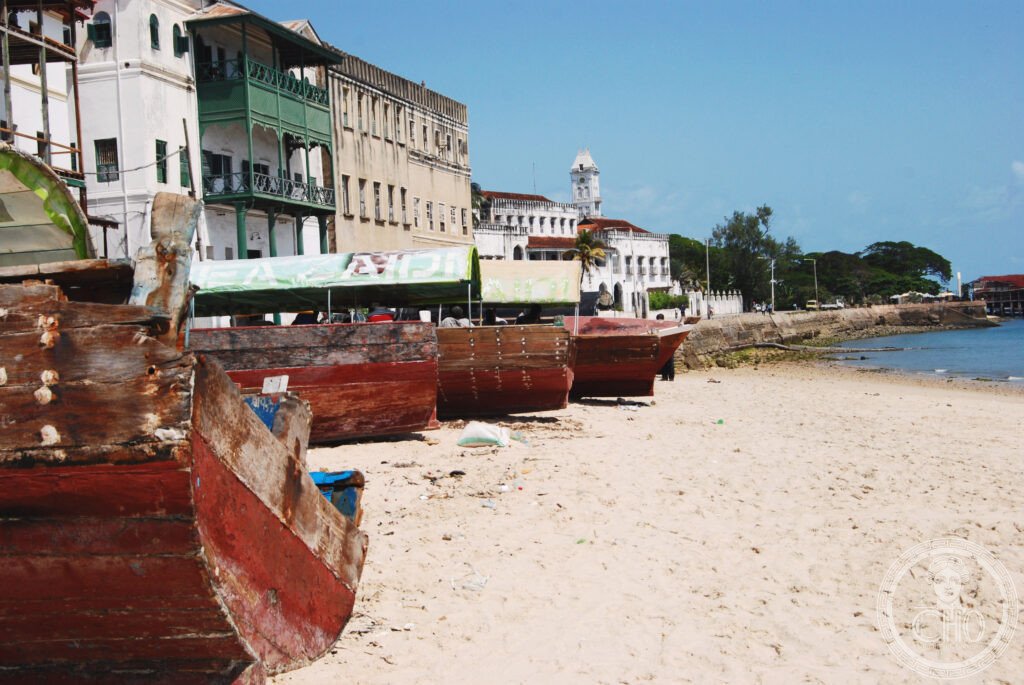
The most cosmopolitan city in the history of East Africa. Stone Town was the capital of the Omani Sultanate of Zanzibar (1856–1964), the hub of the 19th-century Indian Ocean trade in cloves, ivory, and enslaved people, and a city where Arab, Indian, African, and European cultures produced one of the richest material cultures in the world: the elaborately carved doors of the Swahili coral-stone palaces, the fusing of architectural traditions on a single street frontage, and the monsoon trade wind rhythms that still shape daily life.
At a glance
Stone Town (population approximately 200,000) is the old city of Zanzibar City, capital of the Zanzibar Archipelago (an autonomous region of Tanzania), on the western shore of Unguja Island (Zanzibar Island) in the Indian Ocean, 35 km from the Tanzanian mainland. The city was developed primarily in the 19th century during the height of Omani Arab rule, when the Sultanate of Oman transferred its capital from Muscat to Zanzibar (1840) under Sultan Seyyid Said. The subsequent decades saw the construction of the palace complex, the Arab Fort, the great merchant houses, and the distinctive streetscape of multi-storey coral-stone buildings with carved wooden doors and cantilevered balconies. UNESCO inscribed the Stone Town of Zanzibar in 2000.
Key facts
- The carved Zanzibari doors: the most distinctive architectural element of Stone Town and the most concentrated collection of carved wooden doorways in the world. The tradition of elaborate carved wooden entry doors in Zanzibar and the Swahili coast derives from the convergence of three building traditions: the Arab tradition of carved wooden doors as expressions of status, wealth, and learning (Quranic inscriptions and geometric patterns). The Indian Gujarati tradition of deeply carved decorative woodwork (fish, lotus flowers, chains, and protective motifs). And the local Swahili tradition. The traditional Zanzibari door has a heavy teak frame, brass studs (originally to repel elephant attacks), and carved decorative panels whose motifs tell the owner’s cultural identity. The doors of the Hemed bin Ahmed house (1883) and the Arab Fort are the finest examples. The Zanzibar Doors Project has documented approximately 600 surviving carved doors in Stone Town.
- The slave trade and the Anglican Cathedral: Zanzibar was the largest slave market in East Africa between approximately 1820 and 1873. The Sultan of Zanzibar’s Customs House collected taxes on every enslaved person who passed through the market. At its peak in the 1850s–60s, approximately 50,000 enslaved people were sold annually. The British anti-slavery crusade (led partly by the explorer and missionary David Livingstone, who visited Zanzibar several times and whose final letters were dispatched from here) and the treaty of 1873 forced the Sultan to close the slave market. The Anglican Church of England built its Christ Church Cathedral (1873–79, consecrated by Edward Steere, Bishop of Zanzibar) directly on the site of the closed slave market. The high altar is positioned where the whipping post stood. The underground chambers where enslaved people were held pending sale (the original slave pens, rediscovered during construction of the cathedral) are open to visitors and are the most important memorial of the East African slave trade.
- Freddie Mercury and the cultural mix: Stone Town is the birthplace of Farrokh Bulsara (1946–1991), who became Freddie Mercury, the lead singer of the rock band Queen. Mercury was born to Parsi Zoroastrian parents of Indian descent (a community that had lived in Zanzibar since the 19th century as merchants and civil servants) and grew up in Stone Town before his family moved to Bombay (1954) and then London. The mix of cultures that produced Mercury. Parsi Indian, Omani Arab, Swahili African, British colonial. In one city is uniquely Zanzibari. The Freddie Mercury Museum (in the original Mercury family house) opened in 2018. Mercury is now a central part of Stone Town’s cultural identity and the annual Mercury Phoenix Trust concert in Zanzibar.
- Spice Island tradition: Zanzibar produces approximately 75% of the world’s cloves. Sultan Seyyid Said introduced clove cultivation to the island in 1818 from Mauritius (where the French had brought the plant from the Moluccas). By the mid-19th century, the clove plantations of Zanzibar and Pemba Island (50 km to the north) had displaced the Moluccas as the world’s primary clove source. The spice trade (cloves, nutmeg, cinnamon, pepper, vanilla, and cardamom) gives Zanzibar its tourist identity as the “Spice Island”. Guided spice farm tours (typically 2–3 hours, covering a working plantation where the guide demonstrates and names the spices at different growth stages) are the most popular half-day excursion from Stone Town.
- The Old Fort (Arab Fort / Ngome Kongwe): the oldest building in Stone Town. Built by Omani Arabs between 1698 and 1701 on the site of a Portuguese chapel (the Portuguese had a small fort here from 1598). The fort’s outer walls (with their characteristic Omani Arab crenellations, completely different from European castle crenellations) are the symbol of the city on postcards. The interior courtyard is used as an amphitheatre for cultural performances (the Zanzibar International Film Festival, the Stone Town Cultural Festival, and regular evening music events).
- Heritage: UNESCO World Heritage Site, Stone Town of Zanzibar, inscribed 2000.
- GPS: 6.1622° S, 39.1894° E.
History
Unguja Island has been inhabited and visited by Indian Ocean traders since at least the 1st century AD. Arab and Persian merchants established trading posts from the 8th–9th centuries. The Portuguese arrived in 1499 (Vasco da Gama stopped here on his first voyage to India) and maintained an intermittent presence until the Omani Arabs expelled them in 1698. The Omani Sultanate of Oman gradually consolidated control over the entire Swahili coast (present-day Kenya and Tanzania) through the 18th century. Sultan Seyyid Said made the decisive shift of moving the Omani capital from Muscat to Zanzibar in 1840, transforming the island into the commercial and political hub of East Africa and the western Indian Ocean.
The slave trade (Zanzibar was the transshipment point for enslaved people brought from the interior of Africa by Arab and Swahili traders — the route from the Great Lakes to the coast, pioneered by Tippu Tip and other slave-trading entrepreneurs) financed the building boom that created Stone Town. The abolition treaty of 1873 and the subsequent British protectorate (1890) ended the Sultanate’s independence without immediately ending the trade. The Zanzibar Revolution (1964). In which the Arab and Indian ruling class was expelled or killed and Zanzibar merged with Tanganyika to form Tanzania. Transformed the political order but left the architectural fabric largely intact.
What you see
Stone Town is compact and best explored on foot. The narrow streets (many too narrow for cars) form a confusing irregular grid that rewards getting lost. The most efficient starting point is the seafront (Mizingani Road) with the Arab Fort and the Old Dispensary (the finest carved façade in Stone Town, a four-storey Gujarati merchant’s mansion of 1887, now the Stone Town Cultural Centre). Darajani Market (the main market of Stone Town, covered 19th-century market hall selling fresh fish, fruit, spices, and cloth). Forodhani Gardens (the seafront gardens, where the evening street food market — best in Zanzibar — sets up at sunset). Christ Church Cathedral and slave pens.
The Dhow Countries Music Academy (on a lane near the Arab Fort) offers scheduled performances of Taarab music. The distinctive Zanzibari musical tradition that fuses Arabic maqam modal melody, Indian rhythmic patterns, and Swahili poetry. Taarab is unique to the Zanzibar coast and was the music of the Sultans’ courts. Live performances (usually evenings, Fridays and Saturdays) are the best cultural experience available in Stone Town after dark.
Practical information
- Admission: Stone Town streets free. Arab Fort approximately TSH 5,000 (about €1.80). Christ Church Cathedral and slave pens approximately TSH 5,000 (about €1.80). Palace Museum (Beit el-Sahel, the former Sultan’s palace) approximately TSH 5,000. Freddie Mercury Museum approximately TSH 10,000 (about €3.60). Guided walking tours of Stone Town (approximately $20–30, 2 hours, including the doors, the slave market, and the spice market) available from the Arab Fort tourist information desk and from several local guide associations.
- Getting there: Zanzibar Abeid Amani Karume International Airport (ZNZ). Direct international flights from Nairobi (Kenya Airways, 1h), Dar es Salaam (multiple airlines, 20 min), Doha (Qatar Airways, 7h), Addis Ababa (Ethiopian, 3h), Mombasa (seasonal), and European charter flights (from Amsterdam, Frankfurt, and London in the high season). The airport is 7 km south of Stone Town. Taxi approximately $10 (20 min). By ferry from Dar es Salaam (Azam Marine or Kilimanjaro Fast Ferry, 2 hours, approximately $35–40 first class).
- The Zanzibar beaches: the east coast beaches of Zanzibar (Nungwi, Kendwa, Paje, Jambiani — 45–75 km from Stone Town) are among the finest white-sand coral beaches in the Indian Ocean. Stone Town is usually combined with 3–5 nights on the east coast. Nungwi and Kendwa (north coast, 45 km, 1.5h by dala-dala shared bus) have the most developed resort infrastructure. Paje and Jambiani (south-east coast) are the kite-surfing destination and quieter. The transition from the heritage city of Stone Town to the beach lagoon of Nungwi in one island is Zanzibar’s core tourism proposition.
Getting there
Zanzibar Airport (ZNZ): 7 km from Stone Town. Direct flights from Nairobi (1h), Doha (7h). Ferry from Dar es Salaam (2h, $35). GPS: -6.1622, 39.1894.
Nearby
- Jozani Chwaka Bay National Park. 35 km east of Stone Town (45 min by vehicle). The only national park on Zanzibar Island and the habitat of the Zanzibar Red Colobus monkey (Piliocolobus kirkii — endemic to Unguja Island, listed as endangered; approximately 3,000 individuals surviving, almost all within the national park). The red colobus have been habituated to human presence and can be observed at close range from the park trails. The Jozani Forest (a rare example of coastal lowland forest, with 50-metre-tall Pala trees) and the Chwaka Bay mangroves (a RAMSAR wetsite, nursery for Indian Ocean fish) are within the same protected area.
- Pemba Island. 80 km north of Zanzibar by ferry (3h) or by light aircraft (20 min from Zanzibar Airport). The second island of the Zanzibar Archipelago, less visited than Unguja, with the most important clove plantations, the deepest offshore wall dive sites in East Africa (the Pemba Channel, with walls dropping to 600 m), and the ruins of the Ras Mkumbuu mosque (14th century, the oldest mosque ruins on the Swahili coast). The Pemba fruit bat colony (flying foxes, Pteropus voeltzkowi — one of the largest bat colonies in Africa) roosts in the trees of the Ngezi Forest Reserve.
- Kilwa Kisiwani (Tanzania mainland). 320 km south of Dar es Salaam. The ruins of the medieval Swahili trading city of Kilwa Kisiwani (UNESCO World Heritage Site 1981), which was the greatest trading port on the East African coast before the Portuguese arrival. Ibn Battuta visited in 1331 and described it as one of the most beautiful cities in the world. The Husuni Kubwa palace complex (14th century, the largest pre-colonial building in sub-Saharan Africa south of the Sahel) and the Great Mosque of Kilwa (11th–15th century, the largest pre-colonial mosque in sub-Saharan Africa) are the principal ruins. Accessible by plane from Dar es Salaam (45 min) or by a very long road journey.
Sources
- Wikipedia, Stone Town. Zanzibar Sultanate. East African slave trade, accessed June 2026.
- UNESCO, Stone Town of Zanzibar, WHS reference 1015, inscribed 2000.
- Abdul Sheriff and Ed Ferguson (eds.), Zanzibar Under Colonial Rule, James Currey, 1991.
- Leila Sheikh-Hashim, The Carved Doors of Zanzibar, published by Zanzibar Tourism Commission, 2004.
Find it on the map
See this place and what’s around it →📷 Become a Cultural Heritage Online photographer
Share your photos of places: they stay published under your name as the author. The more they're seen, the more you get noticed — and soon a contest will reward the most appreciated photos.
Log in or sign up free to add a photo