
In Kigali, the capital of Rwanda, the parish of Saint-Michel was established in 1963 under the diocese of Kabgayi and became a cathedral on 10 April 1976, when Pope Paul VI erected the archdiocese of Kigali. The sources differ slightly on a further date, 3 May 1976, referring specifically to the designation of the parish as cathedral seat. No source consulted names an architect. The building, in the Kiyovu quarter of Nyarugenge district, stands out for a modern and spacious plan, with arena-style seating around an altar visible from every point, and upper walls of glass for natural light and cross-ventilation. On 7 September 1990, according to a primary document on the official Vatican site, Pope John Paul II visited this cathedral during his pastoral journey in Rwanda, a short evening visit, without celebrating mass there, which was reserved instead for other places such as the cathedral of Kabgayi and the Nyamirambo and Amahoro stadiums. The first archbishop, Vincent Nsengiyumva, who for fourteen years also led the central committee of the single party MRND of President Habyarimana, whose personal confessor he was, until a Vatican order in 1990 to leave politics, was killed by soldiers of the Rwandan Patriotic Front on 7 or 8 June 1994, the sources differing by a day, at Gakurazo, near Kabgayi, about fifty kilometres from Kigali, together with two other bishops and some ten priests. That is an event in the history of the genocide tied to his person, not to this cathedral. Unlike the nearby church of Sainte-Famille, whose parish priest Wenceslas Munyeshyaka was convicted in absentia by a Rwandan military court of collusion with the militias, or the memorial sites of Nyamata, Ntarama and Gikondo, no massacre or mass refuge is documented at the cathedral of Saint-Michel in the main sources consulted on the role of the churches during the genocide of 1994. That is a real absence in the historical record, not a gap in research, and it should be reported as such. His successor Thaddée Ntihinyurwa, archbishop of Kigali only from 1996, was during the genocide bishop of Cyangugu, another see, where he was accused of refusing refuge to Tutsi fleeing into his own cathedral, accusations that never led to a formal conviction and that concern in any case a different building from the one in Kigali. The present archbishop, Antoine Kambanda, in office since 19 November 2018, was created cardinal by Pope Francis on 28 November 2020, the first Rwandan cardinal in history. In 2019 he announced the building of a new cathedral on the site of the former colonial prison «1930» of Nyarugenge, built by the Belgian authorities in 1930 and closed in 2018, a project still under way according to the most recent sources found.
About St. Michael’s Cathedral
In Kigali, Rwanda, the parish of Saint-Michel was established in 1963 under the Diocese of Kabgayi and became a cathedral on 10 April 1976, when Pope Paul VI erected the Archdiocese of Kigali. No source names an architect for the building, which stands in the Kiyovu neighborhood of Nyarugenge District, distinguished by a modern, spacious plan with arena-style seating around a visible altar and upper glass walls for natural light and cross-ventilation.
Key facts
- 1963: the parish established under the Diocese of Kabgayi.
- 10 April 1976: becomes the cathedral of the newly erected Archdiocese of Kigali.
- 7 September 1990: Pope John Paul II visits during his Rwanda pastoral trip.
- 1994: not named in the documented record of church-related genocide violence in Kigali.
- 28 November 2020: Archbishop Antoine Kambanda becomes Rwanda’s first cardinal.
- A new cathedral is planned on the site of Nyarugenge’s former colonial prison.
History
Unlike Kigali’s Sainte-Famille Church or the memorial sites at Nyamata and Ntarama, St. Michael’s Cathedral does not appear in the major documentary accounts of church-related violence during the 1994 genocide — a real absence in the historical record, not a gap in research. Its own first archbishop, Vincent Nsengiyumva, was killed by Rwandan Patriotic Front soldiers in June 1994 at Gakurazo, near Kabgayi, alongside other bishops and priests — an event tied to his person, not to the cathedral building itself, roughly fifty kilometers away.
What you see
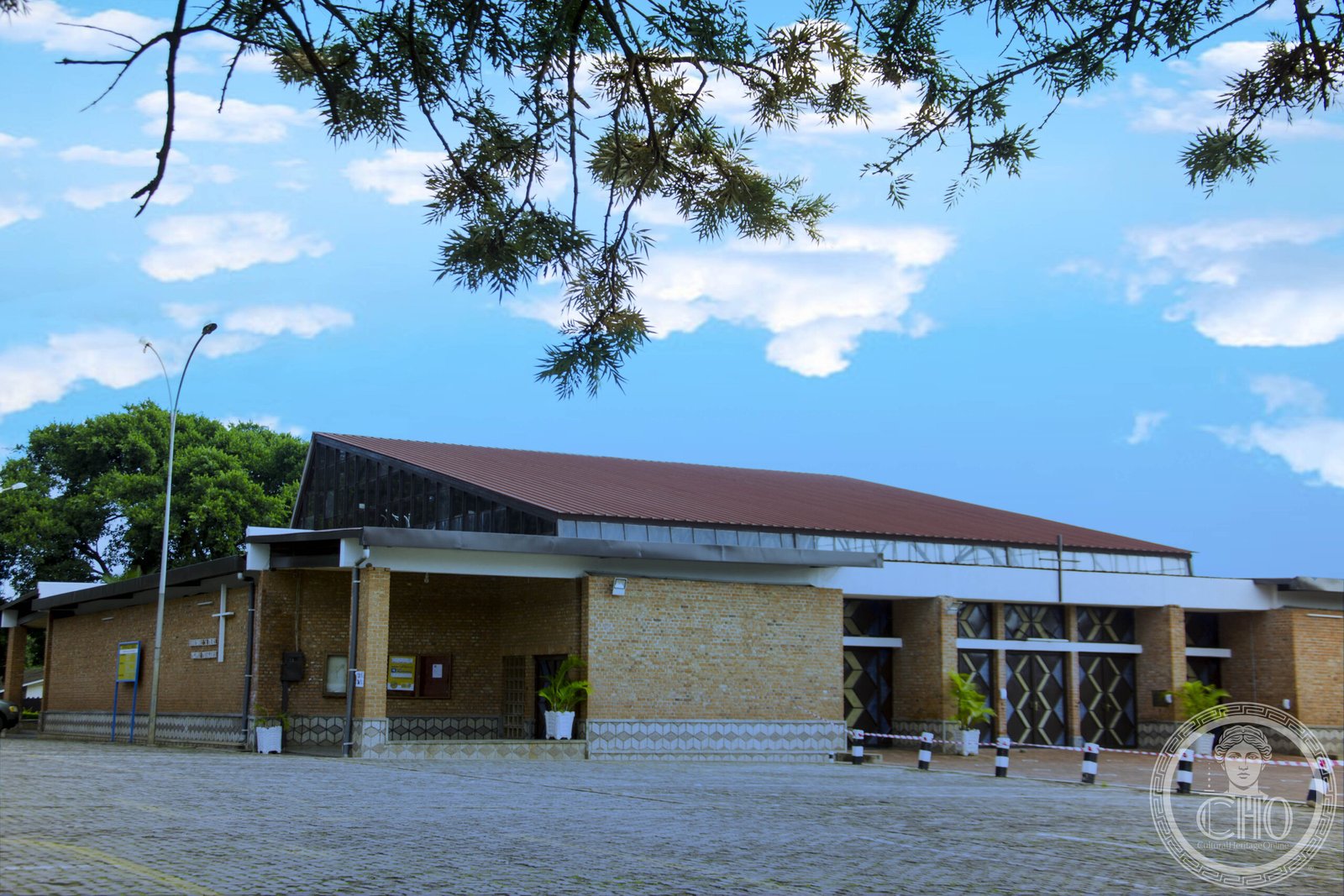
A low, modern brick building with a wide mono-pitch roof and a glazed clerestory strip running along its ridge, its interior arranged in arena-style seating so that every seat looks toward a visible altar, entered through a covered brick porch with decorative diamond-patterned metal doors.
Practical information
- Opening hours: generally open daily outside services; check current hours before visiting.
- Address: KN 67 St, Kiyovu, Nyarugenge District, Kigali, Rwanda.
Getting there
The cathedral stands in the Kiyovu neighborhood of central Kigali. GPS: 1°57′03″S, 30°03′47″E.
Nearby
- Former Nyarugenge “1930” prison site — a colonial-era prison decommissioned in 2018, now planned as the site of Kigali’s future cathedral.
Sources
- Vatican.va — official itinerary, Pope John Paul II’s 1990 pastoral visit to Rwanda.
- Catholic-Hierarchy.org and GCatholic.org — Archdiocese of Kigali records.
- Human Rights Watch — “Leave None to Tell the Story,” on the 1994 Rwandan genocide.
- Wikipedia — “Sainte-Famille Church” and “Wenceslas Munyeshyaka,” for context distinguishing other Kigali sites.
- CruxNow and CatholicPhilly — coverage of the planned new Kigali cathedral, 2020.
Find it on the map
See this place and what’s around it →📷 Become a Cultural Heritage Online photographer
Share your photos of places: they stay published under your name as the author. The more they're seen, the more you get noticed — and soon a contest will reward the most appreciated photos.
Log in or sign up free to add a photo