

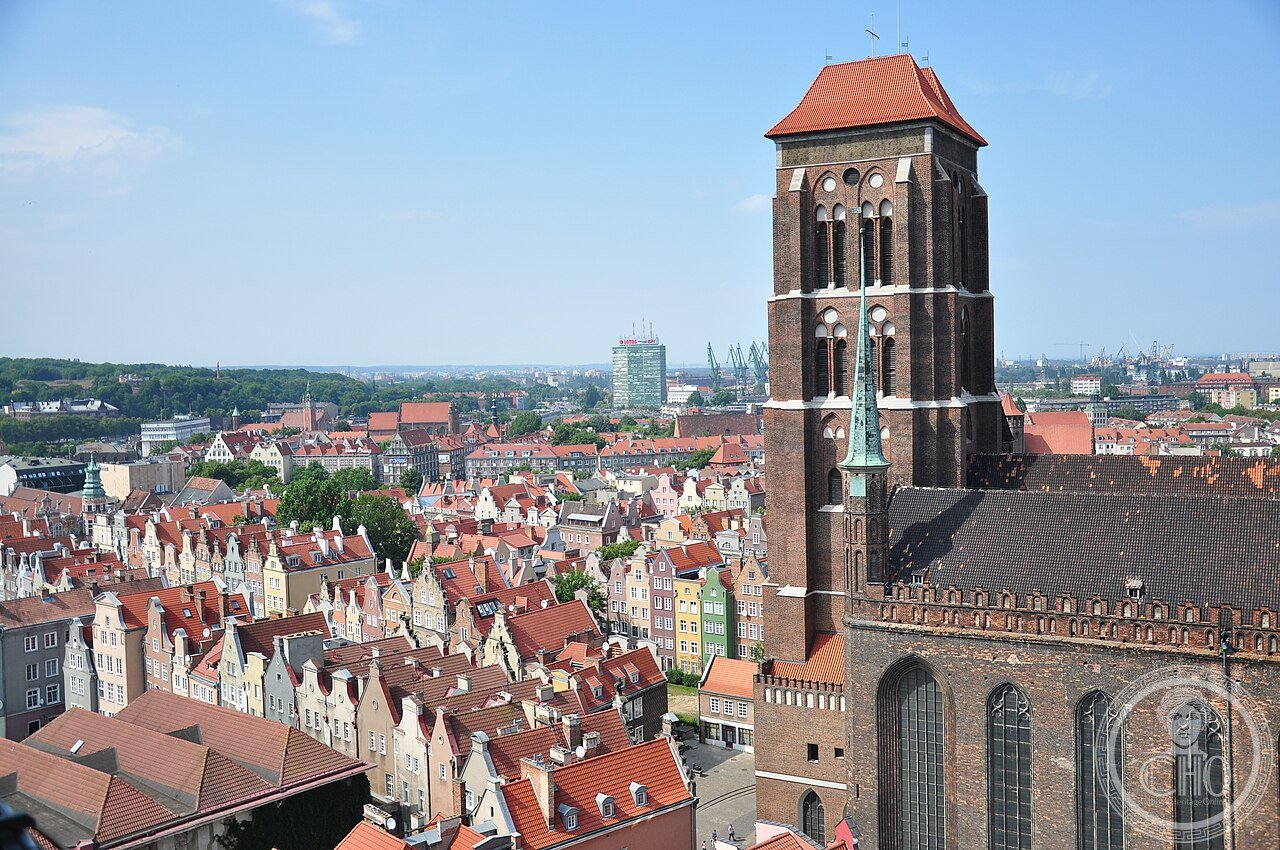
The foundation stone of the new brick church was laid on 25 March 1343, the feast of the Annunciation; it took 159 years, until 1502, to complete the building in Baltic Gothic, built in phases as the technical means and the wealth of the Gdańsk community grew. With room for more than 25,000 people and a volume of some 155,000 cubic metres, it is today one of the three largest brick churches ever built in the world, together with San Petronio in Bologna and the Frauenkirche in Munich: the townspeople call it “the Crown of Gdańsk”. Inside stands the astronomical clock built between 1464 and 1470 by Hans Düringer, almost 14 metres high and, at the time, the largest in the world: every hour Adam and Eve strike a bell, and at noon a procession of automata files past, including the Magi, the Apostles and Death. Damaged during the Second World War, with 40% of its artistic treasures destroyed or harmed, the basilica was restored after the war, but the astronomical clock began working again only on 9 May 1990.
About St Mary’s Basilica, Gdańsk
St Mary’s Church in Gdańsk, officially the Basilica of the Assumption of the Blessed Virgin Mary, is the largest brick building in the entire world. The foundation stone for this new brick church was laid on 25 March 1343, the feast of the Annunciation, and construction proceeded in successive stages over an extraordinary 159 years, tracking the growing technical capabilities and accumulating wealth of Gdańsk’s urban community of believers, until the church was finally completed in 1502 in the distinctive Brick Gothic style of the Baltic region. With a seating capacity exceeding 25,000 and an interior volume of roughly 155,000 cubic metres, St Mary’s ranks among the three largest brick churches ever constructed anywhere, alongside the Basilica of San Petronio in Bologna and the Frauenkirche in Munich; the city’s own inhabitants have long known the building simply as “the Crown of Gdańsk.” Among the basilica’s most celebrated treasures is its astronomical clock, constructed between 1464 and 1470 by the master craftsman Hans Düringer. Standing nearly 14 metres tall, the clock was, at the time of its completion, the largest astronomical clock anywhere in the world, its dials displaying not only the time and date but also the phase of the Moon, the positions of the Moon and Sun against the zodiac, and a calendar of saints’ days. Figures of Adam and Eve ring a bell to mark each hour, while at noon a more elaborate mechanical procession unfolds, featuring Adam and Eve alongside the Three Kings, the Twelve Apostles, and a figure of Death. The basilica suffered extensive damage during the Second World War, with roughly 40 percent of its artistic treasures either destroyed or damaged outright, though many valuable objects had first been evacuated to the Vistula Fens for safekeeping. Restoration of the building itself proceeded in the postwar decades, but the astronomical clock, badly damaged, remained non-functional for far longer: it was not until 1983 that local historian Andrzej Januszajtis assembled a dedicated restoration committee, and the clock was finally reactivated on 9 May 1990, nearly half a century after the war’s end.
Key facts
- 25 March 1343: foundation stone laid
- 1502: construction completed after 159 years
- 25,000+ capacity, roughly 155,000 cubic metres, among the world’s three largest brick churches
- 1464-1470: astronomical clock built by Hans Düringer, nearly 14 metres tall
- World War II: roughly 40% of the basilica’s artistic treasures destroyed or damaged
- 1983: restoration committee formed to repair the astronomical clock
- 9 May 1990: astronomical clock reactivated
History
The 159-year span of St Mary’s construction, tracking the rising wealth and ambition of medieval Gdańsk as a major Hanseatic trading city, situates the basilica among the most sustained single building projects of the entire late medieval Baltic world, its eventual scale reflecting the city’s growing prominence as a commercial and religious centre. The astronomical clock’s original status as the largest of its kind in the world placed Gdańsk at the technical forefront of European mechanical clockmaking in the 15th century, a distinction the city’s civic and religious authorities clearly took considerable pride in maintaining and elaborating over subsequent centuries.
The nearly 45-year gap between the astronomical clock’s wartime damage and its full 1990 restoration illustrates the long timescales often required to fully repair complex mechanical heritage objects, particularly under the resource constraints of communist-era Poland, with the clock’s eventual reactivation coinciding meaningfully with the broader political transformations then underway across the country.
What you see
The basilica’s massive Brick Gothic exterior, built in stages across nearly 160 years, dominates Gdańsk’s historic Main Town with its scale alone, its single great tower offering panoramic views over the city for visitors who climb it. Inside, the restored astronomical clock remains the building’s centrepiece, its hourly bell-ringing figures and elaborate noon procession of mechanical figures continuing to draw visitors more than five and a half centuries after Hans Düringer first built it.
Practical information
- Opening hours: generally open daily with seasonal variation; tower climb and clock viewing available separately; check current hours before visiting
- Address: Podkramarska 5, 80-834 Gdańsk, Poland
Getting there
St Mary’s Basilica stands in the historic Main Town of Gdańsk, on Poland’s Baltic coast, easily reachable on foot from the city’s Long Market and waterfront. GPS: 54.3498° N, 18.6530° E.
Nearby
- Long Market (Długi Targ) — Gdańsk’s historic main street, a short walk away
- Gdańsk Main Town Hall — historic town hall, nearby
- Motława riverfront — the city’s historic waterfront, a short walk from the basilica
Sources
- Wikipedia — “St. Mary’s Church, Gdańsk” (en.wikipedia.org)
- Wikipedia — “Gdańsk astronomical clock” (en.wikipedia.org)
- Pomorskie Travel — “St. Mary’s Church in Gdańsk” (pomorskie.travel)
Find it on the map
See this place and what’s around it →
📷 Become a Cultural Heritage Online photographer
Share your photos of places: they stay published under your name as the author. The more they're seen, the more you get noticed — and soon a contest will reward the most appreciated photos.
Log in or sign up free to add a photo