
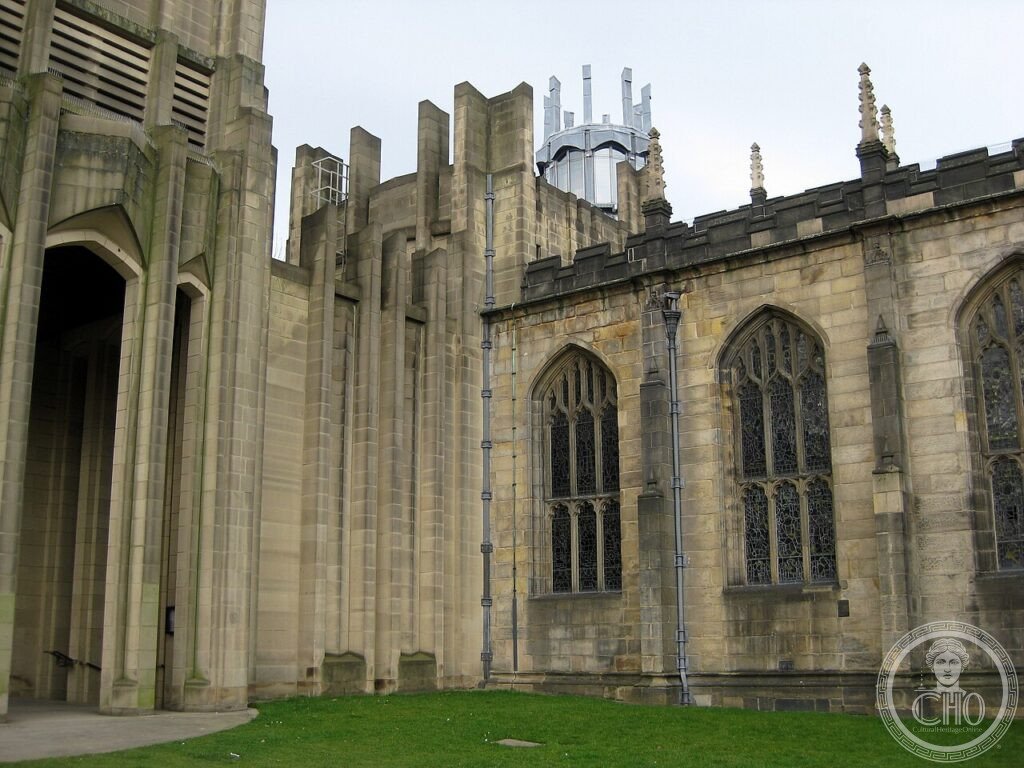
Burnt in a 13th-century war, restored by the Victorians, and reshaped twice more in the 20th century, Sheffield Cathedral wears its long, interrupted history openly — a medieval cruciform plan crowned by an unapologetically modern lantern tower.
At a glance
Sheffield Cathedral, dedicated to Saints Peter and Paul, occupies a site with Christian associations dating to at least the 9th century. A parish church was likely established here in the 12th century under William de Lovetot, one of the local Norman lords, but that building was burnt down in 1266 during the unrest of the Second Barons’ War. The structure seen today began taking shape around 1200 and has been rebuilt and extended repeatedly since, most recently with modernist additions completed in 1966. Raised to cathedral status in 1914 with the creation of the Diocese of Sheffield, it is one of five Grade I listed buildings in the city and stands directly beside the Cathedral tram stop on Sheffield’s Supertram network.
Key facts
- Founded: parish church likely established 12th century by William de Lovetot; burnt in 1266 during the Second Barons’ War
- Present structure: building work began around 1200, with major phases continuing into the 20th century
- Victorian restoration: 1870s–1880, by Flockton & Gibbs, adding new transepts
- 20th-century extensions: Charles Nicholson (1936–48); George Pace with Ansell & Bailey (1960–66), completing the current lantern tower
- Spire: 49 metres (161 feet) tall
- Cathedral status: since 1914, Diocese of Sheffield; one of five Grade I listed buildings in the city
- Notable interior features: hammerbeam roof with gilded angels; Shrewsbury Chapel with Tudor monuments; abstract stained glass in the lantern tower, added 1998–99
History
Christian worship on this site is attested from at least the 9th century, though the first parish church is generally attributed to the 12th century and the Norman lord William de Lovetot. That early church did not survive intact: it was burnt down in 1266 amid the wider unrest of the Second Barons’ War, a period of baronial rebellion against the English crown. Rebuilding began around 1200 and continued, in phases, for the better part of eight centuries, making the cathedral less a single architectural moment than a layered record of Sheffield’s changing fortunes.
A major Victorian restoration by the architectural firm Flockton & Gibbs, carried out through the 1870s and completed around 1880, added new transepts and brought the building into line with 19th-century liturgical and structural standards. The church was elevated to cathedral status in 1914, when the Diocese of Sheffield was created to serve the rapidly industrialising city, giving the modest parish church a role well beyond its original medieval scale.
Two further 20th-century campaigns reshaped the building substantially: Charles Nicholson’s work between 1936 and 1948 extended and reoriented parts of the cathedral, and a final modernist phase, led by George Pace with Ansell & Bailey between 1960 and 1966, added the lantern tower and completed the building’s present form. The cathedral has weathered two serious fires since, in 1979 and again in 2020, both later ruled arson, and its choir was disbanded in 2020.
What you see
The cruciform plan retains its essentially 15th-century medieval outline, but the fabric visibly spans eras: Flockton & Gibbs’s Victorian transepts, Nicholson’s mid-century reworking, and Pace’s 1960s lantern tower sit side by side rather than disguising their different dates. Inside, a hammerbeam roof carries carved and gilded angels, a characteristic feature of English late-medieval church carpentry, while the Shrewsbury Chapel houses Tudor-era monuments connected to the powerful Talbot family, Earls of Shrewsbury, longtime patrons of the church.
The lantern tower, Pace’s principal contribution, was fitted with abstract stained glass in 1998–99, giving the crossing a burst of modern colour that contrasts deliberately with the medieval stonework below. The cathedral’s setting on Church Street, immediately beside the Cathedral tram stop opened with Sheffield’s Supertram network in 1995, keeps it firmly embedded in the working life of the city centre rather than set apart from it.
Practical information
- Opening hours: Monday to Friday approximately 8:15am to 5:30pm; Saturday 9am to 4pm; Sunday 7:30am to 5pm
- Admission: free entry
- Time needed: 30–45 minutes for the nave, chapels, and lantern tower
Getting there
Sheffield Cathedral sits on Church Street in the city centre, directly served by the Cathedral tram stop on all Sheffield Supertram lines. Sheffield railway station, with regular services from London, Manchester, and Leeds, is a short walk or tram ride away. GPS: 53.3832° N, 1.4693° W.
Nearby
- Kelham Island Museum — Sheffield’s industrial history museum on a man-made island in the River Don, a short walk from the cathedral
- Sheffield Manor Lodge — the ruined remains of a 1516 country house where Mary, Queen of Scots was once held; a few miles from the city centre
- Sheffield Winter Garden — a large glasshouse and visitor centre on Surrey Street, a short walk from the cathedral
Sources
Find it on the map
See this place and what’s around it →📷 Become a Cultural Heritage Online photographer
Share your photos of places: they stay published under your name as the author. The more they're seen, the more you get noticed — and soon a contest will reward the most appreciated photos.
Log in or sign up free to add a photoIs this page about you?
This page is read by travellers and heritage enthusiasts who find it on Google. Tell us how you are connected to this place and we will take it from there.