
In 490 CE, according to hagiographic tradition, the Archangel Michael appeared in a cave on the southern slopes of Monte Gargano and left his footprint on a rock, simultaneously founding the oldest continuously venerated Christian sanctuary in the western world — a cave-church that the Lombards made the most important pilgrimage site of early medieval Italy, that was on the Via Sacra Langobardorum (the Lombard pilgrimage road from Pavia to Monte Gargano), that drew pilgrims from England, Germany, and Scandinavia from the seventh century onward, and that is today as active a pilgrimage destination as it was in 1000 CE.
At a glance
The Santuario di San Michele Arcangelo on Monte Gargano is a cave sanctuary on the southern slope of the Gargano massif, in the municipality of Monte Sant’Angelo (Foggia), Puglia. Founded, according to tradition, on the site of a miraculous apparition of the Archangel Michael in 490 CE, it is the oldest continuously functioning Christian sanctuary in the western world — a sanctuary built not by human hands (the cave was the sanctuary) rather than constructed from stone, and therefore considered particularly sacred. It was inscribed on the UNESCO World Heritage List in 2011 (ref. 1318) as part of the “Longobardi in Italia: i Luoghi del Potere” serial inscription, in recognition of its central role as the most important Lombard pilgrimage site of early medieval Italy.
Key facts
- Foundation: According to tradition, the Archangel Michael appeared in the cave four times between 490 and 493 CE; the local bishop, Lorenzo Maiorano of Siponto, established the cave as a sanctuary after the fourth apparition in 493 CE; the earliest documented pilgrimage is in 663 CE (the Lombard king Grimoald I)
- Lombard pilgrimage: The sanctuary was the most important Lombard pilgrimage site; the Via Sacra Langobardorum ran from Pavia (the Lombard capital) south through Tuscany and down to Monte Gargano; Lombard pilgrims included kings, dukes, and the general population; the Lombard veneration of Michael the Archangel (the warrior angel, patron of battles) was particularly intense because Michael was seen as the divine protector of the Lombard people
- Norman and Crusader connection: Robert Guiscard (Norman conqueror of southern Italy) restored the sanctuary in 1059 and added the bronze doors (made in Constantinople); all Crusaders departing for the First Crusade (1095-1099) and subsequent Crusades stopped at Monte Sant’Angelo to pray before embarkation at Bari or Brindisi
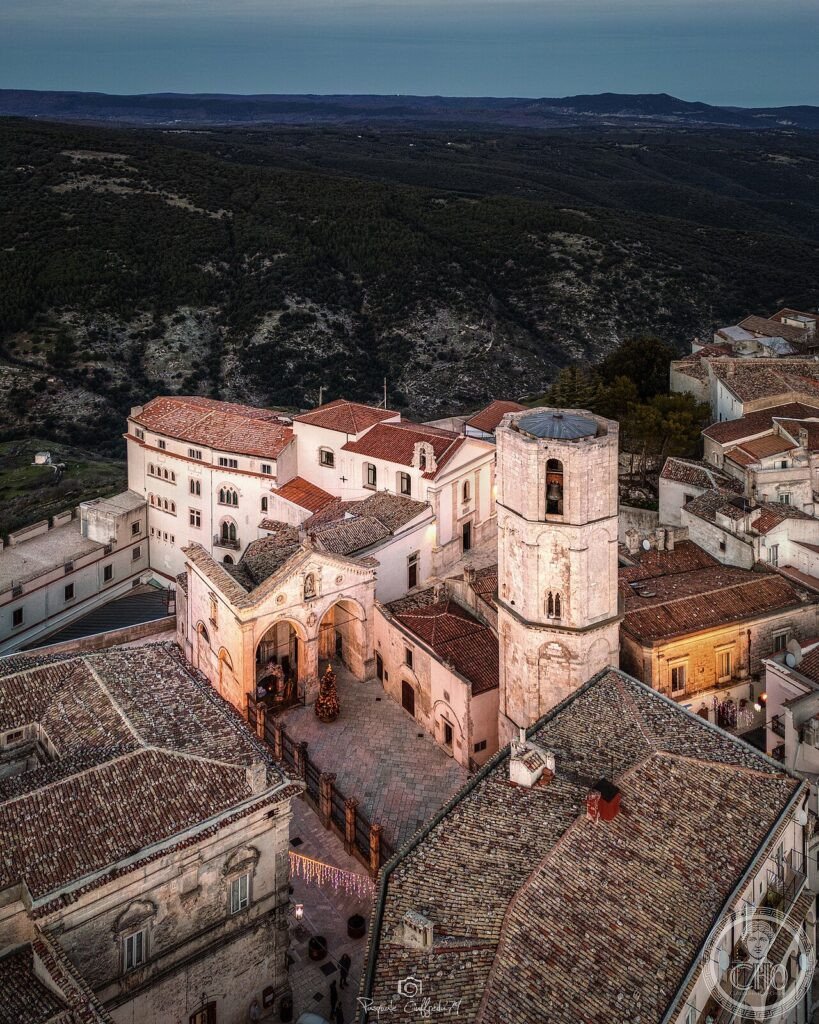
- Architecture: The sanctuary is entered via a Gothic atrium (XIV century); the bronze doors (1076 CE, commissioned by the Lombard duke of Amalfi, made in Constantinople; 24 panels in silver and niello inlay depicting Archangel Michael scenes) are the finest Byzantine metalwork in southern Italy; the cave interior has a 12th-century marble altar and a 12th-century marble bishop’s throne; the octagonal Angevin tower (XIII century) is the dominant external landmark
- UNESCO: 2011, ref. 1318 — one of the 7 “Longobardi in Italia” sites
- GPS: 41.7048, 15.9605 — Google Maps
History
The Gargano promontory — the “spur” of the Italian “boot,” projecting into the Adriatic east of Foggia — was a sacred landscape in antiquity: a cave sanctuary of the god Calcante (a Greek oracular god) on the promontory had been a pilgrimage site since at least the seventh century BCE, and the area was associated with prophecy and divine presence before the Christian period. The identification of the cave of Monte Sant’Angelo with the Archangel Michael replaced the existing pagan cult in a process typical of early Christian appropriation of sacred sites.
The Lombards were the first major Christian patrons of the sanctuary; their veneration of Michael the Archangel (described by Paul the Deacon as a peculiarly Lombard devotion) was connected with their warrior identity and their need for divine military protection. Grimoald I’s pilgrimage in 663 CE was the first of many royal Lombard visits; the sanctuary became the primary national shrine of the Lombard kingdom, equivalent in function (if not in doctrinal status) to Rome for Lombard collective identity. The route from Pavia to Monte Sant’Angelo (the Via Sacra Langobardorum) ran approximately 700 km and was maintained with hostels and chapels for the use of pilgrims.
What you see
The approach to the sanctuary from the main piazza of Monte Sant’Angelo descends via a stepped alley (Via Reale Basilica) to the atrium of the sanctuary complex; the Angevin octagonal tower (approximately 30 m tall, XIII century) rises above the town and is the visual landmark of the approach. The Gothic atrium leads to the bronze doors: 24 panels in silver and niello on bronze, made in Constantinople in 1076 CE, depicting scenes from the apparitions of the Archangel Michael and images of the donors (the Lombard Pantaleone brothers who commissioned them in Amalfi). The level of craft — the silver inlay for the figures, the niello background, the inscriptions in both Latin and Greek — is the finest surviving Byzantine metalwork outside Constantinople.
Beyond the doors, a staircase of 86 marble steps descends into the cave; the cave interior (approximately 30 m wide and 10 m high) is lit by candles and electric lighting and contains the marble altar (XII century, with the original columns), a marble bishop’s throne (XII century), and the presumed footprint of the Archangel in the stone. Active Masses and pilgrimages take place throughout the year (the major feast days of San Michele are 8 May and 29 September); on feast days the cave and the sanctuary complex are intensely crowded.
Gallery
Practical information
- Opening: Daily 7:30-19:30 (summer) / 7:30-12:30 and 14:30-17:30 (winter). Free admission. Mass is celebrated daily; pilgrimage masses on feast days (8 May, 29 September) draw thousands of pilgrims.
- Dress code: Covered shoulders and knees required for entry to the cave-sanctuary (scarves and covering wraps available at the entrance); photography inside the cave is discouraged during religious services.
- The town: Monte Sant’Angelo itself (approximately 12,000 inhabitants) is a medieval Gargano hilltop town with the Castello Angioino (XI-XIII century, free access to the exterior), a Norman-Angevin castle with excellent views over the coastal plain and the Adriatic.
- Duration: 1-1.5 hours for the sanctuary and the town; allow a half-day if combining with the Foresta Umbra or the Gargano coast.
Getting there
Via Reale Basilica, Monte Sant’Angelo (FG), Puglia. By car: from Foggia, 50 km north-east via SS89 Gargano; 1 hour (the road is winding in the final section climbing to the town). From Bari, 130 km north via A14 (exit Foggia) then SS89; 1.5-2 hours. Public transport: SITA/Ferrovie del Gargano bus from Foggia to Monte Sant’Angelo (1h15; infrequent). By ferry: ferries from Croatia (Dubrovnik, Split) and from Bari arrive at Vieste (60 km north on the Gargano coast), from which buses connect to Monte Sant’Angelo.
Nearby
- Foresta Umbra — 20 km north on the Gargano plateau; the only surviving lowland beech forest in southern Italy (3,500 ha); within the Parco Nazionale del Gargano; the forest interior (signposted walking trails, visitor centre) is one of the most unexpected natural environments in Puglia
- Manfredonia e il Museo Nazionale del Gargano — 17 km south-west; the Castello Svevo-Angioino (XIII century, museum of Daunian sculptured steles, VI-V century BCE — unique pre-Roman sculptures from the Gargano area); the Basilica di Santa Maria di Siponto (XII century, on the site of the early Christian bishop’s church that administered the Monte Sant’Angelo sanctuary)
- Le spiagge del Gargano — 40 km north-east (via SS528 to Vieste); the Gargano coast between Vieste and Mattinata has the finest beaches in Puglia: white calcareous cliffs, turquoise water, pebble coves; Baia delle Zagare is the most famous
Sources
- UNESCO: whc.unesco.org/en/list/1318
- Wikipedia EN: Sanctuary of Monte Sant’Angelo
- Bibliotheca Sanctorum: voce “Michele Arcangelo” — Garganico, in: Enciclopedia dei Santi, Città Nuova, 1967
- Pellegrinaggi.net — Santuario di Monte Sant’Angelo: santuariomontesantangelo.it
Find it on the map
See this place and what’s around it →📷 Become a Cultural Heritage Online photographer
Share your photos of places: they stay published under your name as the author. The more they're seen, the more you get noticed — and soon a contest will reward the most appreciated photos.
Log in or sign up free to add a photoIs this page about you?
This page is read by travellers and heritage enthusiasts who find it on Google. Tell us how you are connected to this place and we will take it from there.